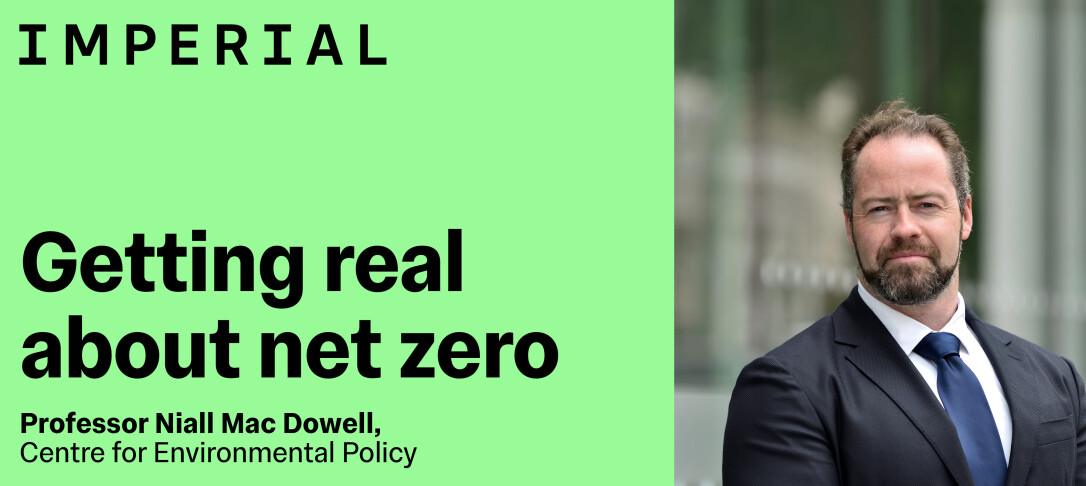
Join Professor Niall Mac Dowell, Professor of Future Energy Systems, as he explores the challenges of reaching net zero and how to balance bold climate action with energy security, economic growth, and societal need.
Please register to attend in person. A live stream link for online attendance is available here.
We look forward to seeing you on Wednesday 12 November!
Abstract
Humanity has been studying the climate since 1770, despite decades of mounting evidence, institutional commitment, and diplomatic consensus, global CO₂ emissions continue to rise. Climate change is not a new problem. What is new is the political prominence of net zero as a strategic goal.
This lecture examines the energy transition not as a singular moral crusade, but as one of many competing national priorities—alongside energy security, economic growth, industrial competitiveness, healthcare, and defence. A nation’s climate ambition is ultimately shaped by its political economy; as circumstances change, so too can priorities. Where we once believed that net zero was the preeminent policy objective, we now recognise the need to situate it within a hierarchy of priorities—one that reflects national capabilities, economic resilience, and evolving public expectations and geopolitical context.
While past energy transitions were catalysed by war, embargo, or economic disruption, our current moment—defined by heightened energy security concerns—may similarly act as a catalyst. Indeed, it may accelerate the transition more effectively than the moral imperative of climate action ever did. At the same time, we too often frame the transition as a cost to be borne, neglecting the reality that failing to transition carries costs of its own—costs that are uncertain in magnitude but potentially profoundly destabilising to society. Moreover, we persistently neglect to be explicit about the opportunities that are implicit in the transition.
Getting real about net zero means understanding the world as it is, not as we wish it to be. It requires placing climate strategy within the hard constraints of governance, public consent, and national interest. The past offers lessons, but not prescriptions. What comes next depends not only on what is technically feasible, but on what is politically tenable, societally equitable, and economically viable.
Biography
Niall is a Professor in Energy Systems Engineering at Imperial College London. He is a Chartered Engineer, a Fellow of both the IChemE and the Royal Society of Chemistry. His research is focused on understanding the transition to a low carbon economy and has published more than 250 peer-reviewed scientific papers, technical reports, and books in this context.
