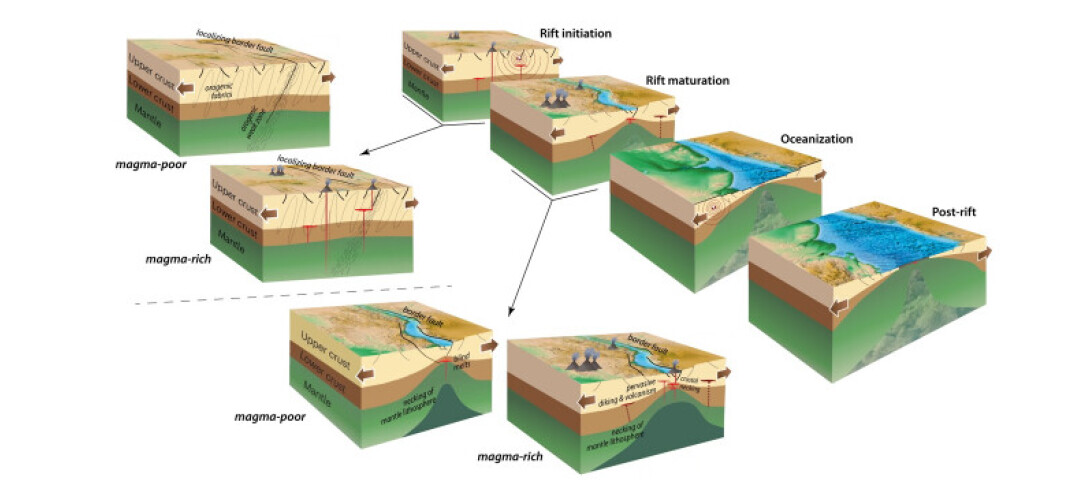
The fate of actively extending continents hinges on sustained and persistent accommodation and localization of
strain in the lithosphere, starting with the rift initiation phase, continuing through the rift maturation phases to latestage extension and breakup phases. Despite decades of geological and geophysical investigations into the
evolution of continental rifts, key questions remain on how rifts initiate and become established as distinct
divergent plate boundaries, and on how they evolve through the rift maturation phases. In recent years, my research has been exploring these specific questions: how and where do incipient continental rifts become border-faulted to establish the plate boundary, and what mechanism(s) drives persistent lithospheric weakening in the absence of voluminous magma?
In his talk, Dr Kolawale will present a series of new results from the East African Rift System, arising from the focused efforts of his group and many collaborators, revealing:
1) distinct crustal deformation patterns during the localization of border faults, and the critical role of rheological inheritance in the incipient rift phases;
2) the influence of ‘blind melts’ on crustal weakening, deformation, and strain release in evolving magmapoor rifts;
and 3) the pervasive mechanical necking of the mantle lithosphere as a major driver of deformation in maturing magmapoor and magma-rich rifts.