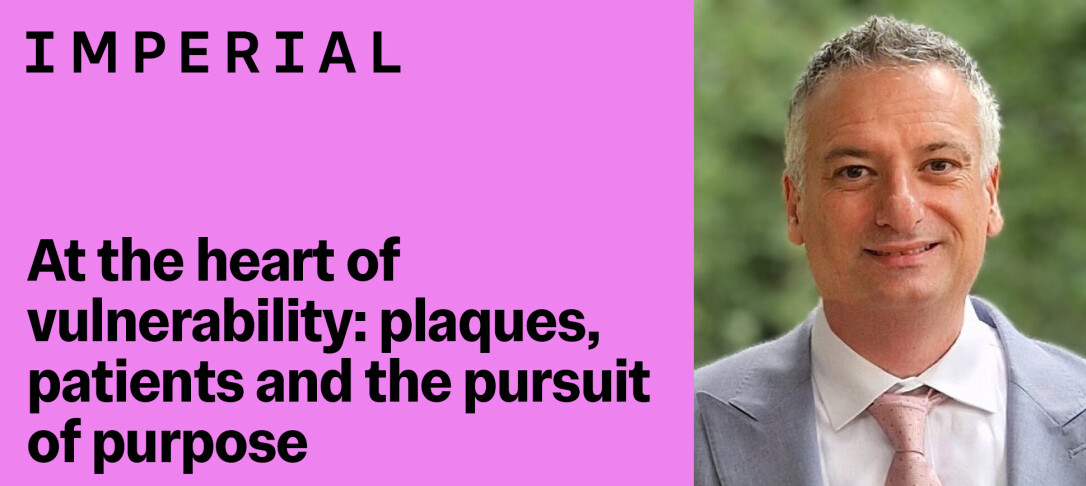
Professor Ramzi Khamis explores the hidden risks of heart disease, focusing on vulnerable arterial plaques, emerging diagnostic tools, and advances in patient care. How can innovation and compassion shape the future of cardiovascular medicine?
Please register to attend in person. A live stream link for online attendance is available on this page.
We look forward to seeing you on Wednesday 10 December.
Imperial Inaugurals are term-time lectures that celebrate our newest Professors, recognising their academic journey and showcasing their research.
Abstract
Heart disease remains the leading cause of death worldwide, yet it is not always the dramatic heart attack that defines the challenge. For many, the danger lies hidden: the apparently healthy person carrying silent arterial plaques that rupture without warning, or the patient whose risk far exceeds what conventional measures can detect. The story of these vulnerable plaques is inseparable from that of the vulnerable patient as well as from society’s wider challenge of how to predict, prevent and treat cardiovascular disease in an ageing, complex world.
At the centre of this lies a question of purpose: how can we move from reacting to catastrophic events, to protecting those at risk before disaster strikes? This lecture will explore the biology of vulnerability, from inflammation and immune responses in atherosclerosis to the development of novel biomarkers and imaging technologies that are now moving into clinical use. It will also reflect on the lived experience of patients, and the responsibility of clinicians and scientists to balance innovation with compassion and social responsibility.
Biography
Professor Ramzi Y. J. Khamis is Professor of Cardiology at Imperial College London, Consultant Interventional Cardiologist at Imperial College Healthcare NHS Trust, and the Wu Family Endowed Chair of Cardiology. His laboratory at the National Heart and Lung Institute has led advances in antibody-based biomarkers and molecular imaging for vulnerable plaque, while his clinical practice focuses on high-risk atherosclerosis and intervention. He leads the high risk atherosclerosiis and cardioimmune clinic, served Clinical Director of Cardiology and Cardiothoracic Surgery at Imperial and is the convenor of the Imperial Vulnerable Plaque and Patient Meeting.
Beyond his academic and clinical work, Professor Khamis has long been committed to humanitarian and outreach programmes. He helped to establish a cardiac centre in Palestine dedicated to the treatment of acute myocardial infarction and cardiovascular disease, which has now served more than 10,000 patients in four years. He continues to train doctors and nurses in deprived regions worldwide. His charitable projects extend to rehabilitation for refugees and the war-injured, and to educational scholarships that support the next generation of clinicians. In his inaugural lecture he will reflect on a journey that has combined science, clinical practice and humanitarian engagement, and consider how research and purpose together can shape the future of cardiovascular medicine.