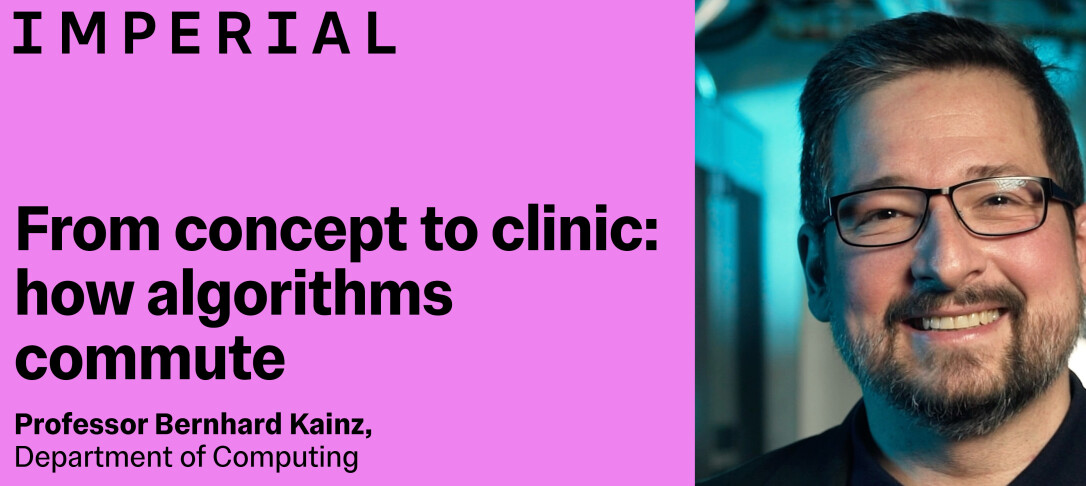
What if computers could go beyond pattern recognition to explain their findings in natural language, check their own reasoning, and collaborate like a team of experts? Professor Bernhard Kainz, Professor in Medical Image Computing, will show how emerging forms of artificial intelligence are doing exactly that.
Please register to attend in person. A live stream link for online attendance is available on this page.
We look forward to seeing you on Wednesday 4 March!
Imperial Inaugurals are term-time lectures that celebrate our newest Professors, recognising their academic journey and showcasing their research
Abstract
Modern hospitals generate a vast ocean of medical images every day. Yet interpreting them is constrained by the limited time doctors can devote, the necessity of coordinating cross-disciplinary expertise, regional variation in training, and the inherent complexity of disease. What if computers could go beyond pattern recognition to explain their findings in natural language, check their own reasoning, and collaborate like a team of experts? In this lecture, I will show how emerging forms of artificial intelligence are doing exactly that. By learning from millions of scans and reports, these systems can answer clinical questions, draft diagnostic notes, assess uncertainty, and identify hidden links among imaging, lifestyle data, and disease phenotypes. The true frontier is not only accuracy but building AI as a trustworthy partner in the clinical workflow—accelerating diagnosis, widening access to specialised knowledge, and improving patient outcomes.
Biography
Bernhard grew up in rural Austria, with a knack for math and science but less talent in languages at school. Despite skepticism from teachers, he pursued his passion for science and computers. At university, he studied a demanding mix of electrical engineering and computer science, developing a strong interest in efficient algorithms for highly parallel processors. A European fellowship brought him to Imperial, where we pioneered ML for medical image analysis. He later moved closer to the clinic, focusing on challenges in health screening, which remain a key interest. Eventually, he was offered a lectureship back in the Department of Computing. Today, he leads a research group dedicated to multi-modal decision support in healthcare.