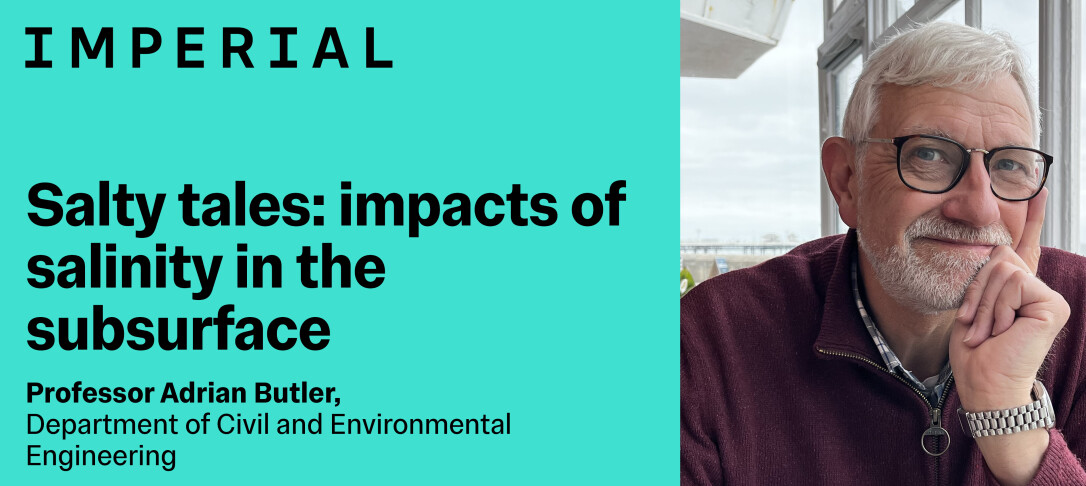
Professor Adrian Butler, Professor of Subsurface Hydrology, explores how sodium and chloride influence water systems, the environment, and human health, from radioactive waste to safe drinking water solutions.
Please register to attend in person. A live stream link for online attendance is available on this page.
We look forward to seeing you on Wednesday 18 February!
Imperial Inaugurals are term-time lectures that celebrate our newest Professors, recognising their academic journey and showcasing their research
Abstract
Sodium and chloride are the two commonest dissolved substances in water, occurring not only in the sea but throughout the subsurface. The lecture will examine how salt influences water systems, pollution, and human health. These include chlorine‑36 in radioactive waste disposal, modelling chloride‑rich leachate from landfills, and innovative ways in which salt movement can be used as a diagnostic tool in hydrogeology. It will show how high sodium concentrations in drinking water has led to serious health risks for millions living in coastal Bangladesh and the interventions being developed to protect these vulnerable communities.
Biography
Adrian Butler teaches subsurface flow and contaminant transport to undergraduate and master’s students in the Department of Civil and Environmental Engineering. His research is associated with measuring, analysing and modelling subsurface flow and transport processes and their associated environmental impact. Over many years he has been involved in studies on the environment behaviour of sodium chloride, including the movement of radiochlorine associated with radioactive waste disposal, chloride migration from landfill and saline intrusion processes in groundwater, as well as the health impacts of sodium in drinking water in Bangladesh.