Please note – bookings are now closed for this event due to demand.
Should you wish to review a recording please email t.gordon@imperial.ac.uk
Outline
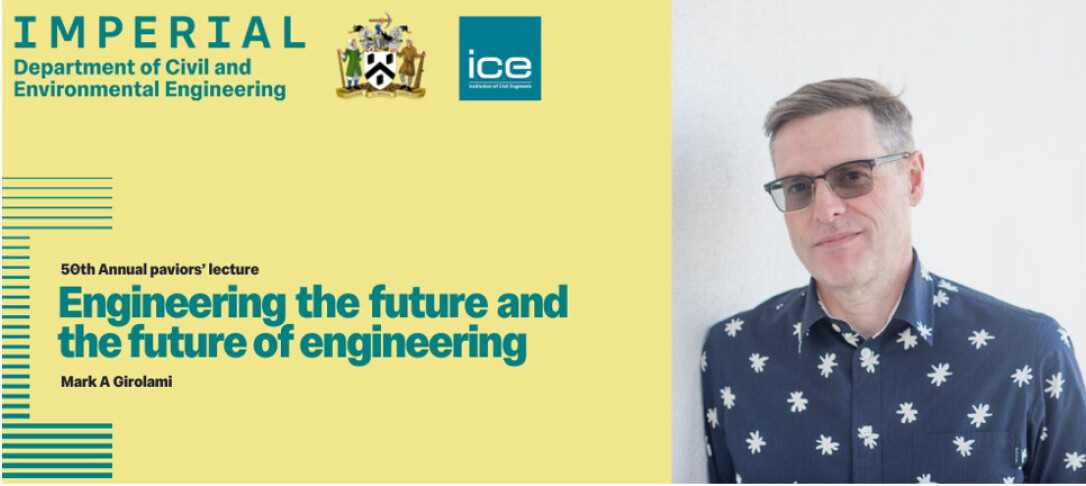
We face a number of global challenges and engineering is at the core to ‘engineering our future’ as highlighted by Lord Patrick Vallance who has said “There’s no doubt that engineering has a major central role to play in the global challenges, whichever ones you choose to pick. Just as it was in the mid-18 century, just as it was in the mid-19th century when this institute (IMechE) was formed, engineering – in all its guises – remains absolutely central to solving the big challenges of the day, and is a way in which those challenges get settled”. The question is what is the future of engineering to ensure we are effective in addressing these big questions? The role of experiment, empirical measurement, observation and data have always been core to the development of the empirical laws of the engineering sciences and associated professions. Is this future a data centric approach to engineering, and what would this actually mean? Is this yet another bandwagon of hype or is there substance behind the term? This talk will highlight the role of recent advances in the data sciences and how they are transforming the study and practice of engineering.
Event Agenda
15.00-17.00, Pre Lecture Showcase
17.00-18.30, Lecture
18.30-19.30, Drinks Reception Showcase
Biography
Mark Girolami is a Computational Statistician having ten years experience as a Chartered Engineer within IBM. In March 2019 he was elected to the Sir Kirby Laing Professorship of Civil Engineering within the Department of Engineering at the University of Cambridge where he also holds the Royal Academy of Engineering Research Chair in Data Centric Engineering.
Prior to joining the University of Cambridge Professor Girolami held the Chair of Statistics in the Department of Mathematics at Imperial College London. Mark was one of the original founding Executive Directors of the Alan Turing Institute the UK’s national institute for Data Science and Artificial Intelligence, after which he was appointed as Strategic Programme Director at Turing, where he established and led the Lloyd’s Register Foundation Programme on Data Centric Engineering. Since October 2021 he has also served as the Chief Scientist of the Alan Turing Institute.
Professor Girolami is an elected fellow of the Royal Academy of Engineering and the Royal Society of Edinburgh, he was an Engineering and Phisical Sciences Research Council (EPSRC) Advanced Research Fellow (2007-2012), an EPSRC Established Career Research Fellow (2012-2018), and a recipient of a Royal Society Wolfson Research Merit Award.
—————————————————————————————————————————————————-
At this year’s CSIC Distinguished Lecture, Professor Mark Girolami captivated the audience with a compelling exploration of engineering’s vital role in addressing some of humanity’s most pressing challenges—environmental sustainability, healthcare and security. He emphasised the urgency of these issues, referencing insights from Lord Patrick Vallance, Minister of State for Science and Technology, who underscored the escalating nature of global concerns and the need for immediate action. As Vallance remarked, “There’s no doubt that engineering has a central role to play in tackling global challenges, whichever ones you choose to pick.” Girolami spotlighted the collaborative efforts of engineers and allied professions, arguing that their synergy is essential for developing innovative solutions. He highlighted several significant initiatives at the University of Cambridge, including the Aviation Impact Accelerator at the Whittle Laboratory, which aims to reduce the environmental footprint of the aviation sector. His talk served as an urgent call for engineers to leverage their skills and creativity to foster a sustainable future.
The Hidden Backbone of Global Communication: Submarine Cables
Continuing his address, Prof. Girolami highlighted the importance of submarine cable networks, the unsung heroes of global communication that connect continents across oceans. He pointed out how investments from major tech companies like Google and Meta are crucial for enhancing this infrastructure, which supports a digitally interconnected world. For instance, Google is committed to improving its submarine cable network, which links cloud infrastructure through more than 100 network edge locations and over 7,500 edge caching nodes, playing a pivotal role in global connectivity. Similarly, Meta plans to lay at least two additional transatlantic cables by 2027, underscoring its dedication to building the foundations for the metaverse and equipping people worldwide to thrive in a digitally connected future. These initiatives highlight the role of engineering innovations from over a century ago in shaping our digital landscape.
Reflecting on the historical significance of submarine cables, Girolami recounted the ambitious project of laying the first transatlantic cable in the 19th century—a monumental achievement likened to a “Victorian moonshot.” Despite facing multiple failures, this endeavour ultimately connected Great Britain and the USA, enabling the first message from Queen Victoria to be transmitted across the Atlantic, a landmark moment in engineering history.
Data-Centric Engineering: A Vision of the Future
As the lecture progressed, Prof. Girolami emphasised the increasing importance of data in the future of engineering, drawing on Lord Kelvin’s 19th-century principle that measurement is key to understanding and improvement. He praised the work of the Cambridge Centre for Smart Infrastructure and Construction (CSIC), which has been at the forefront of measuring infrastructure for 15 years. He argued that the future of engineering will be data-centric, focusing not only on gathering data but on transforming it into actionable insights to improve decision-making and outcomes.
Prof. Girolami used historical examples, such as William Gosset’s t-test at Guinness and Rolls-Royce’s “power by the hour” model, to illustrate how data has long been essential in driving engineering innovation. He highlighted several modern projects that reflect the power of data-driven approaches, including a PhD student’s work with the National Air Traffic Service to improve air traffic control in the UK by analysing flight path data, and a collaboration between the Alan Turing Institute and the Greater London Authority (GLA) during the pandemic. In the latter, real-time data from traffic cameras was used to assess social distancing compliance, leading to over 700 policy changes, such as widening pavements to enhance public safety.
Another key example was a 3D-printed bridge in Amsterdam. Prof. Girolami’s team was involved in analysing the safety of its wire arc additive manufactured steel. They created a digital twin of the bridge, enabling ongoing monitoring and performance assessments. He explained how digital twins—virtual models of physical structures—allow engineers to combine real-time data with simulations to optimise design and maintenance.
Prof. Girolami also discussed the broader significance of data in fields like aviation and urban planning. For instance, Rolls-Royce’s use of sensors on aircraft engines enables predictive maintenance, improving operational efficiency. He also referenced projects like underground farming and collaborations with the Met Office to improve weather forecasting, showing how data-centric approaches are key to addressing modern challenges such as climate change.
Bridging the Gap for a Sustainable Future
In his closing remarks, Prof. Girolami highlighted the British Antarctic Survey’s crucial work in using satellite data to monitor changes in Antarctic ice caps, offering key insights into environmental degradation. He drew a parallel between ice cap imagery and potholes on roads, suggesting that generative models could predict road surface deterioration. He also discussed collaborations in biomedical engineering with St Thomas’ Hospital, stressing the importance of integrating data with digital models to improve medical outcomes.
Ultimately, Prof. Girolami argued that data-centric engineering will shape the future of infrastructure and technology, making systems more efficient, resilient and sustainable. He emphasised that the future of engineering will rely on effectively using data across fields such as biomedical engineering, manufacturing and construction and urged current and future engineers to develop the skills necessary to harness this data.