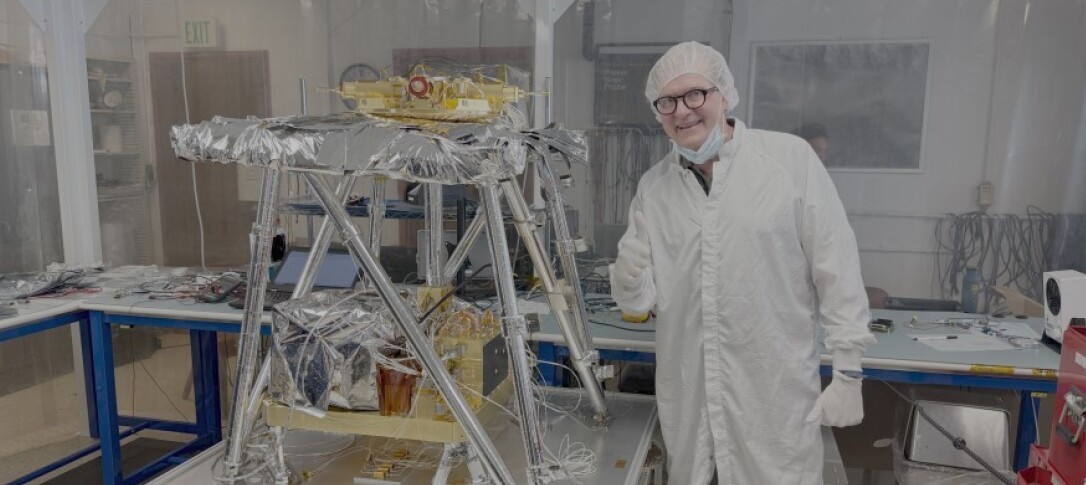
A Department of Physics colloquium entitled “The Parker Solar Probe mission: What we have learned from our first visit to a star” with Professor Stuart Bale, Physics Department and Space Sciences Laboratory, University of California, Berkeley and Royal Society Wolfson Visiting Fellow, Imperial College London.
Please note – The lecture will run from 16:00-17:00, followed by refreshments from 17:00-18:00 in the Level 8 Common Room of the Blackett Building.
Abstract
The NASA Parker Solar Probe (PSP) mission was launched in 2018 and has made 26 orbits of the Sun with perihelion altitudes down to 8.9 solar radii above the solar photosphere. An increasingly plausible picture is emerging of where the solar wind originates, how it is initially energized, and the plasma physics of the extended wind heating process. In this scenario, the fast solar wind originates by magnetic reconnection at intense bundles of field energy associated with the supergranulation convection cells. The emerging wind generates Alfven waves, by the reconnection process, shearing instabilities, or phase speed gradients. These Alfven waves grow to large amplitude dB/B~1 by a combination of plasma expansion and conservation of wave action. The large nonlinear Alfven waves generate small scale turbulence that results in plasma wave heating, which provides the thermal
energy to counteract the cooling of expansion.
Professor Bale will review some of the key PSP results that underpin this scenario and I will show some new results indicating the origin of ‘slow’ solar wind.
Biography
Stuart D. Bale is a Professor of Physics at the University of California, Berkeley and is currently Royal Society Wolfson Visiting Fellow at Imperial College. He is NASA Principal Investigator for an instrument suite on the Parker Solar Probe spacecraft and a 21-cm radio pathfinder instrument LuSEE-Night that will be deployed by NASA on the lunar farside in 2027. He is a Fellow of the American Geophysical Union and the American Physical Society and an Arctowski Medalist of the US National Academy of Sciences.