PLEASE NOTE:
- This seminar is IN PERSON ONLY in room U1202, Level 12, Sir Michael Uren Hub at Imperial College London’s White City campus.
- Refreshments and networking will follow this seminar outside room U1202.
GUEST SPEAKER:
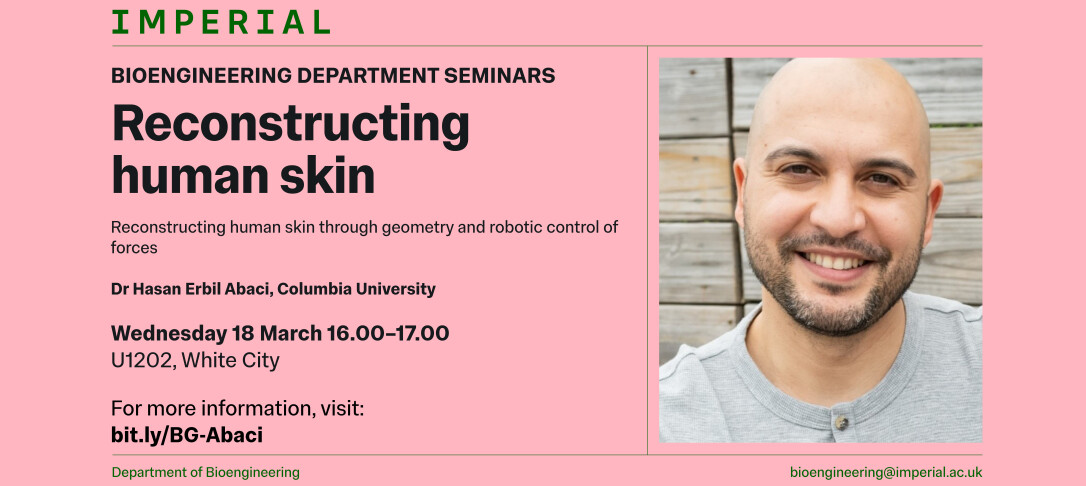
Dr Hasan Erbil Abaci, Assistant Professor at the Department of Dermatology and Biomedical Engineering at Columbia University Medical Centre
TALK TITLE:
Reconstructing Human Skin Through Geometry and Robotic Control of Forces
ABSTRACT:
Despite its long evolutionary history and central role in human health, skin remains one of the most complex tissues to model in vitro. It combines extraordinary cellular diversity, regional specialization, and mechanical adaptability in ways that no current bioengineered construct fully captures. Native human skin is a multilayered, site-specific organ organized into a spatially heterogeneous extracellular matrix (ECM) that adapts to local anatomical, environmental, and mechanical conditions. These features arise during development through the coordinated influence of geometry, biomechanics, and cell–cell interactions, yet most engineered skin systems rely on simplified, static platforms that ignore these developmental principles.
In this seminar, I will present a biomimetic strategy for reconstructing human skin across scales by explicitly controlling form and force. At the microscale, we use 3D bioprinting to pattern hydrogels that guide the spatial organization of primary and iPSC-derived cells, enabling the formation of vascular networks, and hair follicles. At the macroscale, we engineer fully enclosed, anatomically defined skin constructs whose geometry mimics specific body sites. These edgeless designs promote enhanced dermal extracellular matrix production and give rise to anisotropic mechanical properties characteristic of native skin. Building on this foundation, we are integrating robotic actuation with engineered skin tissues to recapitulate the dynamic mechanical forces generated by the musculoskeletal system (e.g., finger bending or smiling) during development and daily use. By coupling tissue geometry with programmable mechanical loading, this platform enables controlled studies of how force regulates skin maturation, remodeling, and function.
BIOGRAPHY:
Dr Hasan Erbil Abaci is an Assistant Professor at the Department of Dermatology and Biomedical Engineering at Columbia University Medical Centre, focusing on the engineering of complex skin and vascular tissues. He has received his Ph.D. degree at the Johns Hopkins University in bioengineering, and completed his postdoctoral trainings with studies on tissue engineering of blood-brain-barrier and skin, as part of the NIH Microphysiological Systems consortium. Dr. Abaci’s research is supported by private and federal agencies including the National Institutes of Health (NIH), National Science Foundation (NSF) and Department of Defense (DoD).
His research lies at the intersection of regenerative medicine, skin/endothelial biology, and biomechanics. His current research at Columbia focuses on understanding the biomechanical cues in skin morphogenesis, vascularization, and innervation using advanced 3D human tissue models. Dr. Abaci’s approach is based on reconstructing the integumentary system in vitro at different levels of complexity through (i) microfluidic-based iPSC-derived organoids, and (ii) 3D-printed multicomponent skin models with the motivation to understand, repair and regenerate the skin and its appendages, and with the dream of ultimately matching and achieving beyond the inherent capabilities of human tissues. Dr Abaci currently serves as the Editorial Board Member of the journal Biomicrofluidics and the Chair of the TERMIS Skin Tissue Engineering Group.