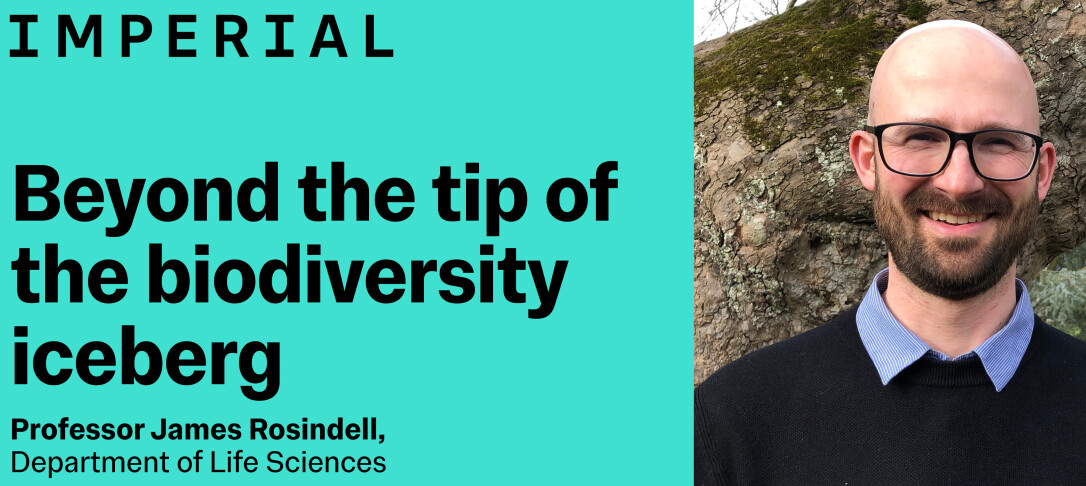
From simulations to the tree of life, Professor James Rosindell, Professor of Biodiversity Theory in the Department of Life Sciences, explores the hidden majority of life on Earth.
Please register to attend in person. A live stream link for online attendance is available on this page.
We look forward to seeing you on Tuesday 5 May!
Imperial Inaugurals are term-time lectures that celebrate our newest Professors, recognising their academic journey and showcasing their research
Abstract
Our planet is packed with a mind-boggling variety of life: biodiversity. Yet of all this, only a tiny and biased part, the tip of the biodiversity iceberg, is well known. This is a problem because, with biodiversity in decline, we need to measure, explore and make predictions about the future of all biodiversity and not just a small part of it.
In this lecture I will share some of the mathematical and computational tricks that help us to unveil the hidden facets of biodiversity. We will see how it’s possible to simulate the fate of large numbers of species without needing to know detailed information about each one. But biodiversity is about more than just species numbers. To see this, we will explore the evolutionary tree of life and the insight it provides into the deeper dimensions of biodiversity. Finally, I will share some thoughts on the future of biodiversity theory in our changing world.
Biography
After completing a degree in Mathematics (2005) and PhD in Biology (2008), James Rosindell joined Imperial College as a research fellow (2012) and later became Professor of Biodiversity Theory (2023). Utilising an interdisciplinary background, his research focuses on the modelling and measurement of biodiversity. Notable achievements include the Linnean Society’s Bicentenary Medal (2023), the student academic choice award for best teaching for postgraduates (2019) and 15 high impact publications as lead or senior author. He is a passionate advocate of conservation and public outreach having founded a not-for-profit organisation for this purpose, which has reached over 2.5 million people.