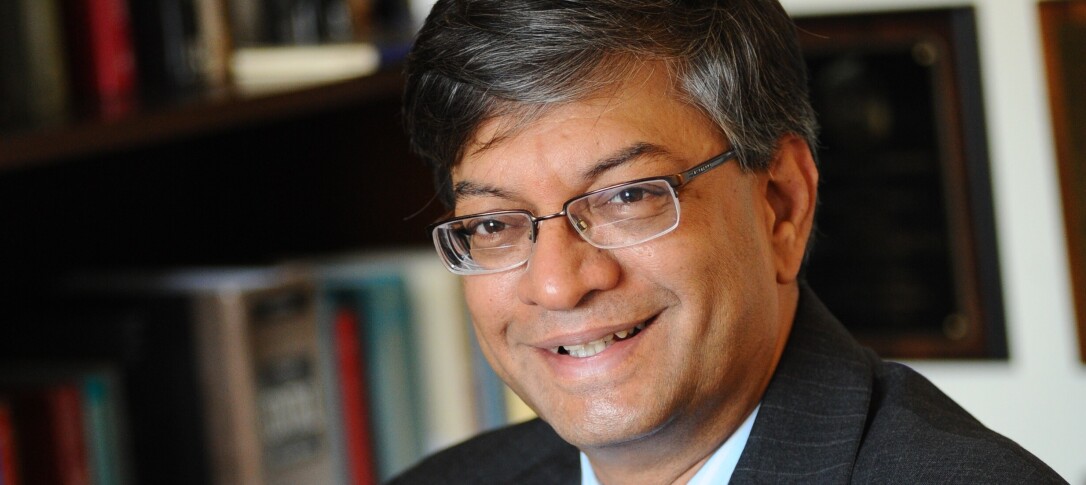
Speaker: Professor Venkat Venkatasubramanian | Columbia University
Talk: AI for Science and the Science of AI
The dramatic success of generative AI models in natural language processing and image synthesis has sparked great interest among researchers in science and engineering. However, there is a crucial difference between these applications and those in scientific research. Scientific applications are governed by fundamental laws of physics, chemistry, and biology, as well as constitutive relations and highly specialized knowledge of materials, processes, and systems. Although data-driven machine learning has immediate uses, the long-term success of AI in scientific fields will depend on effectively combining first principles with specialized knowledge. We need to transition from large language models (LLMs) to large knowledge models (LKMs) using hybrid AI. On the other hand, an even more exciting and exceptional opportunity lies in developing the science of AI.
The current state of LLMs resembles steam engines at the dawn of the Industrial Revolution in the 18th century. Engineers discovered steam power and used it in many ways before fully understanding its mechanics. It took around 80 years for the science of steam engines to evolve into statistical thermodynamics. Similarly, at the start of the automated cognition (i.e., AI) revolution, we find ourselves in a comparable situation—working on numerous applications while having a limited understanding of LLMs.
The key questions are: What is the science of LLMs? What new concepts and laws remain to be discovered? Consider this rather surprising and sobering historical fact: the innovators who developed steam engine technology were not the ones who developed its science. It was achieved by an entirely different group of pioneers—Carnot, Clausius, Kelvin, Maxwell, Gibbs, Helmholtz, and Boltzmann—who possessed very different skill sets. Is there a lesson for us in the LLM revolution? In this talk, I will discuss the challenges and opportunities in AI for science and the science of AI.
This seminar forms part of the Department of Chemical Engineering’s annual Distinguished Seminar Series 2026, and is open to departmental staff and PhD students only. If you are a member of the Imperial community and would like to attend, please reach out to Navta Hussain in the first instance.
Professor Venkat Venkatasubramanian
Professor Venkat Venkatasubramanian is the Samuel Ruben-Peter G. Viele Professor of Engineering at Columbia University. He earned his Ph.D. in chemical engineering from Cornell, M.S. in physics from Vanderbilt, and his B.Tech. from the University of Madras. He taught at Purdue University for 23 years. Venkat considers himself an artist in science, with a natural tendency to conduct curiosity-driven research in an impressionistic style, emphasizing conceptual issues over mere techniques. Venkat’s research interests are diverse, spanning AI, systems engineering, theoretical physics, and economics, but with a focus on understanding complexity and emergent behavior across various domains.
Venkat is an elected member of the U. S. National Academy of Engineering. AIChE recognized him with the William H. Walker Award (2024), the Computing in Chemical Engineering Award (2009), and the designation of Fellow (2011). He received Doctor Honoris Causa from the Széchenyi István University, Hungary, in 2024. Venkat received the Norris Shreve Award for Outstanding Teaching in Chemical Engineering three times at Purdue University, as well as the Research Excellence Award. Three of his papers are among the ten most-cited papers in the 46-year history of Computers & Chemical Engineering. His 2019 paper on AI in chemical engineering is the most-cited paper in the AIChE Journal in the last 20 years. His first book, How Much Inequality is Fair?, was published in 2017. His second book, Emergence as Harmony: Mathematical Principles of Self-organization, Complexity, and Collective Behavior, is scheduled for publication in 2026 by Columbia University Press. Venkat’s other interests include comparative theology, classical music, and cricket.