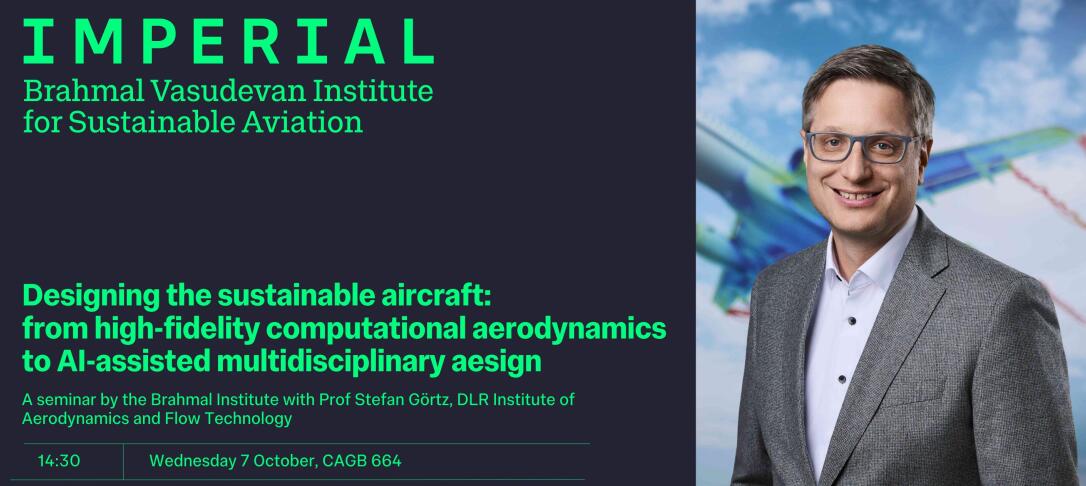
The Brahmal Vasudevan Institute for Sustainable Aviation is pleased to welcome Professor Stefan Görtz of the DLR Institute of Aerodynamics and Flow Technology for a seminar exploring advanced computational approaches to the design of more sustainable aircraft.
Abstract
Sustainable aviation requires aircraft that combine advanced aerodynamics with innovative propulsion and energy systems. This seminar will present how DLR addresses this challenge through advanced computational methods, spanning high-fidelity CFD and multidisciplinary design optimisation, and demonstrate their application to aircraft concepts featuring high-aspect-ratio wings and hybrid-electric propulsion.
Prof. Görtz will also discuss how machine learning and AI-assisted methods can complement high-fidelity simulations to accelerate aerodynamic and loads predictions and enable new approaches to aircraft design. As an outlook, he will briefly explore the potential of quantum computing for accelerating computational fluid dynamics.
Together, these approaches illustrate a pathway towards increasingly digital, integrated and physics-based design of more sustainable aircraft.
About the speaker
Stefan Görtz heads the Center for Computer Applications in AeroSpace Science and Engineering (C²A²S²E) at the DLR Institute of Aerodynamics and Flow Technology in Braunschweig, which conducts research and develops numerical methods and software solutions for aircraft aerodynamics, including the flow solvers TAU and CODA (CFD Software by ONERA, DLR and Airbus), the multidisciplinary simulation environment FlowSimulator and a software for data-driven aerodynamic modelling, analysis and design, SMARTy. He is also spokesperson for the DLR subtopic “Virtual Design and Certification” and represents DLR’s aeronautics research in the Helmholtz-Inkubator, an interdisciplinary think tank for emerging technologies in information and data science of the Helmholtz Association of German Research Centres.
He studied Mechanical and Vehicle Engineering in Darmstadt, Lausanne and Stockholm and received his PhD in Aeronautical Engineering from KTH Royal Institute of Technology in Stockholm in 2005. Following research stays at FOI and the U.S. Air Force Academy, he joined DLR in 2006. Since 2019, he has been Professor of Multidisciplinary Design Optimisation at Technische Universität Braunschweig and a member of the Lower Saxony Aviation Research Centre (NFL).
The seminar will be followed by a reception with tea and coffee.