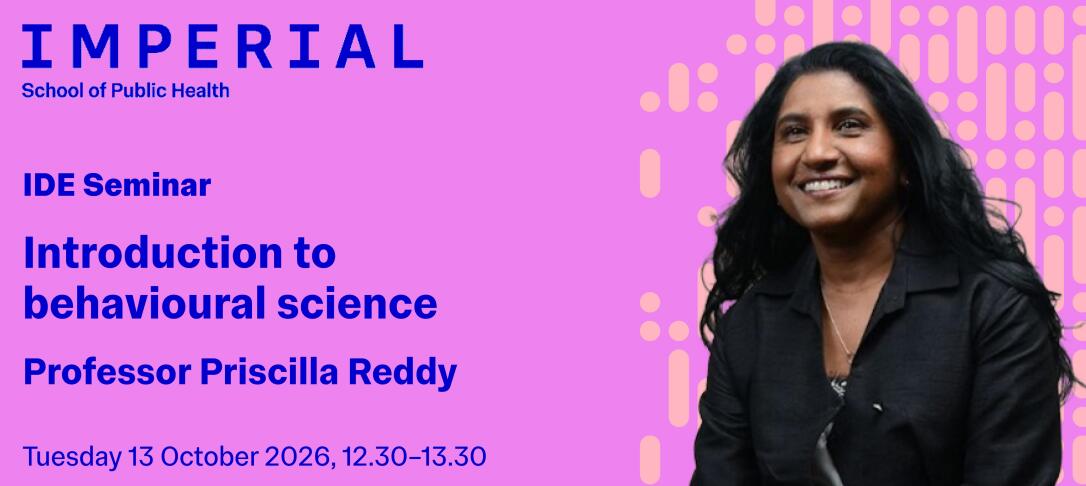
Introduction to behavioural science
Location: White City, School of Public Health Building
Room: SPH 204 – Seminar Room
In-person event. If you wish to join online, please join via this link.
Priscilla Reddy is Visiting Professor in the School of Public Health at Imperial College London. A behavioural scientist with over thirty years in public health, she founded the Health Promotion Research and Development Unit at the South African Medical Research Council and has led national surveys of youth risk behaviour and tobacco use in South Africa.
Abstract
Behavioural science helps us understand why people do what they do, and why simply providing information is often insufficient to change behaviour. Traditional public health approaches have frequently assumed that unhealthy behaviours are primarily the result of a lack of knowledge. However, decades of research have demonstrated that people often continue behaviours despite being aware of the associated risks, whether related to smoking, physical inactivity, unhealthy diets, or poor adherence to medical treatment. In this presentation, I will introduce the foundations of behavioural science and explore why information-deficit approaches often fail to achieve sustained behaviour change. Drawing on my work in health promotion and behaviour change, I will discuss how behaviour is shaped not only by knowledge, but also by beliefs, social norms, self-efficacy, outcome expectations, environmental influences, and broader structural factors.
The presentation will also highlight how behavioural science can inform the design of more targeted, tailored, culturally sensitive, and theory-informed public health interventions. Rather than relying on a single explanation for behaviour, comprehensive behavioural models recognise the complex interplay between individual, social, environmental, and structural influences. I will discuss the importance of identifying behavioural determinants, selecting appropriate intervention strategies, and tailoring approaches to different populations and contexts. By understanding what drives behaviour and applying evidence-based behaviour change principles, public health practitioners can design interventions that are more likely to achieve meaningful, equitable, and sustainable outcomes. This introduction will provide a foundation for understanding behaviour change as a central component of improving population health and reducing health inequalities.