About the Dennis Gabor Lecture
The Dennis Gabor Lecture is a Department of Electrical and Electronic Engineering flagship event, honouring Dennis Gabor, the inventor of holography. The lecture series focuses on the impact of science and engineering on society.
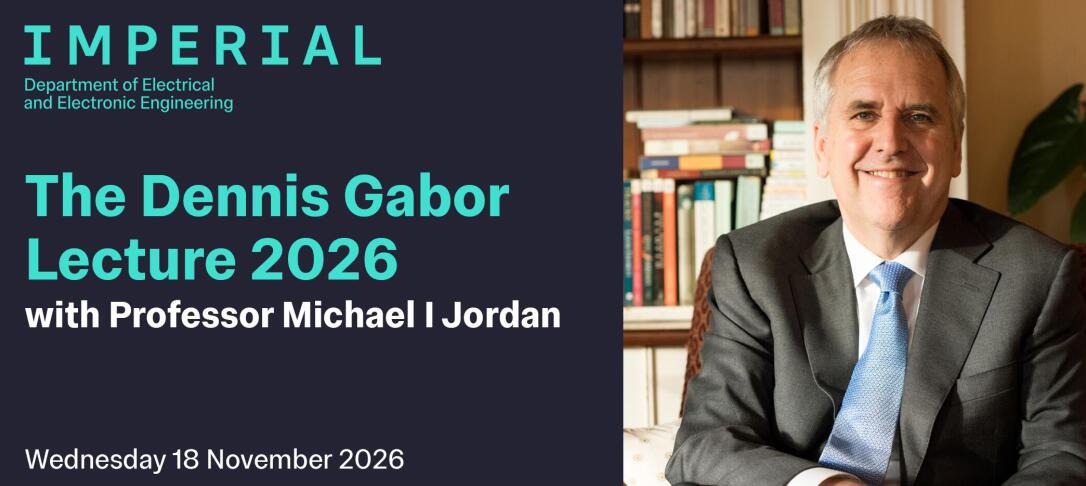
This year, we welcome Professor Michael I. Jordan, Inria Paris and the University of California, Berkeley. Professor Jordan has been a leading researcher in computer science and statistics for over four decades. He is a member of the US National Academy of Sciences, a Foreign Member of the Royal Society and a Foreign Member of the Chinese Academy of Sciences.
Agenda:
- 15:30 Research Poster Session with Refreshments
- 16:30 Lecture
- 17:15 Question and Answer Session
- 17:45 Further Refreshments and Posters
- 19:00 Close
The 2026 Dennis Gabor Lecture: A Collectivist, Economic Perspective on AI
Abstract: Information technology is in the midst of a revolution in which omnipresent data collection and machine learning are impacting the human world as never before. The word “intelligence” is being used as a North Star for the development of this technology, with human cognition viewed as a baseline.
This view neglects the fact that humans are social animals, and that much of our intelligence is social and cultural in origin. Thus, a broader framing is to consider the system level, where the agents in the system, be they computers or humans, are active, they are cooperative, and they wish to obtain value from their participation in learning-based systems. Agents may supply data and other resources to the system only if it is in their interest to do so, and they may be honest and cooperative only if it is in their interest to do so. Critically, intelligence inheres as much in the overall system as it does in individual agents. In the overall system, computation of equilibria replaces computation of optima.
This is a perspective that is familiar in economics, although without the focus on learning algorithms. A key challenge is thus to bring (micro)economic concepts into contact with foundational issues in the computing, statistical, and decision-making sciences. I‘ll discuss some concrete examples of problems and solutions at this tripartite interface.