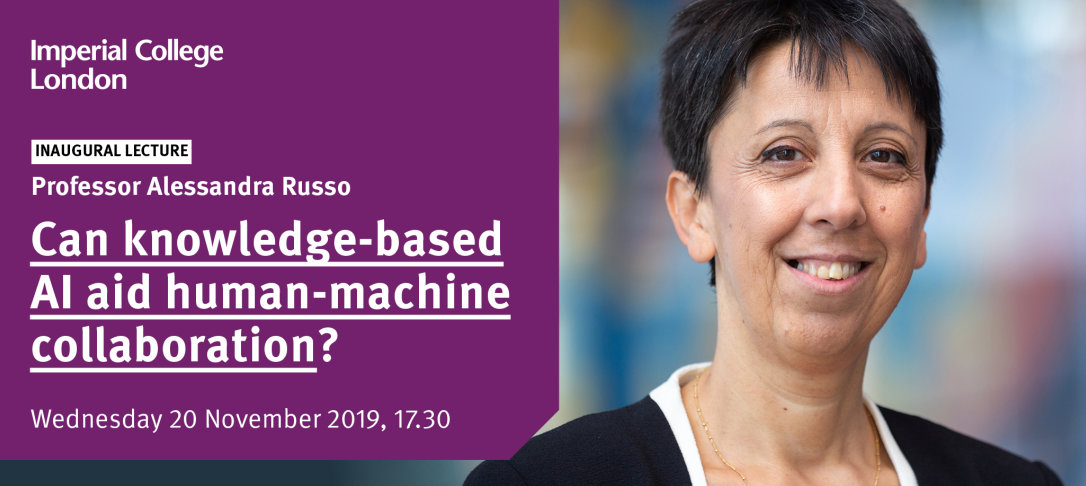
The lecture is free to attend and open to all, but registration is required in advance.
Abstract
Reasoning, explaining and learning are all key to human intelligence. Currently, artificial intelligence is largely focused on data-intensive machine learning, and this is gaining increasing impact in many areas of science and technology. But the propensity towards the “black box” solutions that these techniques facilitate means that humans cannot easily understand what the systems are actually learning, how they learn, and what influences the answers they compute.
It is widely accepted that machine intelligence solutions of the future should instead be able to reason, explain conclusions, and learn directly from expert-knowledge, not least in order to enable effective human-machine collaboration. For example, intelligent systems for supporting software engineers do not just have to predict whether software will be faulty, but also explain why, and offer suggestions for repair or fault avoidance. Similarly, a personal recommender assistant should be able to reason about specific users’ preferences and past decisions in order to better provide personalised recommendations. These intelligent tasks are driven by knowledge and small quantities of data and are therefore not suitable for current data-intensive machine learning techniques.
Alessandra Russo works on knowledge-based AI, looking specifically at user-centred algorithms for automated explanation generation and knowledge-driven learning. With these methods we can be optimistic that the learning and reasoning of an artificial intelligent system is optimised, and that its biases can be understood, controlled and minimised. In her inaugural lecture she will discuss the advancements she has made in knowledge-based AI. From developing intelligent systems capable of assessing and explaining success and failures of hardwired policies in adaptive software, to incorporating human users as a feedback source in a continuous cycle of intelligent machine learning, she will explain why a knowledge-based, and not just a data-intensive approach, is key to holding AI to account.
Biography
Alessandra Russo, Fellow of the British Computer Society (FBCS), is a Professor in Applied Computational Logic, Imperial College London, where she leads the “Structured and Probabilistic Intelligent Knowledge Engineering” (SPIKE) research group. Her research expertise concerns algorithms and systems for distributed inference, symbolic machine learning and probabilistic rule learning. She has pioneered, in collaboration with members of her research group, new symbolic machine learning algorithms and systems, some of which are currently among the state-of-the-art learning systems. She also has an established track record on the application of these systems to security, privacy, policy-based management systems and software engineering in general.
She graduated, summa cum laude, in Computer Science at the University of Bari, Italy, in 1991, received her PhD in Computing in 1996, from Imperial College London, and was conferred the title of Professor in Applied Computational Logic in September 2016. Prof. Russo has co-authored two research manuscripts and published over 150 articles in flagship conferences and high impact journals in the areas of Artificial Intelligence and Software Engineering. She has received research funding from EPSRC, EU and industry. She is currently Senior PC member at IJCAI2019, co-chair of ESEC/FSE2019, and PC member for AAAI, KR, ILP, ICLP, and ICSE. She has been editor-in-chief of the IET Software in 2006-2016 and Associate Editor of ACM Computing Survey in 2013-2016.