The lecture is free to attend and open to all, but registration is required in advance.
Abstract
A century ago Einstein showed gravitation was due to space and time being dynamical, rather than simply being a fixed stage on which reality plays out. Now, modern physics is grappling with the consequences of his theory. How did the space and time of the universe start? What is causing its runaway expansion? What happens inside a black hole where space and time become infinitely warped? And what happens when a black hole evaporates?
These are huge questions in physics that require us to understand space and time at the tiniest quantum level, or equivalently, to understand the theory governing quantum gravity. At the turn of the millennium a new principle emerged, born from string theory, called `Space-time holography’. It has helped show that rather than a fundamental medium, space and time may actually emerge from some more fundamental reality in lower dimensions. Like viewing a two dimensional hologram to see an apparent three dimensional scene.
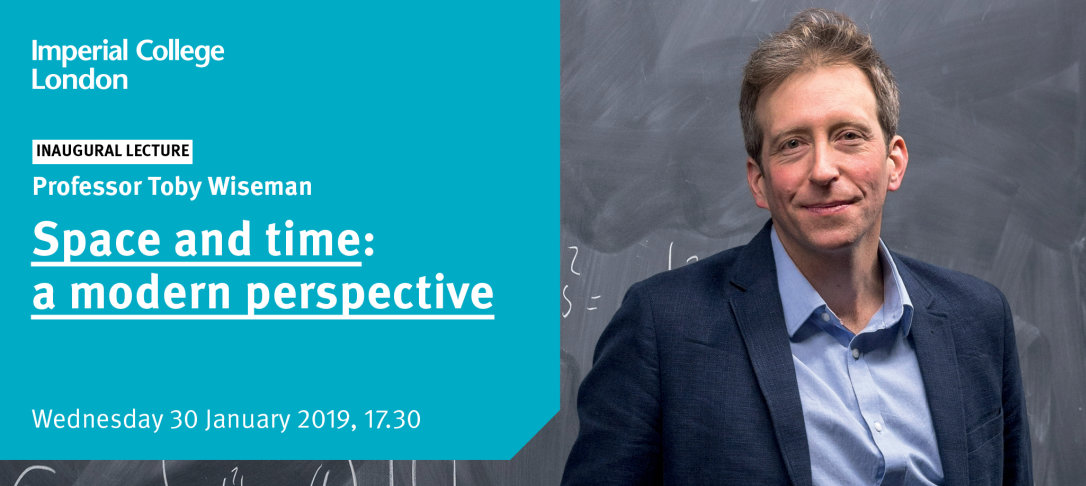
Toby Wiseman is Professor of Theoretical Physics at Imperial College London, and has spent much of his career exploring aspects of space-time holography. In particular having been a member of Professor Stephen Hawking’s research group, Toby has used it to show it correctly reproduces Hawking’s prediction for the thermal properties of black holes.
In his inaugural lecture he will explore the idea of quantum gravity and this holographic description of space and time. Starting with the ideas of Newton, before moving through Einstein’s theory of General Relativity and Hawking’s own work, Wiseman will explain why discoveries on these smallest scales may help us understand the origin of the universe.
Biography
Toby Wiseman is a Professor of Theoretical Physics at Imperial College London. He completed his PhD in cosmology in the University of Cambridge applied mathematics department, and continued after as a Junior Research Fellow in Stephen Hawking’s ‘General Relativity’ research group. He then spent 3 years in Harvard as a postdoctoral researcher before returning to the UK as a lecturer at Imperial College in 2006.
His research specialises in fundamental aspects of gravity and black holes. He is particularly interested in understanding space-time and gravitation at the smallest and largest scales, and how string theory combines Einstein’s theory of gravity with quantum mechanics.
He is involved in public outreach work at Imperial, and has appeared in the media discussing the science of black holes and gravity.