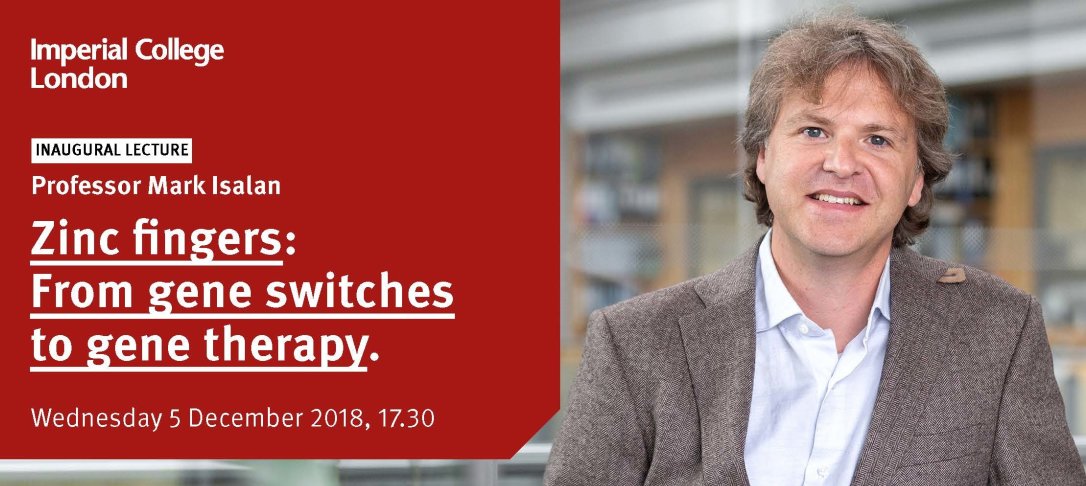
The lecture is free to attend and open to all, but registration is required in advance.
Abstract
Zinc fingers are natural DNA-binding proteins that are used by humans and other animals to switch genes on and off. They are extremely common – we have over 700 different kinds of zinc finger in our bodies – and they are a very important part of the genetic ‘computer program’ that makes us what we are. For over a quarter of a century, scientists have dedicated careers to re-engineering these zinc fingers to make tools to control genes. Since many zinc fingers have human origins, they can be delivered to patients without causing a strong immune response. Such targeted gene switches therefore having the potential to revolutionise medicine.
Recently, zinc fingers, and a related technology called CRISPR, have been adapted into tiny molecular scissors, to grab, copy, cut and paste DNA and make designer genes and genomes. In this lecture, we will look at the current frontiers of this technology.
Mark Isalan is Professor of Synthetic Biology at Imperial College London whose passion for zinc fingers has seen him spend the last 25 years working on protein and gene network engineering, aiming to design biological systems that behave predictably, and to develop gene therapies for diseases like Huntington’s. In his inaugural lecture, Mark will tell the story of gene editing that spans the discovery of DNA, from Franklin, Crick and Watson, through to Franklin’s colleague Aaron Klug – who discovered zinc fingers – and up to the present day where these technologies are turning the potential for DNA and genome editing into a reality.
Biography
Mark Isalan is Professor of Synthetic Biology in the Department of Life Sciences at Imperial College London. He works on protein and gene network engineering, aiming to design biological systems that behave predictably and robustly. Previously, he headed the Gene Network Engineering Group in the EMBL-CRG Systems Biology Unit in Barcelona (2006-2013) and held postdoctoral positions at EMBL Heidelberg, Germany (2002-2006). He has also worked in industry, developing zinc fingers at Gendaq Ltd, UK (2000-2002), based on his PhD at the MRC LMB in Cambridge (1996-2000). Current work includes engineering artificial gene circuits in bacterial and mammalian cells, answering basic questions on how to engineer patterns and structures, as well as more applied work towards human gene therapy.