/prod01/channel_3/media/images/landscape-3000X2000/LhARA-A-radiobiological-cancer-therapy_imperial-tech_3000X2000.jpg)
LhARA uses laser-driven proton beams for precise, high-dose cancer therapy, enabling compact, flexible treatment systems and radiobiological research.
Problem Addressed:
Traditional X-ray therapy uses high-energy photons to treat tumours but can damage healthy tissue. New techniques are envisaged where proton beams (rather than photon beams) are directed at a tumour. This deposits energy more precisely within tumours, sparing healthy tissue. However, existing proton machines are large and expensive.
How LhARA Addresses It:
Proton beam machines are mainly cyclotron-based, often large and expensive to use and operate, so there exists a need to develop smaller, cheaper and more flexible machines. LhARA aims to develop smaller, more flexible proton machines for producing a range of particles at different energies using high-power lasers. These machines can deliver short, intense pulses and micro-beams, enhancing cancer cell killing while minimising harm to healthy tissue. LhARA aims to open PBT to the many and enable the investigation of radio-biological interactions to improve treatments and explore laser-hybrid accelerators.
LhARA will integrate cutting-edge technologies including:
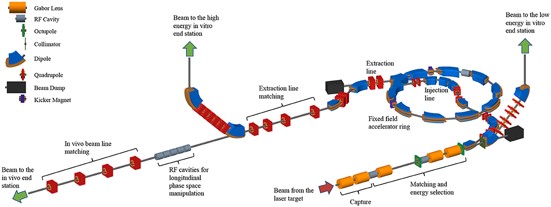
- Laser-driven proton & ion source: This component generates short, intense pulses for “FLASH” radiation and tightly focused mini-beams. Unlike traditional methods, LhARA achieves this without collimation.
- Electron Plasma (Gabor) Lens: Laser-driven ion sources create highly divergent beams, with a large energy spread that can vary up to 25% pulse by pulse. A Gabor lens is a cost-effective alternative to conventional solenoids and provides strong focusing capabilities.
- Post Acceleration using Fixed-Field Alternating (FFA) Gradient Accelerator: Rapid acceleration will be performed using a Fixed-field alternating-gradient accelerator which allows flexibility in adjusting the time, energy, and spatial structure of the ion beam. Collaboration with major UK institute groups in ion-source lasers and accelerators ensures robust development.
- Intelligent automation for patient positioning.
- Novel instrumentation & diagnostics including Ion-acoustic imaging.
Benefits
- Higher Beam Energy: LhARA will provide proton and ion beams at much higher energies than traditional methods, allowing for new applications.
- Breaching the Dose Rate Limit: LhARA surpasses the current limit on how much radiation can be delivered at once, potentially improving treatment times.
- Enhanced Precision: LhARA offers a more precise way to deliver particle beam therapy (PBT) compared to conventional methods like X-rays.
- Cost-Effective Technology: The machinery needed for LhARA is expected to be smaller, cheaper, and more adaptable than existing facilities.
- Advanced Radiobiological Research: LhARA will enable a deeper understanding of the radiobiological interactions that occur during PBT.
Contact for this technology
Commercialisation Executive, Faculty of Natural Sciences
Luis Gomez Sarosi
