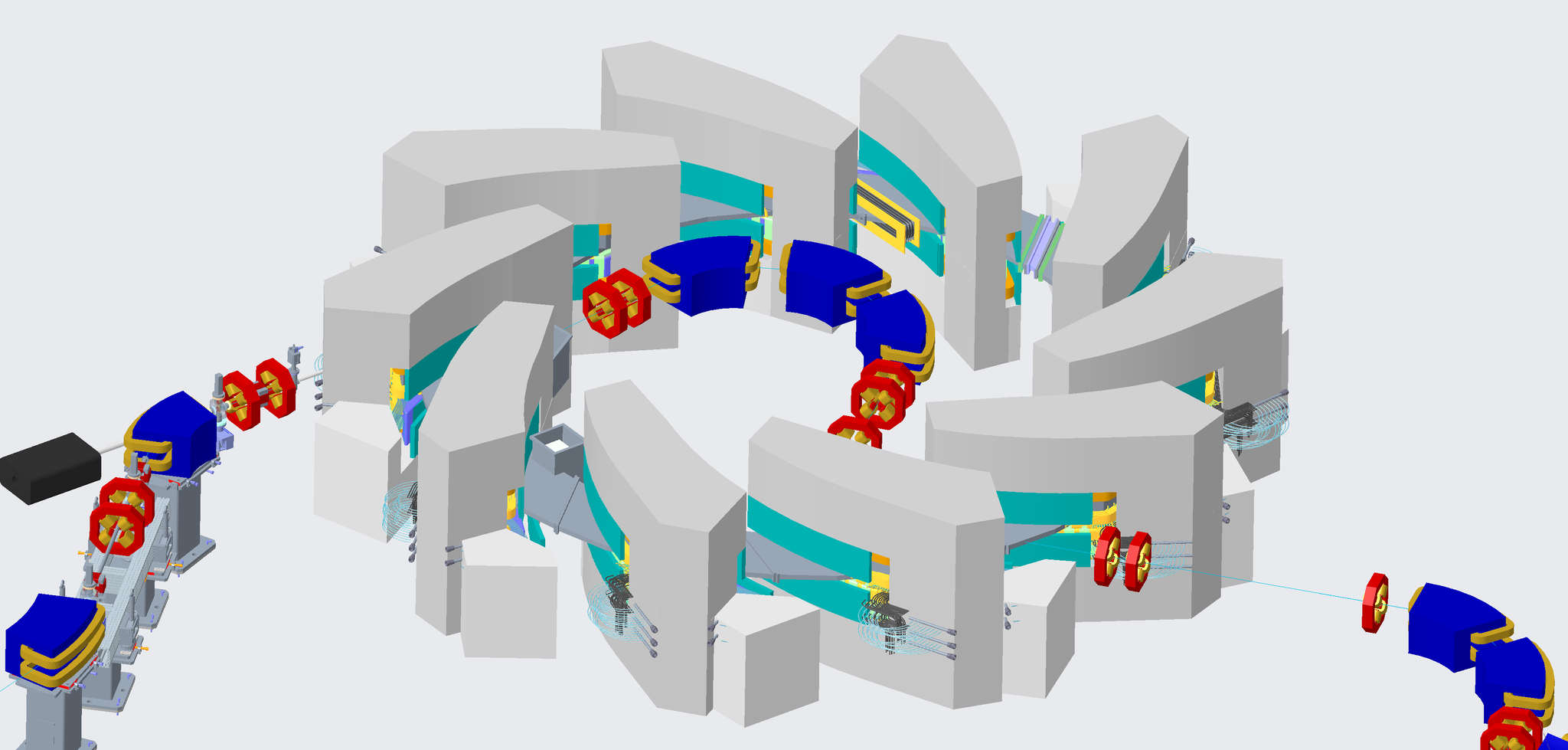
The LhARA collaboration is developing innovative accelerator technologies to produce, capture and deliver proton and ion beams for radiobiological research. Combining laser-driven particle acceleration with novel beam-focusing and transport systems, the LhARA collaboration aims to provide unprecedented flexibility in beam energy, intensity and dose delivery.
A key area of LhARA research at Imperial is the development of plasma (Gabor) lenses, which use confined electron plasmas to focus charged particle beams. These offer the potential for strong focusing at a fraction of the cost of conventional magnetic systems. Further research focuses on laser-driven ion production and the design of a fixed-field alternating-gradient accelerator (FFA), which will increase particle energies while preserving the flexibility of the laser source.
Research at Imperial also includes the design of novel end stations with beam delivery systems that use magnetic focusing to produce mini- and microbeams for spatially fractionated radiotherapy (SFRT). Research at the end station also includes diagnostics, for example ion-acoustic imaging, which uses the acoustic signals generated by deposited radiation energy to measure dose distributions. Together, these technologies aim to enable precise, reproducible irradiation experiments and support the development of future particle-beam therapies.