
Learn lean entrepreneurship, generate impact and sustainable business models
Module details
- Offered to Year 1 students
- Tuesdays, 16.00-18.00
- 8 weeks (autumn or spring term)
- Planned delivery: On campus (South Kensington)
- Non-credit only
Got any questions?
Contact the lecturer:
Dr Igor Baranov
Whether your aim is to launch a breakthrough technology on the market, or advance through the corporate career ladder, entrepreneurship is a powerful mindset and a set of tools that anyone can learn and make their own.
This module is a practical and engaging journey that combines methodologies such as Design Thinking and Lean Startup, important for anyone seeking to develop their entrepreneurial drive. We will learn how to understand customer needs, develop and test a prototype, and build a business model for your innovative idea.
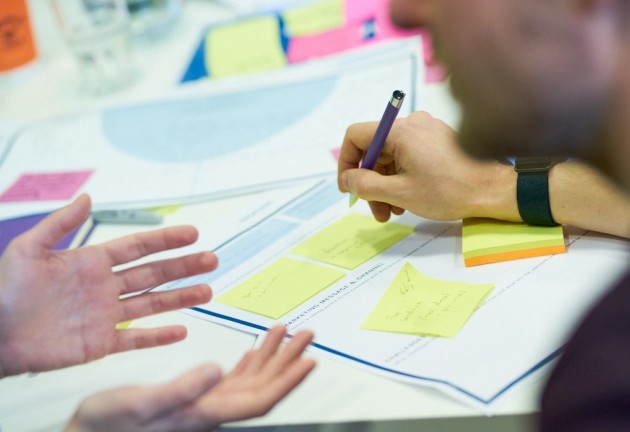
At least half of classroom time, you will work in a team on a project of your choice, applying the startup founder’s toolkit to your ideas.
Information blocks
 On completion of this module, you will be better prepared to:
- explore and develop entrepreneurial opportunities;
- build key elements of a business model in a team project;
- appraise others’ entrepreneurial thinking in a constructive way.
We will start with Design Thinking: a structured approach to understanding customer needs and develop a successful product. Customer development plays a crucial role in Design Thinking—this involves market segmentation to identify target audiences and conducting empathy interviews to gather direct insights. Once key needs are identified, the next steps include ideation and prototyping, followed by the creation of a minimum viable product (MVP) to validate assumptions with real users. Finally, pitching your project to the class will allow you to develop your business presentation skills necessary to ensure stakeholder buy-in.
In parallel with product development, we will discuss options for business-model innovation. Key elements of a business model include identifying demand for a product, its financial viability (based on unit economics analysis), and feasibility that must be evaluated by determining the key resources and partnerships required to deliver a strong customer experience.
Understanding the competitive environment through market analysis helps refine positioning and strategy. We will be examining case studies of platform business models, such as social networks and marketplaces, as well as business models based on using generative AI, to get insights into typical challenges a new digital business may face.
Entrepreneurship is a mindset complemented by methodologies for customer-centric product design and delivery. It is successfully used in both startups and inside top global corporations to engage teams in creating value for their customer. As a STEM student, you can benefit from developing your entrepreneurial skills and knowledge of business management to have a balanced view of how new products and technologies are created.
Throughout the module, you will engage in a product business model development journey based on Design Thinking and Lean Startup methodologies. In classroom, we will split time between (a) discussing the key elements of these methodologies based on real-life cases, and (b) working in teams on your product/business idea development (startup projects). The last session of the module will be fully devoted to team pitches with Q&As.
- Coursework: Group presentation with Q&A (up to 15 minutes) and a pitch deck (minimum 8 slides) (85%)
- Coursework: Peer assessment – written task (250-350 words) (15%)
Formative feedback will be provided by the module leader during teams’ presentations of their product and business model development in each classroom session.
Written summative feedback will be provided via the module VLE within two weeks of completion of the module. It will consist of written feedback on final team pitches from a module leader, organised around the pitches’ strengths and areas for improvement through three dimensions of the startup project (proof of demand, financial viability, feasibility).
All teams will also receive a summary of feedback from their peers for their information only; the assessment by peers does not impact the mark given by a module leader for the group assignment.
This module serves as a safe space for experimentation. There is no expectation that your team project will necessarily conclude with a recommendation to adopt the chosen solution. A team may instead decide to suggest rejecting the solution, which would be considered a 'fast failure.' In such cases, a presentation on the lessons learned from the experience is expected.
- ECTS value: 0
- Requirements: You must be prepared to attend all classes and to spend about an hour a week preparing for each session
- This module is designed as an undergraduate Level 4 course. For an explanation of levels, view the Imperial Horizons Level Descriptors page.
"A huge thank you from us all for the module, we really enjoyed it and learned a huge amount! Thank you."
"This is a wonderful course for beginners who want to start a business, it not only teaches us business strategies but also lets us know how to be an entrepreneur with good values."
"I enjoyed having the chance to put some key entrepreneurship strategies into practice. What captured my attention the most was learning about the lives of real entrepreneurs, their motivations and the challenges they faced."
"I am grateful to have learned this in my first year of university."
"a wonderful experience to work in a team... an amazing tool for my future career"
"Prior to the course, I felt that entrepreneurship is only meant for creative people. However, in creating my pitch deck, I was able to experience how to develop my ideas and view the process as methodological and systematic."