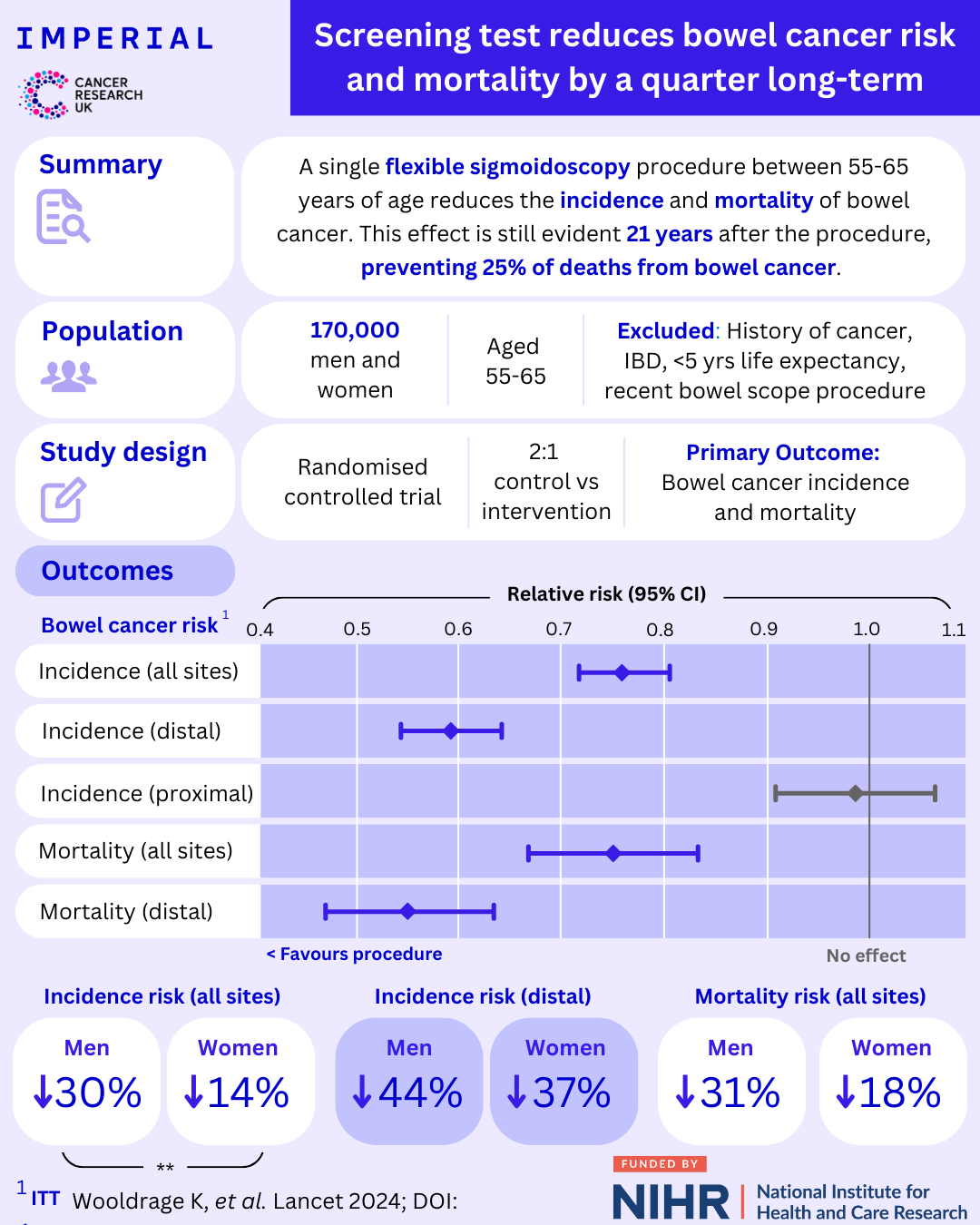
Our recently published analyses, funded by the National Institute for Health and Care Research and Cancer Research UK, revealed that invitation for a one-off screening test called flexible sigmoidoscopy (flexi-sig) reduced the number of bowel cancers and the number of deaths from bowel cancer by a quarter over a 21-year period.
Bowel cancer is the 4th most common cancer and the 2nd most common cause of cancer deaths each year in the UK. Screening for bowel cancer in individuals without symptoms can lower the chance of dying from bowel cancer and can help prevent it developing in the first place. Flexi-sig is a screening test which involves a camera attached to a thin tube being passed through the bottom to look at the inside of the bowel. During the test, polyps (small growths on the lining of the bowel that can develop into cancer) can be removed or bowel cancers can be detected at an earlier stage. In contrast to colonoscopy, another common bowel test, flexi-sigs are quicker and less invasive because they look at a smaller portion of the bowel.
In our analyses recently published in the Lancet Gastroenterology and Hepatology, we included 170,000 participants aged 55-64 years who were recruited from 1994 to 1999 and were randomly divided into two groups: 1) those who were invited for screening with flexi-sig (57,000 people); and 2) control participants who were not invited for flexi-sig (113,000 people). Of those invited for flexi-sig, 41,000 (approximately 70%) had the test. We have continued to follow-up the two groups and compared them to investigate if a single flexi-sig reduced the risk of getting bowel cancer and reduced the risk of dying from this disease.
The results revealed that a single flexi-sig screen reduced the chance of developing bowel cancer by 24% and reduced the chance of dying from bowel cancer by 25% over 21 years after screening, showing that flexi-sig offers long-term protection against bowel cancer.
Interestingly, our results also showed that flexi-sig screening appears to be more effective in men, who benefited from a 30% decrease in risk of bowel cancer, compared to women who experienced a 14% decrease. This is likely because men tend to develop bowel cancer near the end of their bowels and rectum (known as distal bowel cancer) where a flexi-sig can easily reach, whereas women are more likely to develop bowel cancer further up in the bowel, out of range of a flexi-sig; women are also more likely to experience difficulties when having a flexi-sig. Overall, the protective effect of flexi-sig became even more pronounced when looking at just distal bowel cancers, as there was a 41% reduction in risk of distal bowel cancer and a 45% reduction in deaths from distal bowel cancer.
That a one-off screening test can have such a large and long-lasting protective effect against bowel cancer is impressive. We hope that our data will contribute to the ongoing discussion around bowel cancer screening guidelines.
This study was conducted by Kate Wooldrage, Dr Emma Robbins and Professor Amanda J Cross at Imperial College London, and Professor Stephen W Duffy at Queen Mary University of London. Research funded by Cancer Research UK and National Institute for Health and Care Research.