UKRI Project Reference: UKRI2167 Link
What are PFAS?
Per- and poly-fluoroalkyl substances (PFAS) are a large group of over 7 million chemicals. These so-called, “forever chemicals” possess strong carbon–fluorine bonds to make them highly persistent. They accumulate in ecosystems and potentially harm wildlife. At least 63 have already been detected in the environment and some UK waterways already show concerning concentrations, far above environmental safety standards.
What will we do in the UNSaFE project?
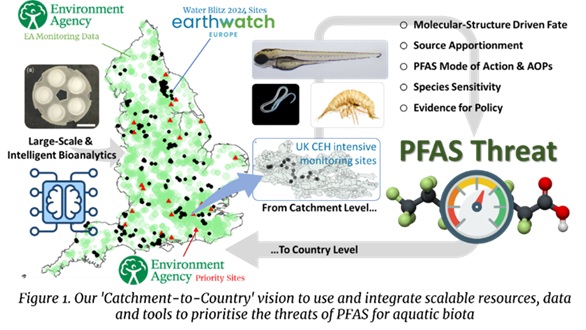
UNSaFE is a £2 million UKRI-funded research project designed to close major knowledge gaps around PFAS exposure, sources, environmental behaviour, and biological effects in UK waters. The project aims to:
- Integrate advanced analytical tools to monitor a wide range of PFAS in water and aquatic organisms.
- Build a coordinated “catchment-to-country” monitoring network with universities, the Environment Agency, and citizen scientists through Earthwatch’s national Water Blitz events.
- Understand how PFAS chemical structures influence persistence, mobility, and bioaccumulation.
- Investigate how PFAS affect organisms using multi-omics and systems biology approaches.
- Establish ecologically relevant thresholds to better protect sensitive species.
Aligned with the NERC Digital Strategy 2021–2030, UNSaFE combines innovative digital technologies, AI-driven modelling, high-resolution mass spectrometry, and low-cost sensors to create a scalable system for national PFAS assessment. The project also tests how these new tools compare with standard regulatory methods, ensuring findings translate quickly into policy and risk assessment.
By uniting researchers, regulators, and communities, UNSaFE will significantly advance the UK’s capacity to detect, prioritise, and manage PFAS, helping safeguard the environment from these persistent chemicals.
The Team
Principal Investigator - Professor Leon Barron
Professor Barron is Professor of Analytical & Environmental Sciences at Imperial College London and leads the UNSaFE project as Principal Investigator. He leads the Emerging Chemical Contaminants team at the Environmental Research Group. He is an analytical chemist with over 20 years’ experience with the development of new tools, methodologies and approaches to measure and understand chemical impacts in our environment and on public health. In particular, he leads the activities surrounding management of the project (including liaising with stakeholders, organising annual workshops on PFAS, and managing external communications). He also co-leads the activities on improving measurement approaches and knowledge of PFAS occurrence in the environment using new sampling tools, national scale citizen science ‘water blitzes’, and inter-laboratory cooperation for analysis of exposed wildlife. A full list of his research publications can be found here.
Deputy Principal Investigator - Dr Alice Baynes
Dr Baynes is a Senior Lecturer in Environmental Sciences at Brunel University London. Alice is an Environmental Biologist with more than 20 years of ecotoxicology experience investigating the impacts of environmental contaminants and pollutants on aquatic wildlife, especially chemicals that can alter an animal's development, reproductive and immune systems. She is a co-Investigator on the UNSaFE project and will be co-leading, with Prof Barron, the management and communication of the UNSaFE project. A full list of her research publications can be found here.
Dr Thomas Miller is a Senior Lecturer in Environmental Toxicology at Brunel University of London and is a co-lead on the UNSaFE project. He is an ecotoxicologist combining his background in biology and analytical chemistry to measure chemical exposure and understand the effects of contaminants in the environment for animal health. Areas of particular interest are concerned with the determination of chemicals (and mixtures) using exposomics to characterise the chemical space in the environment, improving mechanistic understanding of cause-effect relationships using metabolomics and lipidomics, and the development and application of AI to support environmental risk assessment and replace animal testing. His roles in UNSaFE will involve the development and comparison of analytical methods to determine PFAS from animal samples, hazard screening and prioritisation of specific PFAS, characterisation of lipid profiles from animals exposed to PFAS and integration of molecular data to understand mechanisms of toxicity. A full list of his research publications can be found here.
Dr Gareth Roberts is Associate Professor of Earth Sciences at Imperial College London. His research focusses on geo- and environmental science, particularly relating to computational techniques to understand how the Earth works from the mantle to the surface and its interaction with the environment and biota. His role on the project is to lead the development and application of new modelling tools to identify the sources of PFAS in UK waters. He will also co-lead the wider work package on source apportionment, sensitivity analysis and risk assessment. A list of his publications can be found here.
Professor Jason Weeks is Director of Environmental Risk Assessment at the Joint Nature Conservation Committee (JNCC). JNCC closely collaborates with Defra and its other agencies, the devolved administrations, regulators and research bodies. His role on this project is to use the data generated from UNSaFE to determine which PFAS are most toxicologically relevant for biota in UK freshwaters with direct input to provide evidence towards UK EQS setting.
Dr Claus Svendsen is Associate Science Director for National Capability and Digital Research at the UK Centre for Ecology and Hydrology. His research interests include nanoecotoxicology, microplastics, pesticides and biological pest control, comparative environmental genomics, bioavailability, and mixture toxicity. The overall focus is on how effects at the mechanistic levels of biology translate into effects for populations and how organisms survive as populations in polluted habitats. His role on UNSaFE is to co-lead the work package on source apportionment, sensitivity analysis and risk assessment.
Professor Christer Hogstrand is Professor of Molecular Ecotoxicology at King’s College London. His research concerns functions of trace elements in health and disease, and molecular toxicology of environmental contaminants. His role on the project is to co-lead PFAS hazard assessment in vertebrates and invertebrates and particularly to decipher their modes of action.
Dr Luigi Margiotta Casaluci is a Senior Lecturer in Toxicology at King’s College London. The aims of his research re to understand the multiscale mechanisms underlying chemical-induced toxicity and to develop new approaches to predict adverse effects in humans and wildlife. His role on this project will be to lead activities relating to modelling and mechanisms of PFAS uptake and toxicity, across multiple species using an array of hazard endpoints. He will also work closely on molecular profiling to understand metabolism and gene expression.
Dr Alexandra Richardson is an environmental scientist at Imperial College London based within the Emerging Chemical Contaminants Team. Her research focusses on the development and application of novel analytical approaches to assess the risks of chemicals to aquatic wildlife. Her expertise extends to large-scale community engagement regarding chemicals in drinking water (including PFAS) and surface water. Her role on UNSaFE is on the development of new passive sampler tools for suspect screening of PFAS, national water blitz activities and interlaboratory PFAS analytical method evaluations within Prof. Barron’s team. A list of her publications can be found here.
Dr Sarah Roberts is an Environmental Pollution Scientist at the UK Centre for Ecology & Hydrology. Dr Roberts’s expertise includes species sensitivity modelling, analysing spatio-temporal pollution patterns, reviewing data sources and literature and conducting pollution risk assessments. She will co-lead on the species sensitivity analysis and risk assessment activities to predict downstream risk of PFAS. A list of selected publications can be found here.
Dr Jasmin Uhlhorn is an environmental scientist at Brunel University London working within Dr Millers research group. Her research focusses on ecotoxicology and in particular the development and application of catchment-based monitoring analytical workflows for chemicals of emerging concern. Her role on the project is in biomonitoring of PFAS in aquatic wildlife including catchment surveys and laboratory effect measurements of PFAS on selected organisms using metabolomics.
People
Professor Leon Barron
/prod01/channel_3/media/images/non-standard-dimensions/Leon-Barron-200X200.jpg)
Professor Leon Barron
Principal Investigator
Dr Alice Baynes
/prod01/channel_3/media/images/non-standard-dimensions/Alice-Baynes-400X400-(1).jpg)
Dr Alice Baynes
Deputy Principal Investigator
Dr Luigi Margiotta Casaluci
/prod01/channel_3/media/images/people-list/Dr-Luigi-Margiotta-Casaluci-400X400.jpg)
Dr Luigi Margiotta Casaluci
Project Co-Lead
Professor Christer Hogstrand

Professor Christer Hogstrand
Project Co-Lead
Dr Thomas Miller
/prod01/channel_3/media/images/non-standard-dimensions/Thomas-Miller-400X400.jpg)
Dr Thomas Miller
Project Co-Lead
Dr Gareth Roberts
/prod01/channel_3/media/images/people-list/Gareth-Roberts-400X400.jpg)
Dr Gareth Roberts
Project Co-Lead
Professor Jonathan Weeks
/prod01/channel_3/media/images/people-list/Prof-Jason-Weeks-400X400.jpg)
Professor Jonathan Weeks
Project Co-Lead
Dr Claus Svendsen
/prod01/channel_3/media/images/people-list/Dr-Claus-Svendsen-400X400.jpg)
Dr Claus Svendsen
Project Co-Lead
Dr Alexandra Richardson
/prod01/channel_3/media/images/people-list/Dr-Alexandra-Richardson-400X400.jpg)
Dr Alexandra Richardson
Researcher Co-Lead
Dr Sarah Roberts
/prod01/channel_3/media/images/people-list/Dr-Sarah-Roberts-400X400.jpg)
Dr Sarah Roberts
Researcher Co-Lead
Dr Jasmin Uhlorn
/prod01/channel_3/media/images/people-list/Dr-Jasmin-Uhlorn-400X400.jpg)
Dr Jasmin Uhlorn
Researcher Co-Lead
Social media
Keep up to date by following us on our social channels
YouTube: Environmental Research Group


