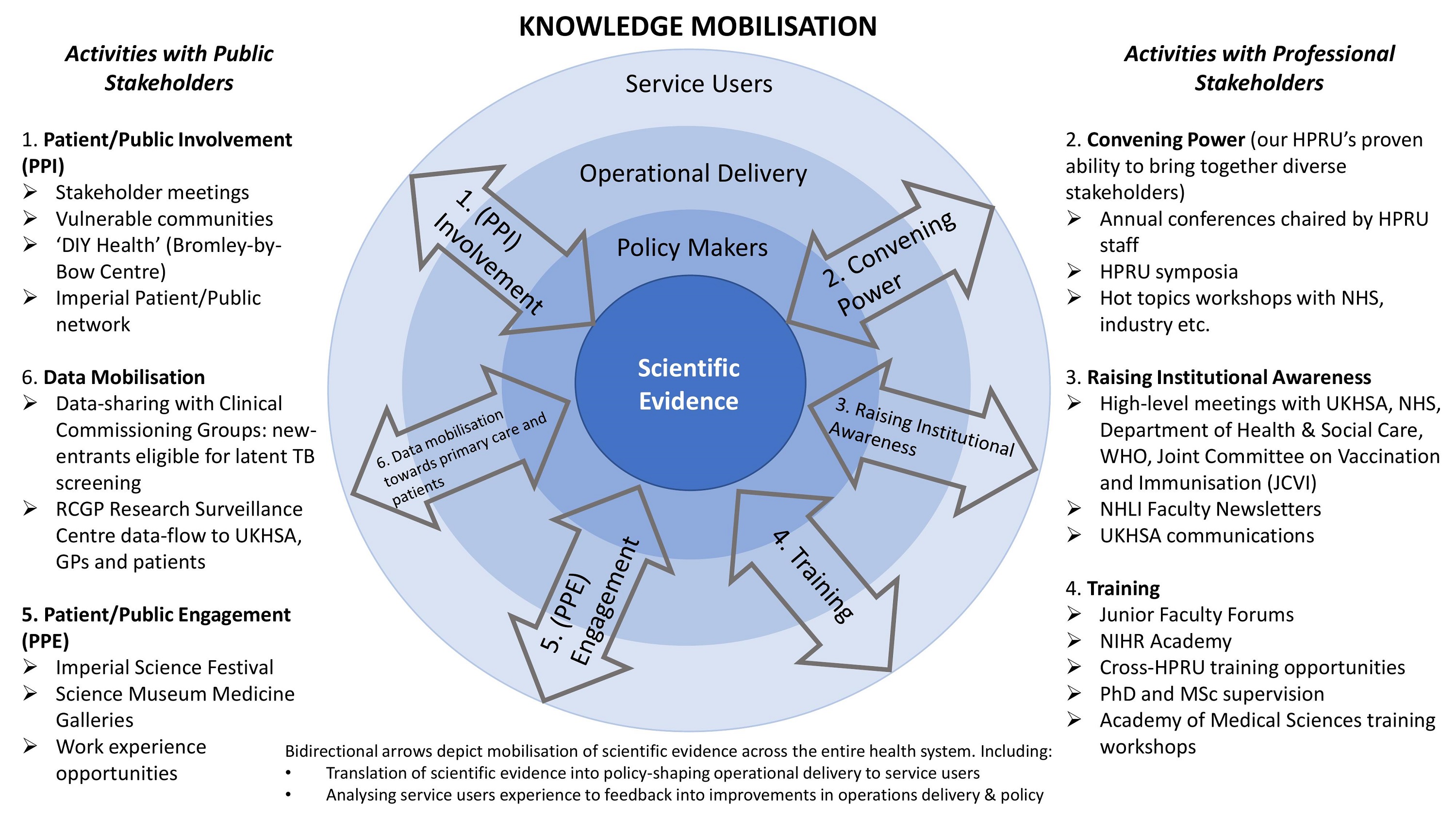
Knowledge mobilisation (KM) enables translation of advances in health protection research into benefits for patients and the public; supporting research informed decision-making by policy makers, public health practitioners, the public, and other stakeholders.
Our KM strategy addresses how to mobilise knowledge generated by the HPRU in Respiratory Infections and to develop expertise and establish a culture in partner organisations to improve their capacity to use research evidence.
How do we do this?
Within the HPRU in Respiratory Infections
As part of their induction, all new staff members will participate in an individual or group discussion with the HPRU Knowledge Mobilisation Lead, Dr Raheelah Ahmad.
PhD students are encouraged to incorporate early consideration of a placement or collaboration within a relevant practice or policy setting into their research plans.
For scientists and theme leads, each research project includes a clear identification of its intended beneficiaries. We also outline how and when stakeholder engagement should take place to ensure the research remains relevant, impactful, and well-integrated with end-user needs.
Across HPRUs
We are one of 13 HPRUs across England, and we work with these units via a HPRU network to ensure that we are learning from each other. For example, online-training resources in knowledge mobilisation are accessible across the HPRU network.
Collaboration with UKHSA, NIHR and across HPRUs
As the principal user of research evidence generated by HPRUs, collaboration between UKHSA and the Units is critical. This will include development of relationships to support joint working in the area and specifically ensure engagement of UKHSA in framing the research questions addressed so that results will fit to policy and practice needs.
For cross cutting HPRUs, a relationship with similar subject area HPRUs as well as UKHSA will target method development to the needs of these users. Co-production of user guides and interface quality with users will be undertaken to increase implementation.
Effectiveness in this area of strategy will be evidenced by overall collaborative structures and processes as well as the role of these in case study examples.
Engagement with policy-makers, professionals, industry and the public
Developing relationships to allow expertise and insights of these key stakeholders to be included in the research journey is critical; from asking the right research questions to being able to understand and interpret the findings.
Activities include stakeholder workshops to steer research directions and construction of a Theory of Change to explicitly set out assumptions, preconditions, interim steps and outcomes needed to reach the impact we hope for. In these ways we recognise the ways of thinking or mental maps of different end-users and the wider context including organisational culture and external factors affecting change.
International News Media Coverage
Our high-impact publications continue to stimulate intense public interest as they addressed questions of fundamental scientific and public health importance. The international news media have highlighted the public health implications of our work through hundreds of print, broadcast and digital news articles globally. Two recent examples include:
- Cross-reactive memory T cells associate with protection against SARS-CoV-2 infection in COVID-19 contacts. Kundu R et al. Nature Communications 2022. Metrics: altmetric score 4,395; in the top 5% of all research outputs scored by altmetric; covered by >480 news articles through 413 international news outlets; ranked 10th in c. 40,000 Nature Communications outputs; 1633 social media mentions [as of 09.02.2022].
- Community transmission and viral load kinetics of the SARS-CoV-2 delta (B.1.617.2) variant in vaccinated and unvaccinated individuals in the UK: a prospective, longitudinal, cohort study. Singanayagam A et al. Lancet Infectious Diseases 2021. Metrics: altmetric score 19,365; in the top 1% of all research outputs scored by altmetric; ranked 32nd out of >20 million outputs across all altmetric sources; covered by >360 news articles through 320 international news outlets; ranked 1st in c. 5000 Lancet Infectious Diseases outputs; 21,728 social media mentions [as of 09.02.2022].
How do we do know if this works?
Measuring impacts and the role of knowledge mobilisation in this
At the end of each year, we evaluate the effectiveness of our stakeholder engagement and intended beneficiaries. To understand this impact, we consider questions such as:
- What difference has involvement made?
- Who is using the research findings, and how?
- What difference has it made in terms of policy or in terms of the practice of healthcare professional or patients? Or others?
For more information about Knowledge Mobilisation at the HPRU in Respiratory Infections please contact Dr Raheelah Ahmad raheelah.ahmad@citystgeorges.ac.uk

Important links
General enquiries
NIHR HPRU in Respiratory Infections
Dr Victor Phillip Dahdaleh (VPD) Building
Level 5, Office 586
Imperial College London
Hammersmith Campus
Du Cane Road
London, W12 0NN