From Namibia to global environmental policy: advancing climate adaptation and food security
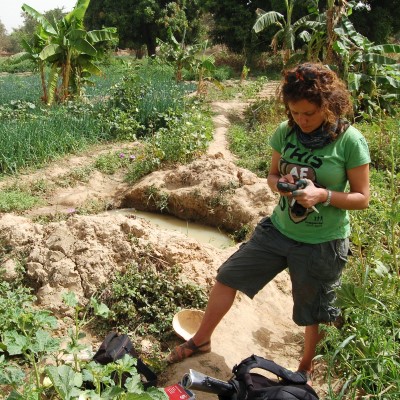 Dr Jessica Nosizwe Thorn is an Assistant Lecturer in the Centre for Environmental Policy, working at the nexus between global environmental change, food security, climate adaptation, infrastructure and informality. She leads the African Nature Futures Lab, with active research campaigns in Madagascar, Namibia, Sierra Leone, Kenya, Tanzania, and the Republic of Congo. She also leads the Sustainable Food, Land and Water Systems theme and co-convenes the Environmental Resource Management Option for the MSc in Environmental Technology.
Growing up in Namibia, Thorn and her family spent long periods camping in the desert and travelling through remote landscapes. That environment, defined by low rainfall and vast distances, sparked her early curiosity about natural resources and our dependence on them. She began her academic training at the University of Cape Town in Human Geography. After working in the conservation NGO and government sectors, she pursued an MSc in Environmental Change and Management and later a PhD in Zoology at the University of Oxford.
Namibia continues to shape her scientific perspective. It is, she says, “a water-scarce environment”, where the limits of natural resources are tangible. Its cultural diversity also shaped her understanding of the continent’s complexity. “It allows me to recognise the importance of individual action, planning, and policy.”
Today, Jess contributes to a range of international policy processes, including reports from the International Panel on Climate Change the African Union Climate Change Strategy, and United Nations Environment Programme Global Environmental Outlook. In recent years, she has also helped build a research network with the Food and Agricultural Organisation and UN-Habitat through the African Forum on Urban Forests, where she serves as Scientific Chair. With a strong interest in implementation, she leads a research collaboration with Freetown City Council supporting the planting of 1.2 million trees in Sierra Leone’s capital through the Freetown the Treetown Campaign.
Through this work, in 2025 she was recognised as the 5th top female scientist in Namibia by the National Commission of Science Research and Technology. She also received the Africa Planet Prize, created by the African Academy of Sciences in partnership with the Frontiers Research Foundation of Switzerland. The prize recognises outstanding peer-reviewed scientific work that contributes to safeguarding the Earth’s nine planetary boundaries. She has also been recognised as an African Women in Climate Change Science by the African Institute of Mathematical Sciences, a Climate Research for Development Fellow, and a Next Einstein Forum Fellow.
On International Women’s Day, she reflects that while it is important to celebrate the contributions African women make to STEM, structural barriers persist; from underrepresentation in leadership and funding gaps to unconscious bias and the additional burden of care responsibilities. In fields where senior positions are still largely dominated by men, this experience has shaped her commitment to mentoring women in STEM.
Capacity building is a central part of her work. Through participatory scenario planning, she has trained more than 1,400 practitioners across 12 countries. The process encourages people to “think more imaginatively about what’s possible, what the trade-offs might be, and who might lose out”, while helping to build legitimacy, trust, and innovation in engagement with groups that do not usually work together. She believes that supporting African women in science is essential for building more equitable, decolonial and applied global knowledge.
Find out more