Schistosomiasis control in Yemen to restart

The World Bank has agreed to reinstate funding for Yemen’s 6 year national schistosomiasis & intestinal worms programme which was suspended indefinitely in 2011 due to civil and political unrest
Yemen’s attempts to control schistosomiasis and intestinal worms are being re-launched. Following a nine month hiatus caused by the civil and political unrest in the country, the programme’s main funders, the World Bank, have agreed to a reinstatement of funding for the six-year national programme.
Even though significant security and operational challenges remain, the need is so great in many parts of the country that it was imperative the suspension be lifted.
Yemen is the poorest country in the middle-east, and suffers from low levels of natural resources and high disease burden. It has extensive infection with schistosomiasis and intestinal worms, with three million people estimate to be infected and 600,000 with clinical morbidity. A six-year nationwide schistosomiasis and intestinal worms programme commenced in 2010 with the aim of eliminating schistosomiasis-related morbidity via annual treatment. The programme is run by the Yemen Ministry of Health and involves collaborative partnerships with the WB, World Health Organization, and the Schistosomiasis Control Initiative.
In the first treatment rounds in Dec 2010 and April 2011, over 4 million people were treated, and reaching 87% of school-age children targeted, exceeding both the programme targets and the WHO target of 75% coverage. Crucially, this included both enrolled and non-enrolled children, the latter thought to be at particular risk of developing disease.
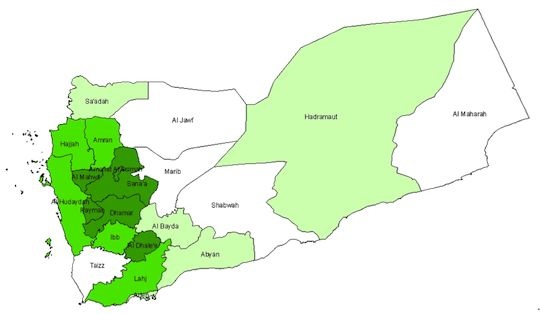
Map of Governorates of Yemen showing when they received/will receive treatment. Dark green areas treated in Dec 2010, medium green in April 2011 and light green due to be treated in March 2012. White areas either do not have any schistosomiasis (Al Maharah/Shabwah) or will be treated when the security situation allows it (Al Jawf, Marib, Shabwah, Taizz).
A treatment campaign that was originally planned for prior to the suspension will now be carried out in the second half of March 2012. This will reach out treatment to a further one million people, even in security-compromised areas. In fact, in these areas, it is the people themselves who are requesting treatment, demonstrating that there is a need and a demand for such programmes. An important impact of the unrest has been the displacement of large numbers of internal refugees in the country. These internally displaced persons (IDPs) are moving from highly endemic to less infected areas, mostly from Lahaj to Aden governorates, raising the risk of ‘seeding’ the new area with infection. To combat this, special campaigns will be carried out to reach vulnerable IDPs in temporary camps in Aden in the South of the country.
The programme stakeholders will meet at the World Health Organization regional office in Cairo in March 2012 to re-launch the programme and to plan the best approach to reach all those in need in the country.
Article text (excluding photos or graphics) © Imperial College London.
Photos and graphics subject to third party copyright used with permission or © Imperial College London.
Reporter
Press Office
Communications and Public Affairs
- Email: press.office@imperial.ac.uk