Hamlyn Centre Student Creates Augmented Reality Medical Visualisation App
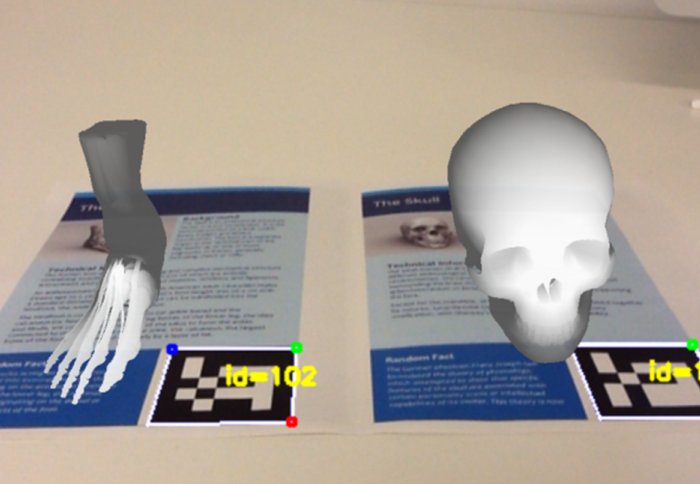
The Augmented Reality App overlays 3D medical data onto the surroundings to give an immersive, navigatable 3D environment
A Hamlyn Centre Student has developed an App which enables augmented 3D medical image visualization of patient’s organs
Over his 8 week UROP (Undergraduate Research Opportunities Programme) placement, Benjamin Ryder has developed an Augmented Reality framework for the iPad, which enables augmented 3D medical image visualization of patient’s organs in real-time. The application makes use of the tablet’s front facing camera and utilizes small black and white markers to detect camera positions enabling the superimposition of pre-loaded 3D meshes of medical images (e.g. CT) over the live camera feed. Different versions of the application (single marker and multiple markers) have been implemented, and a medical info flyer is provided which demos the use of the application by superimposing the 3D models of organs of interest along a medical description of the corresponding organ. This application is also capable of detecting user touch motions on the tablet’s screen to rotate the 3D models for ease of viewing. The final product could be of significant use for medical diagnosis as well as educational purposes.
The UROP program provides a research-based placement for undergraduates within Imperial College, lasting 6 – 10 weeks during the summer, providing an opportunity to participate in research and develop technical skills within a research group.
Benjamin describes his experience as challenging yet very rewarding: “I've really enjoyed my time at the Hamlyn Centre, the work has been interesting and rewarding and it has been great finding out about the research going on around the group. I was also given the opportunity to visit St Mark’s and St Mary’s hospitals and see the sort of situations where my project could be applied.”
Article text (excluding photos or graphics) © Imperial College London.
Photos and graphics subject to third party copyright used with permission or © Imperial College London.
Reporter
Press Office
Communications and Public Affairs
- Email: press.office@imperial.ac.uk