Mind control and mind waves
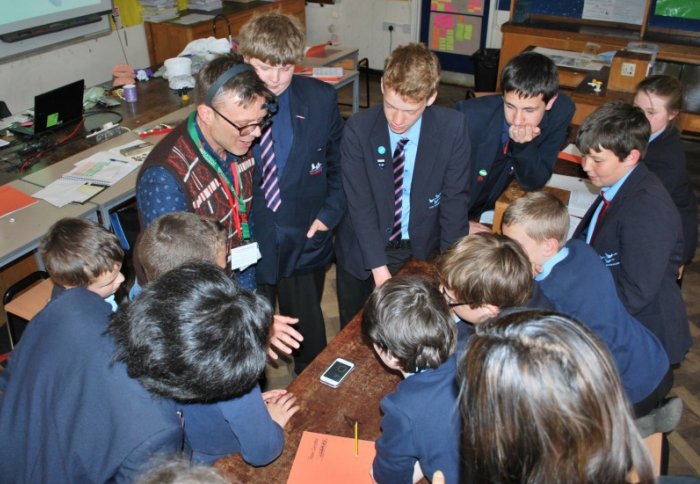
Dr Durrenberger demonstrates the use of brain computer-interface technology which would allow students to control gadgets with their thoughts.
Brain Sciences academic Dr Pascal Durrenberger has assisted a school to acquire funding to undertake a series of science based projects.
Dr Pascal Durenberger has assisted The Misbourne, a High School in Great Missenden, North West of London to secure funds for their school Science, Technology, Engineering and Mathematics (STEM) Club.
The Partnership Grant from the Royal Society amounting to nearly 3K, will allow the students from The Misbourne to carry out a small science project with the guidance of Dr Pascal alongside their science teacher Ms Anita Kapila; who drove the application and obtained the award.
The project, titled “The Effect of various activities on Wave patterns of the Brain” will allow students to observe their brainwave patterns whilst conducting various tasks such as calculus or painting.
Dr Durrenberger stated “I thought it would be a great opportunity to introduce pupils to the Brain as an organ but also to the increasing appearance of biosensors in our lives”.
The funds will allow the school to purchase several MindWave mobile headsets, a portable EEG device which will allow the pupils to develop their tasks and measurement strategies. Pascal hopes that the students will also gain the basics of the scientific methodology; observation, measurements, and recording as well as some fundamental insights on their brain by participating in the project.
Dr Durrenberger recently undertook his first visit to the school where he conducted a series of activities with the students from the STEM Club.
Pascal explained all about the human brain’s structure and function using a plastic teaching brain.
Human brain slices donated by the Brain Bank were also made available for viewing by the students as Dr Durrenberger demonstrated the differences between a brain that has been affected by multiple sclerosis and one that has not.
Students were also given the opportunity to experience the cutting-edge area of brain computer-interface and control gadgets with their thoughts.
Later in the afternoon skipping ropes were used on the playground to illustrate neuronal activity within the brain.
The project will provide insights and experiences to high school students who otherwise would not have the opportunity to speak one on one with an established neuroscientist about the brain.
Pascal noted “I haven’t seen children so interested in a while; hopefully there is enough interest to spark a new generation of neuroscientists!”
Article text (excluding photos or graphics) © Imperial College London.
Photos and graphics subject to third party copyright used with permission or © Imperial College London.
Reporter
Press Office
Communications and Public Affairs
- Email: press.office@imperial.ac.uk