PE-CDT student James Bannock is a finalist in the EPSRC ICT Pioneers competition
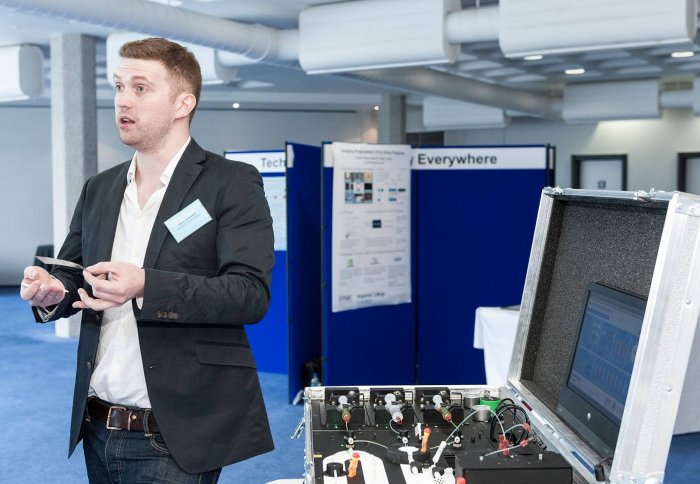
James Bannock reports on his experience of the prestigious EPSRC ICT Pioneer competition 2014.
The Engineering and Physical Sciences Research Council (EPSRC) is the UK's main agency for funding research in engineering and the physical sciences. EPSRC invests around £800 million a year in research and postgraduate training, to help the nation handle the next generation of technological change. The areas covered range from information technology to structural engineering, and mathematics to materials science. This research forms the basis for future economic development in the UK and improvements for everyone's health, lifestyle and culture. EPSRC works alongside other Research Councils with responsibility for other areas of research. The Research Councils work collectively on issues of common concern via Research Councils UK.
My entry into the Transforming Society category of the EPSRC UK ICT Pioneers 2014 competition was based on the development of chemical flow reactors to enable large-scale production of cheap and reliable semiconducting polymers for consumer electronics.
The preliminary stages of the competition consisted of a short essay explaining the research and its application to ICT, followed by a 3-minute video presentation (thanks to Kirsty Roy and Tom Phillips for their help with the video!).
After successfully making it through the initial stages I was invited to participate in the final at the QEII Conference Centre in Westminster along with 14 other successful finalists.
Before the doors opened to the invited delegates we delivered a final series of interactive pitches to the competition judges to help them select a winner for each of the three categories.
To demonstrate our flow reactors I took along our freshly polished Lab-in-a-Suitcase flow reactor, complete with flashing lights and Lego workers. The reactor was used to demonstrate the core flow technologies that we are using in the lab to produce highly controlled electronic materials.
In the evening the event filled with a mix of academics and industry representatives keen to explore the offerings. On display was a wide variety of innovative research: from algorithms that solve mathematical problems faster and more efficiently to systems that physically guide anaesthetists while performing an injection and thereby preventing injury.
Unfortunately I was unsuccessful at repeating David Beesley’s triumph in the previous ICT Pioneers competition. Nonetheless the competition was thoroughly enjoyable; in particular hearing the views of industry on the flow technology provided valuable perspective for future work.
The title this time around was handed to Nathan Chong from the Department of Computing at Imperial with his work on automated methods for identifying errors and weaknesses in computer programs.
Article text (excluding photos or graphics) © Imperial College London.
Photos and graphics subject to third party copyright used with permission or © Imperial College London.
Reporter
Dr James H. Bannock
Department of Chemistry
