November 2014 ESE Newsletter
Comet landings and mole tunnels
Contents
Publications
Conferences, Lectures and Seminars
Awards
Research Activity
Workshops and Courses
Impact and Media
Outreach
New Staff
Publications
Davison, T. M., Ciesla, F. J., Collins, G. S. and Elbeshausen, D. (2014), The effect of impact obliquity on shock heating in planetesimal collisions. Meteoritics & Planetary Science.
Jackson, C.A-L, Carruthers, D.T., Mahlo, S.N. and Briggs, O. (2014) Can polygonal faults help locate deep-water reservoirs? AAPG Bulletin, 98, 1717-1738. DOI: 10.1306/03131413104.
Maidment, S. C. R., Bates, K. T. and Barrett, P. M. (2014). Three-dimensional computational modeling of pelvic locomotor muscle moment arms in Edmontosaurus (Dinosauria, Hadrosauridae) and comparisons with other archosaurs. In Evans, D. C and Eberth D. E. (eds), Hadrosaurs. Indiana University Press, Bloomington.
McDonald, A. T., Maidment, S. C. R., Barrett, P. M., You, H.-L., and Dodson, P. (2014). Osteology of the basal hadrosauroid Equijubus normani (Dinosauria, Ornithopoda) from the Early Cretaceous of China. In Evans, D. C and Eberth D. E. (eds), Hadrosaurs. Indiana University Press, Bloomington.
Myrgorodska, I., Meinert, C., Martins, Z., d'Hendecourt, L. and Meierhenrich, U. J. (2014) Molecular Chirality in Meteorites and Interstellar Ices, and the Chirality Experiment on Board the ESA Cometary Rosetta Mission. Angewandte Chemie International Edition. DOI: 10.1002/anie.201409354
Poropat, S.F., Mannion, P.D., Upchurch, P., Hocknull, S.A., Kear, B.P. and Elliott, D.A. (2014) Reassessment of the non-titanosaurian somphospondylan Wintonotitan wattsi (Dinosauria: Sauropoda: Titanosauriformes) from the mid-Cretaceous Winton Formation, Queensland, Australia. Papers in Palaeontology. DOI: 10.1002/spp2.1004
Prentice, K., Jones, T.D., Lees, J., Young, J., Bown, P., Langer, G. and Fearn, S. (2014). Trace metal (Mg/Ca and Sr/Ca) analyses of single coccoliths by Secondary Ion Mass Spectrometry. Geochimica et Cosmochimica Acta. DOI: 10.1016/j.gca.2014.09.041
Rotevatn, A. and Jackson. C.A-L. (2014) 3D structure and evolution of folds during normal fault dip linkage. Journal of the Geological Society, 171, 821-829. DOI: 10.1144/jgs2014-045.
Selley, R.C. and Sonnenberg, S.A. (2015) Elements of Petroleum Geology. 3rd Edition. Academic Press, Elsevier, 527pp.
Singh, G. and Zimmerman, R.W. (2014). Modification of Griffith–McClintock–Walsh model for crack growth under compression to incorporate stick-slip along the crack faces. International Journal of Rock Mechanics. DOI: 10.1016/j.ijrmms.2014.09.020
Conferences, Lectures and Seminars
Susie Maidment gave a presentation at the Society of Vertebrate Paleontology Annual Meeting entitled, “Red blood cells and collagen fibres preserved in 75 million year old dinosaur specimens”.
Julie Prytulak gave a departmental seminar at the University of Portsmouth titled “Why measure stable vanadium isotopes?”.
The Integrated Ocean Discovery Program (IODP) held its annual meeting on 5 November at the Royal Geographical Society. Tina van de Flierdt gave a keynote address on the wide range of results arising from Expedition 318 to Antarctica, which sailed in 2010. Julie Prytulak gave an invited talk on the (very) preliminary results of Expedition 352 to the Bonin Forearc, which sailed in August-September of this year. The event also attracted significant attendance from ESE including fellows, postdocs, PhD and MSci students.
Chris Jackson gave a keynote presentation at the FORCE Salt Tectonics meeting in Stavanger, Norway, on 13 November. His talk, “Salt-Influenced Rift Basins; structure, stratigraphy and new models”, presented material arising from the Salt-Influenced Rift Basins (SIRB) project.
Chris Jackson gave an invited presentation at the Applied Geodynamic Laboratory (AGL) Annual General Meeting held at the Bureau of Economic Geology, University of Texas at Austin, on 14 November. His talk, “Geological and geophysical characterisation of a salt weld; Santos Basin, offshore Brazil”, included material arising from Clara Rodriguez’s PhD, and work conducted in collaboration with Rebecca Bell.
Chris Jackson gave an invited presentation at the Petroleum Exploration Society of Great Britain (PESGB) Evening Lecture in Aberdeen, on 18 November. His talk was entitled, “The internal structure and composition of salt diapirs: what do we know, what might we want to know and why might it be important?”.
Chris Jackson gave an invited presentation at the Eastern Mediterranean Research Symposium held at IFP Energies nouvelles, Paris, France, on 24 November. His talk, “When the water went away; an overview of Messinian Salinity Crisis-related research at Imperial College”, presented material arising from the PhD projects of Hayley Allen and Abdulaziz Al-Balushi (both co-supervised by Al Fraser), in addition to MSci student Ciprian Verdes.
Chris Jackson, along with collaborator David Hodgson from the University of Leeds, gave a series of invited presentations at BG Group’s ‘Lunch-and-Learn’ seminar series, on 7 November. The presentations focused on the seismic expression, stratigraphy and sedimentology of mass-transport complexes (MTCs) and their impact on petroleum systems development along passive margins.
Former PhD student Hanli de la Porte, now with Gaffney, Cline and Associates, delivered a paper at the 2014 SPE Annual Technology Conference and Exhibition in Amsterdam, 27-29 October: “Modelling heavy oil viscosity during thermal stimulation using the free volume theory”, co-authored by J. J. de la Porte, R. W. Zimmerman, and C. A. Kossack, SPE 170817.
Phil Mannion and PhD students Chris Dean and Jon Tennant attended the Annual Meeting of the Society of Vertebrate Paleontology, 5–8 November, in Berlin. Phil gave a presentation entitled “Climate drives spatiotemporal patterns in crocodylomorph diversity”; Chris presented work from his MSci: “The completeness of the fossil record of pterosaurs: implications for their diversity and evolution through the Mesozoic”, and Jon presented a poster on his PhD work entitled “Evolutionary relationships of atoposaurid crocodylomorphs, and evidence for allopatric speciation driving their high diversity in the Late Jurassic of western Europe”.
PhD student Alex Norori-McCormac, with Pablo Brito-Parada and Jan Cilliers attended the 28th IMPC (International Mineral Processing Congress) in Santiago, Chile, 20-24 October. Alex presented a paper entitled, “Peak Air Recovery: An investigation into the effect of particle size,”.
Awards
PhD student Alex Norori-McCormac was awarded the Rio Tinto Safety Prize 2014 this month for developing and testing undergraduate student fieldwork safety cards, based on an industrial equivalent.
Research Activity
Dominik Weiss has been elected to join the EAG Council in 2015
In November PhD student Jay Shah visited the Ernst Ruska Centre for Microscopy at the Forschungzentrum in Jülich, Germany. He conducted off-axis electron holography experiments on meteorites using high-end TEMs. Jay has been working alongside ESE’s Trevor Almeida.

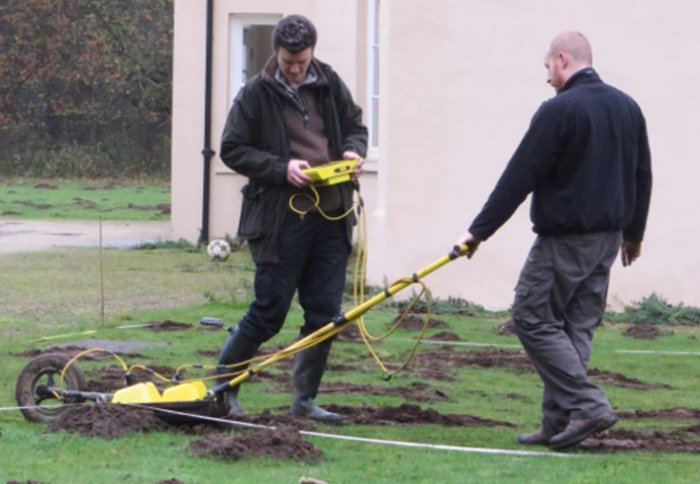
Finding mole tunnels and a Mosquito using different geophysical and geochemical techniques
Adam Booth and Veerle Vandeginste performed a geophysical survey at Nuthampstead Airfield, with the Airfield Museum, to help locate the site of a Mosquito aircraft that crashed during the Second World War. Adam performed electrical and magnetic surveys - standard in archaeology - whereas Veerle pushed back the boundaries with the deployment of in-field X-ray fluorescence equipment. A likely crash site was identified, and the museum plans an excavation next year.
Adam Booth undertook a trial deployment of ground-penetrating radar (GPR) to map networks of mole tunnels, in conjunction with Oxford University's WildCRU conservationists. The GPR successfully imaged a tunnel network, with tunnels - only 10 cm in diameter! - validated with test trenches. The research will lead to a time-lapse geophysical study of how moles develop their tunnels over the year.
Workshops and Courses
PhD student Philipp Lang gave a presentation entitled "Coupled multi-scale thermo-hydro-mechanical-chemical modelling of rock fractures" at the Decovalex 2015 Workshop, on 12 November. Decovalex is an eight-nation collaborative research project on modelling coupled processes associated with underground nuclear waste disposal. Philipp's work is supervised by Adriana Paluszny and Robert Zimmerman, and is funded by the Nuclear Decommissioning Authority
The Impacts and Astromaterials Research Centre (IARC) held their annual symposium on 11 November in the NHM, with members from both ESE and the NHM presenting their work. From ESE, Matt Genge, Gareth Collins, Tom Davison, Matthias van Ginneken, Duy Luong, Richard Court, Renato dos Santos, Carl Palk, Graeme Poole, James Lewis, Auriol Rae, and Roland Stumpf all gave talks or posters on their current research.
James Hammond was invited to participate in a NERC/ESRC - NSF, China sponsored scoping workshop for China-UK cooperation in Chengdu, China. The aim of the workshop was to strengthen and develop collaborations between UK and Chinese scientists in the natural and social sciences, with particular focus on the areas of geohazards, palaeontology and geofluids. The workshop will shape the focus of a new £5 million NERC/ESRC/NSFC call for funding into resilience to natural hazards (IRNH) (through a Newton fund call).
Phil Mannion co-organised a symposium and workshop at the Linnean Society of London and Imperial College London, 10–11 November, entitled “Radiation and Extinction: Investigating Clade Dynamics in Deep Time”. This brought together an international array of researchers developing and applying methods for reconstructing deep time macroevolutionary patterns in biodiversity. PhD student Jon Tennant also attended and presented a poster entitled “Diversity crash in crocodylomorphs at the Jurassic/Cretaceous boundary”.
Impact and Media
ESE PhD student Christoph Mazur together with Physics PhD student Christopher Emmott created a documentary on Nepal's energy system, "Powering the Top of the World - Empowering communities", for the Energy Futures Lab here at Imperial, which they’ve been invited to submit to the tve Global Sustainability Film Awards 2014. The project examines the transition of Nepal’s energy system and explores the challenges that this developing nation is facing. Through interviews with those in charge as well as the people whose daily lives are impacted, the film focuses on the small solutions that may empower communities to supply their own electricity without reliance on centralised plans.
Zita Martins has appeared on the BBC documentary “The Sky at Night” speaking about comets and the Rosetta mission.
Outreach
Lidia Lonergan did a 'Classify Rocks' science session with year 6 children at a Richmond state Primary School. Thirty 10-11 year olds successfully classified a sandstone, chalk, fossiliferous limestone, granite, basalt and a garnet mica schist into categories of sedimentary, igneous and metamorphic rocks. The experiment enjoyed most was squirting acid on the specimens and seeing resultant fizzing and 'smoke'!
Adriana Paluszny gave an invited talk at the DigiGirlz 2014 event, on 28 November at Microsoft Headquarters London. She was invited to participate as a mentor, with her recent Codess Hackathon winning team 'Travelling Climatologists'. DigiGirlz is an outreach event organised by Skype and Microsoft to encourage school girls to embark on technology oriented careers.
New Staff
Saeed Salimzadeh joined the department on 17 November as a PDRA. He will be working with Adriana Paluszny and Robert Zimmerman on geomechanical issues associated with subsurface carbon sequestration, as part of the EPSRC-funded CONTAIN project. Saeed recently completed his PhD at the University of New South Wales, in Australia.
Olivier Dubrule has replaced Olivier Gosselin as of 3 November as Total-seconded visiting professor. His main area of expertise is Petroleum Geostatistics.
Article text (excluding photos or graphics) © Imperial College London.
Photos and graphics subject to third party copyright used with permission or © Imperial College London.
Reporter
Dr Emma Passmore
Department of Earth Science & Engineering