Centre for Neurotechnology at Imperial Festival
by Kate Hobson
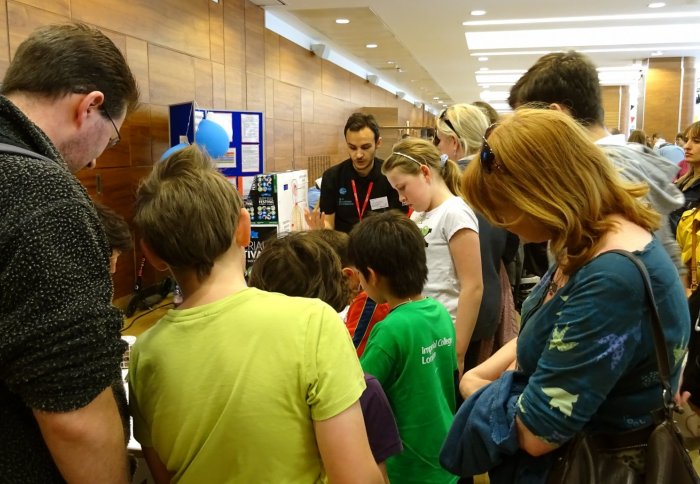
The Brain Zone at the Imperial Festival
Students from the CDT and Centre for Neurotechnology took part in the Imperial Festival on 9th & 10th May

The Brain Chain stand
Students from the CDT and Centre for Neurotechnology hosted two successful stands in the Brain Zone at the Imperial Festival on 9th & 10th May.
The “Brain Chain” stand demonstrated the path of electrical signals in the nervous system and how they are affected by disease, and the “Mind Control” stand invited volunteers to control a drone quadricopter using an EEG headset.

Mind control
Additional activities at the stands included the “Brain Anatomy Challenge”, which challenged visitors to assemble a model brain in the shortest time possible, and the “Design a Mind-Machine” table, where visitors were encouraged to draw or model their own brain-controlled machine.
It was great to see how much the kids were enjoying the activities.
– Peter Quicke
CDT student
Both stands proved extremely popular, with an estimated 600 people visiting the stands over the two days. Unexpectedly popular were the Brain Anatomy Challenge – taken by over 90 visitors, with the fastest assembly time of 27 seconds – and the creative mind-machine table, which inspired some interesting results!

Brain anatomy challenge
The Centre would like to extend a big thank you to all the students from the CDT and Centre who worked brilliantly together to produce and run the two excellent exhibits.


Article text (excluding photos or graphics) © Imperial College London.
Photos and graphics subject to third party copyright used with permission or © Imperial College London.
Reporter
Kate Hobson
Department of Bioengineering
