Fun final year projects by DoC Masters students
by Sarah Willis
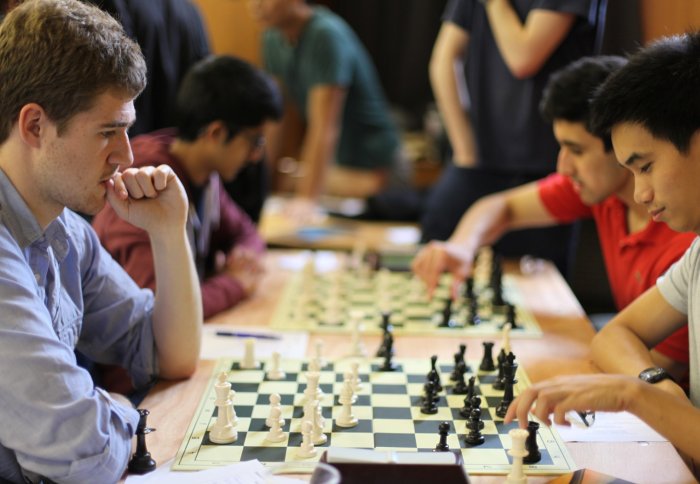
DoC Masters students undertake final year projects, many of which turn out to be highly entertaining and garner much attention outside of the College.
When MSc student, Matthew Lai (supervised by Prof. Duncan Gillies) posted his project report on ArXiv, it immediately generated a flurry of media interest. For the project Matthew built a computer that managed to teach itself chess, and in just three days attained a level of skill comparable with some of the world’s most skilful players.
The machine called ‘Giraffe’ plays chess by evaluating the board and positions much like human players would, in an entirely different way to other chess engines. The technology behind Giraffe is a neural network, which is a way of processing information inspired by the human brain. Several layers of nodes connect in a way that change as the system is trained, developed using 175 million examples of real chess games. Giraffe evaluates the board and can predict which moves would be strong and which weak.
Matthew, speaking to Technology Review, said of Giraffe; “unlike most chess engines in existence today, Giraffe derives its playing strength not from being able to see very far ahead, but from being able to evaluate tricky positions accurately, and understanding complicated positional concepts that are intuitive to humans, but have been elusive to chess engines for a long time."
Along with Technology Review, Matthew was also featured by The Independent, Fusion, and Popular Science. For further information on each story please see:
Technology Review, Independent, Fusion, Popular Science
Le Thanh Hoang, DoC 4th year M.Eng Computing student (supervised by Prof. Andrew Davison) also undertook an entertaining final year project, building a robot that can solve a Rubik’s cube in just 32 seconds.
The project was a fantastic example to show to DoC students of the future at the recent Undergraduate Open Day.
Watch the video at the link below to see the robot in action:
Article text (excluding photos or graphics) © Imperial College London.
Photos and graphics subject to third party copyright used with permission or © Imperial College London.
Reporter
Sarah Willis
Department of Civil and Environmental Engineering
