11th Annual MTW Lecture: Bioinformatic approaches to genetics of lung cancer
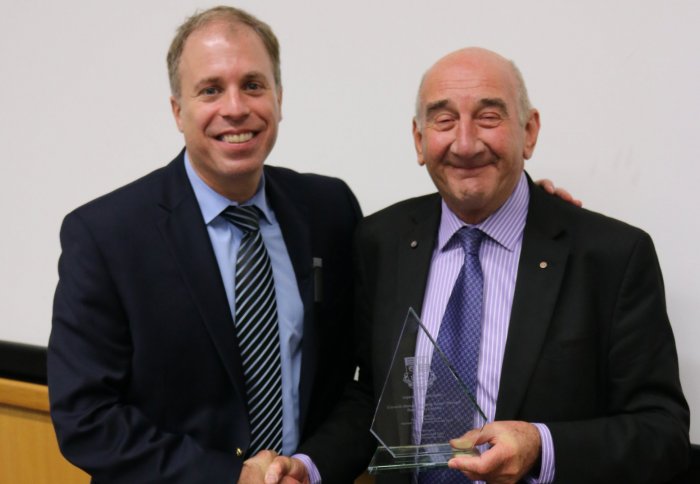
The 11th Annual Margaret Turner-Warwick lecture was given by Professor Avrum Spira, from Boston University.
Professor Spira gave an inspiring talk on his research using bioinformatic approaches to study the genetics of lung cancer, in order to predict lung cancer progression and to design precision medicine. Prof. Spira’s career has taken him from a newly qualified clinician, to a lead researcher in the application of bioinformatics to lung disease, and designer of diagnostic tests that allow clinical application of his research.
During his presentation, Professor Spira described the processes he went through to establish a company based on his research, and the challenges in raising venture capitalist funding. He described the launch of Allegro Diagnostics and how they were bought by Veracyte in 2015. The company are now selling a diagnostic kit that can be used on airway bronchoscopy samples and detect whether there are specific genetic changes that are only found when a cancer is present in a distant site in the lungs.

Dame Margaret Turner-Warwick
Professor Spira went onto highlight the benefits of having a great mentor in his early career, and emphasised the mentorship he received from Professor Jerome Brody, particularly as he guided him towards bioinformatics and his successful career in research. He noted that at the National Heart & Lung Institute, we have a wealth of brilliant scientists that fulfil this role for our young researchers. After discussing his long term studies on lung cancer genetics, he finished by talking about COPD, where he noted increased genetic changes in COPD lungs as the disease progressed, and highlighted his desire to generate a ‘pre-lung disease genome atlas’ (PLDGA) to provide data for which future disease studies can be compared.
The question session was led by Dame Margaret Turner-Warwick, who asked about using the technology to identify specific cancer types in order to further personalise treatment. Following this discussion, a celebratory dinner was held in the Rector’s house, where conversation about the fascinating lecture continued.
Article text (excluding photos or graphics) © Imperial College London.
Photos and graphics subject to third party copyright used with permission or © Imperial College London.
Reporter
Dr Kylie Belchamber
National Heart & Lung Institute
