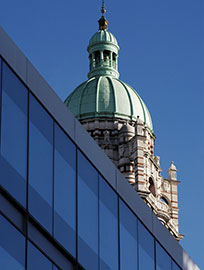
Future directions for the Department of Bioengineering

Professor Ethier joins Imperial as new head of bioengineering - News
17 September 2007
By Colin Smith
Professor Ross Ethier , Imperial College London’s new head of bioengineering, started his career in the oil fields of Alberta, Canada, as an engineering student.
“The province of Alberta is often referred to as the 'Texas of Canada'. I worked in the oil fields during my summer breaks from university,” he said.
Professor Ethier says he learnt a lot about engineering in those early years, most of which wasn’t in any textbooks.
“It was dangerous work, and if you made a mistake there was the real possibility of blowing something up. I learnt not to make mistakes in that job.”
From this precarious start, Professor Ethier went on to forge a successful career at the University of Toronto, moving up the ranks to become Director of the Institute of Biomaterials and Biomedical Engineering.
After nearly 21 years in Toronto, Professor Ethier decided to make the move to the UK. He succeeded Professor Chris Hankin, 1 August 2007, who was acting head of the Department since the death of the previous head Professor John Lever in 2006.
Professor Ethier says he was excited to join Imperial. Commenting about the College he said:
“It is a world-class university situated in one of the world’s greatest cities. Bioengineering is a wide-open field with huge potential. I look forward to working with my team, and further developing a great department.”
One of the Department’s immediate challenges is the relocation to new state-of-the-art laboratories, which are due for completion in December 2007. Other priorities include hiring more staff.
“Imperial’s academic reputation rests on the quality of its academic staff. I want to bring more junior academic stars into the department.”
 Professor Ethier’s research interests include the biomechanics of molecules, cells and whole organs; numerical and experimental studies of blood flow in large arteries; and the study of arterial disease.
His research also looks into the causes of the ocular disease, glaucoma. Professor Ethier investigates the mechanical and cellular response of optic nerve tissues and the outflow of aqueous humour, which provides nutrients to the lens and cornea.
“Glaucoma is the second most common cause of blindness in the world. This disease is often caused by pressure which builds up in the eye. My work investigates why pressure builds up, how it can be lowered and why elevated pressure damages vision.”
Professor Ethier has been recognised many times in his career for both his research and teaching achievements. In 2006 he was elected a Fellow of both the American Society of Mechanical Engineers and the American Institute of Biology and Medicine in Engineering.
Looking to the future, Professor Ethier wants to build on the interdisciplinary partnerships between departments in engineering, medicine and the biological sciences at Imperial. In particular, he plans to work closely with the Institute of Biomedical Engineering to advance bioengineering at Imperial.
The Department of Bioengineering conducts high quality basic and applied research in the general field of bioengineering. It employs the techniques of engineering and physical science to address medical and biological problems. The department’s research is actively driven both to provide a sound theoretical foundation and to develop novel techniques which will benefit clinical medicine, the health care industry, and the growing field of biological engineering.
Article text (excluding photos or graphics) © Imperial College London.
Photos and graphics subject to third party copyright used with permission or © Imperial College London.
Reporter
Press Office
Communications and Public Affairs
- Email: press.office@imperial.ac.uk