Student is presented Distinguised Poster Award at ICHEP2016
by Paul Bennett
Marco Morrone, a student co-supervised by Design Engineering academic Dr Marco Aurisicchio is presented with a Distinguished Poster Award at ICHEP2016
PhD student Marco Morrone who is co-supervised by Dr Cedric Garion and Dr Paolo Chiggiato based at CERN, and Dyson School of Design Engineering academic Dr Marco Aurisicchio was presented with a Distinguished Poster Award at the International Conference on High Energy Physics 2016.
In acceptance of this award, student Marco Morrone stated the following:
"I am very honoured of this award related to the work that I am conducting as a PhD student in the TE/VSC group and in collaboration with Imperial College London. I find this project extremely interesting and I am happy to contribute to the development of the HL-LHC upgrade. I think that performing numerical simulations and then validating them through experiments is certainly a big excitement for an engineer at the early stage of his career. The numerical work has been concluded and we are about to perform, along with other CERN groups and external partners, the relative experimental investigation. This will include thermal, magnet quench and fracture mechanics tests. I am very grateful to Paolo Chiggiato, Cedric Garion and Marco Aurisicchio for their constant support and to the other members of the group involved in the project.
I am involved in the design of the new HL-LHC beam screen that will be installed in the triplet area of CMS and ATLAS in 2024. The beam screen is a very complex assembly which plays a dominant role for future LHC operations. It ensures vacuum stability by means of small holes along its uncovered surfaces, and shields the 1.9 K magnet cryogenic system from the heat loads and damage to the coils that would otherwise be induced by the highly penetrating collision debris. It is placed in an extreme environment and a robust design approach is therefore mandatory. Part of my work consists in predicting the thermomechanical behaviour of the assembly through numerical simulations. This allows us to identify a geometry that can fulfil the typical beam screen requirements rapidly. The remaining part concerns the experimental validation of the numerical models along with mechanical, thermal and magnetic characterisation of some materials used for the beam screen.
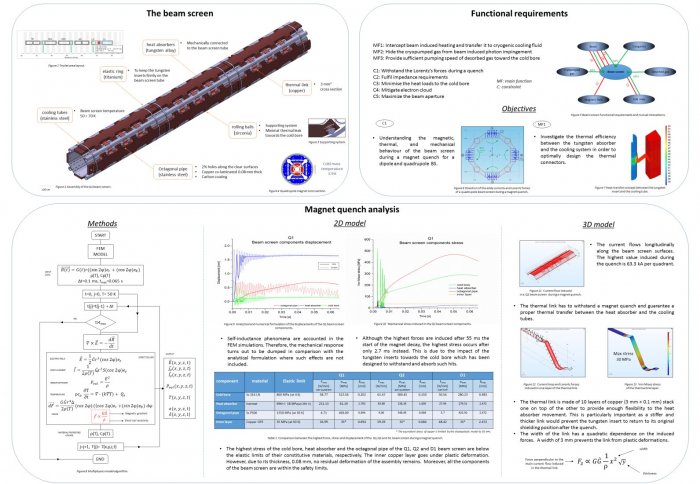
The poster presented in Chicago during ICHEP 2016 illustrates two FEM models used for the design of the beam screen. The multiphysics model estimates the mechanical response in case of a magnet quench. In this model all the equations governing the phenomena arising in a quench are fully coupled to evaluate the final mechanical behaviour. The other model has been developed to assess the thermal transfer between the tungsten absorbers and the cooling system in normal working conditions. The solution for both models, although solved separately, must be mutually valid as they are interrelated."
Congratulations to Marco on receiving the award.
Article text (excluding photos or graphics) © Imperial College London.
Photos and graphics subject to third party copyright used with permission or © Imperial College London.
Reporter
Paul Bennett
Department of Mechanical Engineering