July 2023 - Article Published in Nature Reviews Chemistry
Nature Reviews Chemistry
An opinion piece on AI in Chemistry Education by Alan Spivey, Becky Greenaway, Kim Jelffs and Sophia Yaliraki is published in Nature Reviews Chemistry
R.L. Greenaway, K.E. Jelfs, A.C. Spivey and S.N. Yaliraki, ‘From alchemist to AI chemist’ Nat. Rev. Chem. 2023, 7, 527-528. DOI: https://doi.org/10.1038/s41570-023-00522-w
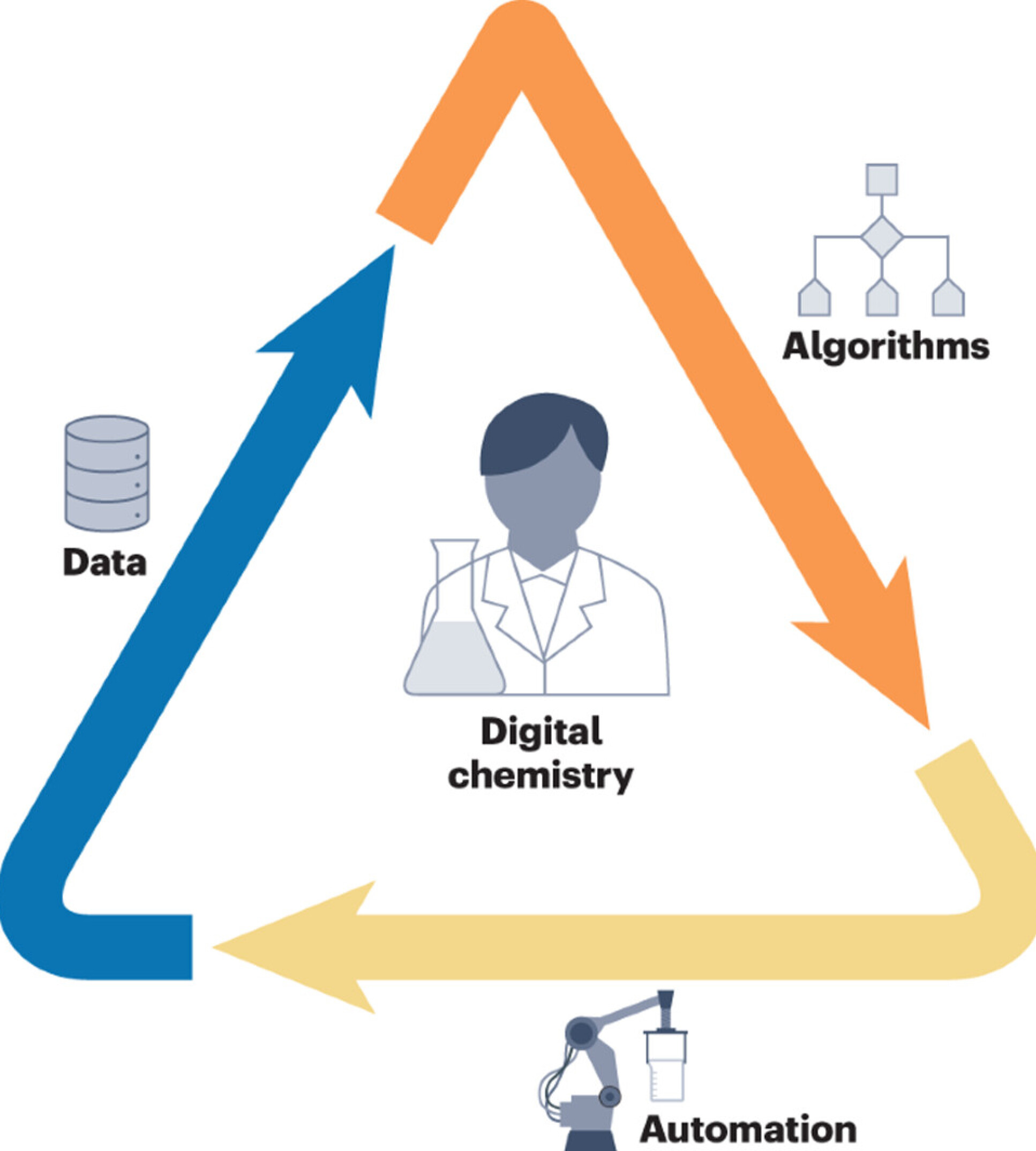
An opinion piece reimagining the training of the next generation of chemists in the era of digital chemistry, automation, robotics and artificial intelligence.
Digital technologies ranging from advanced automation approaches for data acquisition, analysis and curation, through to bespoke machine learning algorithms, are driving a revolution in chemistry. This not only promises to bring a step change in productivity and enhance the speed of discovery, but also to radically change the way chemists approach their work and innovation. The emergence of this new field, broadly referred to as digital chemistry, encompasses the application of digital tools within both lab experiments and molecular computation to create new workflows that will lead to discoveries in a faster, cheaper and more sustainable manner. Crucially, it also paves the way for exploring new chemical space and frees up chemists’ time from repetitive tasks or troubleshooting irreproducible experiments to allow them to engage in more creative and insightful analyses - this article elaborates how this should drive university-level chemical education.
Article text (excluding photos or graphics) © Imperial College London.
Photos and graphics subject to third party copyright used with permission or © Imperial College London.
Reporter
Professor Alan C Spivey
Department of Chemistry