Oct 2023 - Article Published in Nano Lett.

Nano Lett.
Stas Piletsky's work showing the efficacy of Molecular Imprinted Polymers (MIPs) targeting intracellular EGFR peptides is published in Nano Lett.
S.S. Piletsky, E. Baidyuk, E.V. Piletska, L. Lezina, K. Shevchenko, D.J.L. Jones, T.H. Cao, R. Singh, A.C. Spivey, E.O. Aboagye, S.A. Piletski and N.A. Barlev, ‘Modulation of EGFR Activity by Molecularly Imprinted Polymer Nanoparticles Targeting Intracellular Epitopes’ Nano Lett. 2023, 23, 9677–9682. DOI: https://doi.org/10.1021/acs.nanolett.3c01374
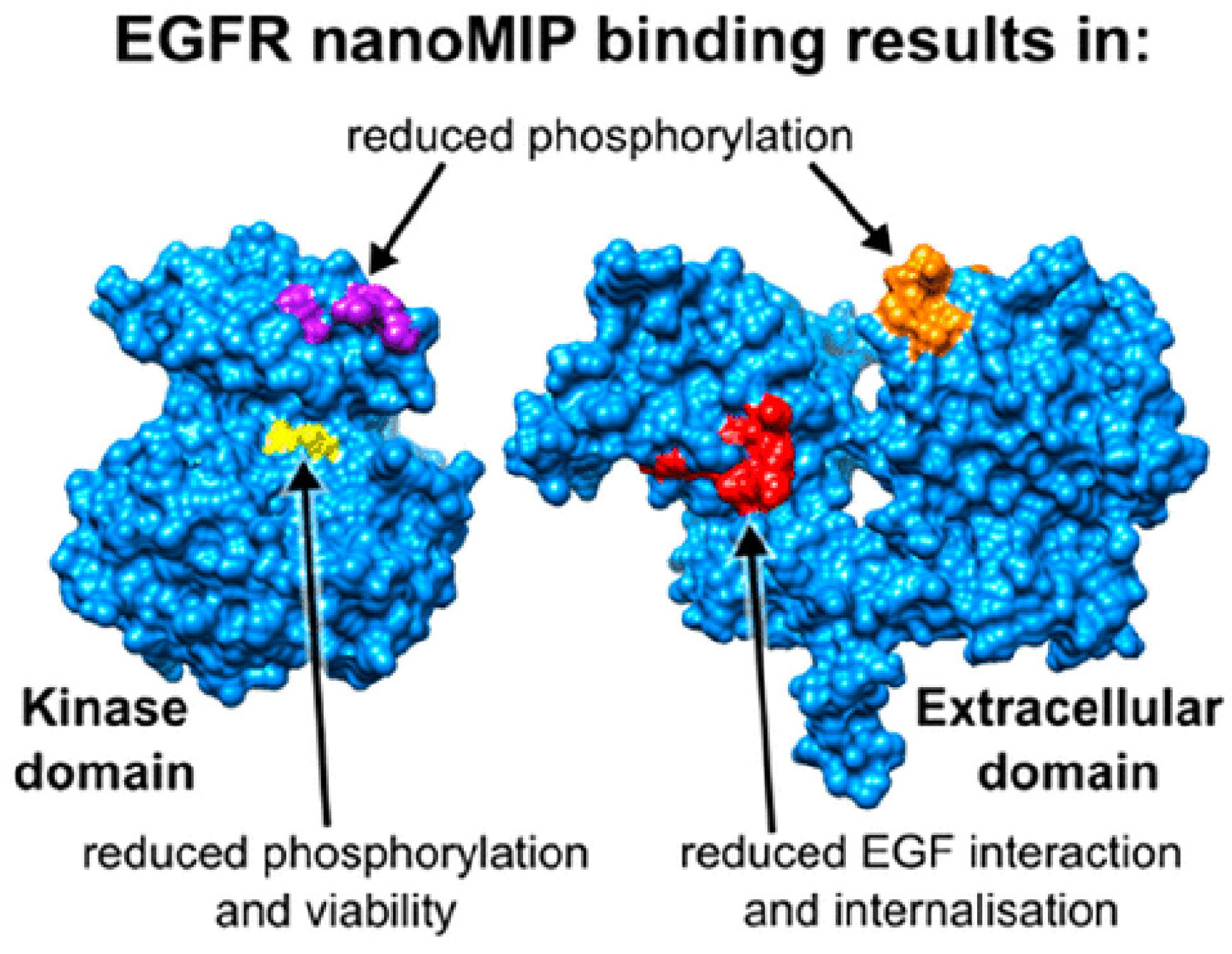
In recent years, molecularly imprinted polymer nanoparticles (nanoMIPs) have proven to be an attractive alternative to antibodies in diagnostic and therapeutic applications. However, several key questions remain: how suitable are intracellular epitopes as targets for nanoMIP binding? And to what extent can protein function be modulated via targeting specific epitopes? To investigate this, three extracellular and three intracellular epitopes of epidermal growth factor receptor (EGFR) were used as templates for the synthesis of nanoMIPs which were then used to treat cancer cells with different expression levels of EGFR. It was observed that nanoMIPs imprinted with epitopes from the intracellular kinase domain and the extracellular ligand binding domain of EGFR caused cells to form large foci of EGFR sequestered away from the cell surface, caused a reduction in autophosphorylation, and demonstrated effects on cell viability. Collectively, this suggests that intracellular domain-targeting nanoMIPs can be a potential new tool for cancer therapy.
Article text (excluding photos or graphics) © Imperial College London.
Photos and graphics subject to third party copyright used with permission or © Imperial College London.
Reporter
Professor Alan C Spivey
Department of Chemistry