Partner spotlight: Dr Christian Holtze from chemical company BASF
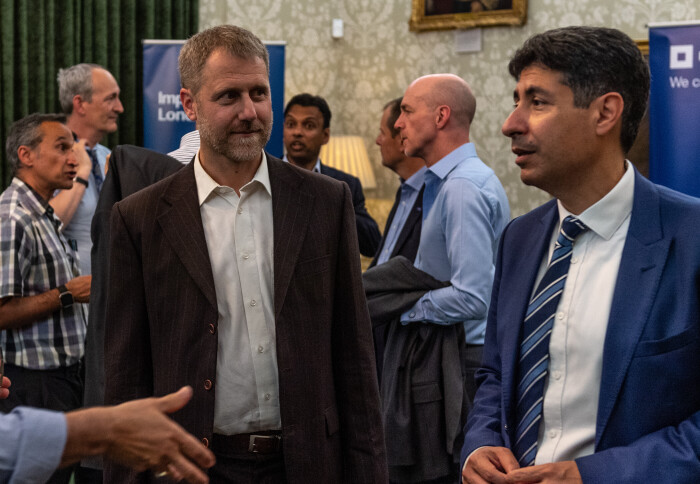
BASF's Dr Christian Holtze (left) with Professor Omar Matar
A community of researchers from Imperial and BASF, the world's largest chemical company, aims to make the chemical industry sustainable and resilient.
A key focus of the partnership is developing flow chemistry, a technique that provides very finely controlled conditions for continuous chemical reactions, particularly at the smaller scales needed for R&D and small scale production. The team is working to translate the research into new technologies through a variety of routes, including transfer to BASF, collaboration with other industrial partners, and commercialisation with investors.
We asked Dr Christian Holtze, Principal Scientist Flow Chemistry and Academic Partnerships Developer at BASF, to provide an inside look at the collaboration.
What does BASF aim to achieve by working with Imperial?
At present, the world’s supply of chemicals is produced by a handful of world-scale plants. But distributed production could reduce cost and mitigate supply chain risks.
Sustainability is a key challenge for the chemical industry, and BASF is focusing on this with its research activities. This involves reducing the carbon footprint of our products and advancing the circular economy, as well as developing new processes that avoid using hazardous solvents and minimising undesired by-products. All research at BASF needs to show a positive effect on sustainability, otherwise it will not get funded.
At present, the world’s supply of chemicals is produced by a handful of so-called world-scale chemical plants. This approach is driven by economies of scale and enabled by the inexpensive availability of fossil feedstocks almost anywhere. But by diversifying manufacturing processes and exploring alternative feedstocks, the chemical industry can reduce its dependency on fossil fuels and enhance its resilience.
Regional and distributed production at smaller scales could become a manufacturing concept for the future: It can reduce cost, delays, and emissions of shipping, and mitigate supply chain risks. For the UK, this could improve resilience and nucleate novel value chains in the chemical sector.
Why work with a university on these challenges?
At BASF about 10,000 employees are involved in R&D. The additional research we’re doing with Imperial is transformational, and longer-term than we usually do in our internal research.
The research we’re doing with Imperial is transformational, and longer-term than we usually do in our internal research.
We’re starting out with academically exciting concepts and surprising discoveries, and evolving these into research programmes that combine competence from the excellent departments at Imperial in an interdisciplinary and convergent way. We’re then building clusters to take forward and translate our innovations. One example is a new enzymatic technique that Mimi Hii [Professor of Catalysis] is developing for very selectively synthesising valuable chemicals in flow for flavours and fragrances, crop protection and pharmaceuticals.
What drew you to Imperial in particular?
One thing that is particular about Imperial is the importance of digital competences – every student is doing some modelling, lab automation, coding – and an interdisciplinary and pragmatic mindset.
BASF has academic research alliances on every continent. But we only have a few very important strategic partnerships, and Imperial is our largest single academic partner.
In setting up a partnership, the first thing you do is look for a match between the needs of your organisation and the competence of the partners. Imperial does excellent research in chemistry, chemical engineering and computing, and – as we have discovered recently – in process systems engineering.
One thing that is particular about Imperial is the importance of digital competences in education and research – every student is doing some modelling, lab automation, coding – and an interdisciplinary and pragmatic mindset for translating research into something that is useful. I’m working with excellent, dedicated people, and getting the chance to make an impact through innovation, technology transfer, and supporting researchers to build successful careers. It is this focus on translation that distinguishes Imperial from most other universities.
How do you structure a partnership to address big research challenges?
Before we developed our current partnership model with Imperial, BASF’s research alliances focused on postdoctoral research, since postdocs have the advanced skills needed to deliver results in just one or two years. But I discovered there are also fantastic opportunities to start longer term interactions by supporting PhD students under the framework of Imperial’s Centres for Doctoral Training and cross-departmental research clusters.
The PhD model is suitable if we are venturing into a new field that we have a gut feeling will be interesting but is unknown territory.
The PhD model is suitable if we are venturing into a new field that we have a gut feeling will be interesting but is unknown territory. In this respect, our PhD clusters are complementary to postdoc collaborations, as they offer a more generous time-frame, the cost is lower, and the challenges can be more fundamental. By bringing together our own scientists, and Imperial academics and PhD students, we can tackle more transformational challenges and embark on longer term research. We found that in many cases, exciting results are produced that justify continuing research in that area way beyond the a specific PhD studentship, often in the framework of a postdoc collaboration.
Why is partnering with other organisations important?
BASF and Imperial are interested in open innovation. We’re delivering this through a consortium of companies that bring in their needs and expertise at different stages along the chemical value chain. With such open innovation, this type of consortium can be very attractive if the public sector is also involved, as it can link up the various parts of the value chain.
Translation opportunities can go beyond the direct transfer into BASF – they can result in spinning out companies like the Imperial-BASF joint startup SOLVE.
We then speak about the triple helix – government, industry, and academia. These partnerships are all underpinned by a collaborative atmosphere and culture that facilitates delivery. This allows us to think about commercialising our innovations in various ways. Translation opportunities can go beyond the direct transfer into BASF – they can result in spinning out companies like the Imperial-BASF joint startup SOLVE. They can also result in joint development of novel technologies by partners in different sectors, for example with partners from the pharmaceutical sector.
BASF’s partnership with Imperial is a prime example of how open innovation can complement internal industrial R&D to drive transformative innovation, leading to industrial deployment, commercial translation, and real-world impact.
Learn more about Imperial's support for industry from Imperial Enterprise and sign up here for updates and exclusive content in our industry newsletter.
Article supporters
Article text (excluding photos or graphics) © Imperial College London.
Photos and graphics subject to third party copyright used with permission or © Imperial College London.
Reporter
David Silverman
Communications Division
