Researchers create advanced models to guide Antarctic krill management
Researchers from Imperial College London have developed advanced models which are shaping shaping krill conservation efforts in the Antarctic.
Launched in October 2023, Imperial College London joined forces with the British Antarctic Survey to launch the Turner Kirk Trust Antarctic Krill Project, backed by a £35,000 grant from the Turner Kirk Charitable Trust.
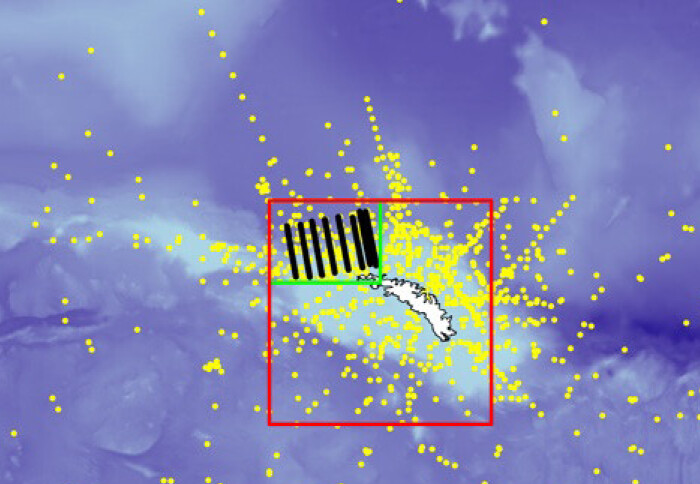
Imperial's researchers spearheaded the development of advanced spatio-temporal models to map krill distribution across the Southwest Atlantic’s CCAMLR Area 48, home to 70% of the world’s krill stock.
Antarctic krill are vital for carbon sequestration and the Southern Ocean ecosystem. Climate change is forcing them southward, disrupting food chains and fisheries.
Using acoustic data, satellite imagery, and drifting buoys, the team of researchers - which included Dr Emma Cavan (Department of Life Sciences), Dr Adam Sykulski and André Victor Ribeiro Amaral (Department of Mathematics) - developed advanced models to improve predictions of krill abundance and inform decision-making for krill management.
This approach has already yielded significant insights into retention, dispersal, and movement pathways of krill swarms around South Georgia Island, a critical region for understanding ecosystem dynamics.
Two PhD projects will further explore krill’s role in carbon storage and ocean dynamics, with future research expanding to broader climate impacts.
Discover more about this project's impact on the Turner Kirk Trust website.
Read more about Imperial's partnership with the Turner Kirk Trust.
Article text (excluding photos or graphics) © Imperial College London.
Photos and graphics subject to third party copyright used with permission or © Imperial College London.
Reporter
Press Office
Communications and Public Affairs
- Email: press.office@imperial.ac.uk