Shedding light on how bacteria and glycans interact in reproductive health

Cutting-edge glycan microarray technology reveals how beneficial and harmful bacteria interact with sugar molecules in the vaginal tract.
"Our findings offer the first detailed insight into these complex glycan-bacteria interactions and open the door to broader microbiome research, not just for women’s health, but across diverse biological systems.” Dr. Yan Liu Associate Professor in Glycosciences in the Department of Metabolism, Digestion and Reproduction and joint corresponding author
Led by researchers from the Department of Metabolism, Digestion and Reproduction, a new study presents the first detailed analysis of the diverse set of sugar molecules, or glycans, recognised by harmful and beneficial bacteria in the vaginal niche.
The study, published in Nature Communications and titled “Identification and characterisation of vaginal bacteria–glycan interactions implicated in reproductive tract health and pregnancy outcomes”, provides novel insights into bacteria competition mechanisms within the vaginal microenvironment, and reveals how these interactions influence their ability to colonise in this niche.
Speaking about the research, Dr. Virginia Tajadura-Ortega, first and joint corresponding author, said: “Understanding how glycans enable microorganisms to get a foothold in the vaginal microbiome offers new, exciting avenues for therapeutic design to prevent or encourage their binding and colonisation and hence improve women's health outcomes.”
Understanding the glycan binding features of the vaginal microbiome
The vaginal microbiome, the community of bacteria that lives in the vaginal tract, plays a vital role in protecting against infections and supporting reproductive health. When beneficial bacteria such as Lactobacillus are lost, the risk of complications like bacterial vaginosis, sexually transmitted infections, and even preterm birth increases.
While it’s long been known that bacteria attach to glycans found on vaginal cells, which glycans they bind to and how this affects bacterial behaviour has remained poorly understood.
Using a custom-built glycan microarray, the team was able to mimic the vaginal glycan landscape and systematically test how different bacteria interact with it.
The study uncovered several key findings:
- Different bacteria bind to different sugars: Pathogens like E. coli, Streptococcus agalactiae(group B Streptococcus), and Fusobacterium nucleatum showed distinct glycan preferences compared to beneficial species like Lactobacillus crispatus. This may help explain why some bacteria thrive while others don’t.
- Vaginal pH affects bacterial binding: Changes in pH within the reproductive tract, or when the microbiome is disrupted, can alter how strongly bacteria attach to glycans, potentially increasing infection risk.
- Beneficial bacteria can block pathogens: Lactobacillus species were found to compete with harmful bacteria for key glycans, helping protect the vaginal environment.
- A new research tool: The microarray platform implemented by the team can screen whole bacterial cells of pathogenic and probiotic strains, guiding the design of glycan-based diagnostics and therapeutics to promote women’s health.
Dr. Yan Liu, Associate Professor in Glycosciences in the Department of Metabolism, Digestion and Reproduction, and joint corresponding author, said: “It has been a great team effort by members of the March of Dimes Prematurity Research Centre and the Carbohydrate Microarray Facility at Imperial. Our findings offer the first detailed insight into these complex glycan-bacteria interactions and open the door to broader microbiome research, not just for women’s health, but across diverse biological systems.”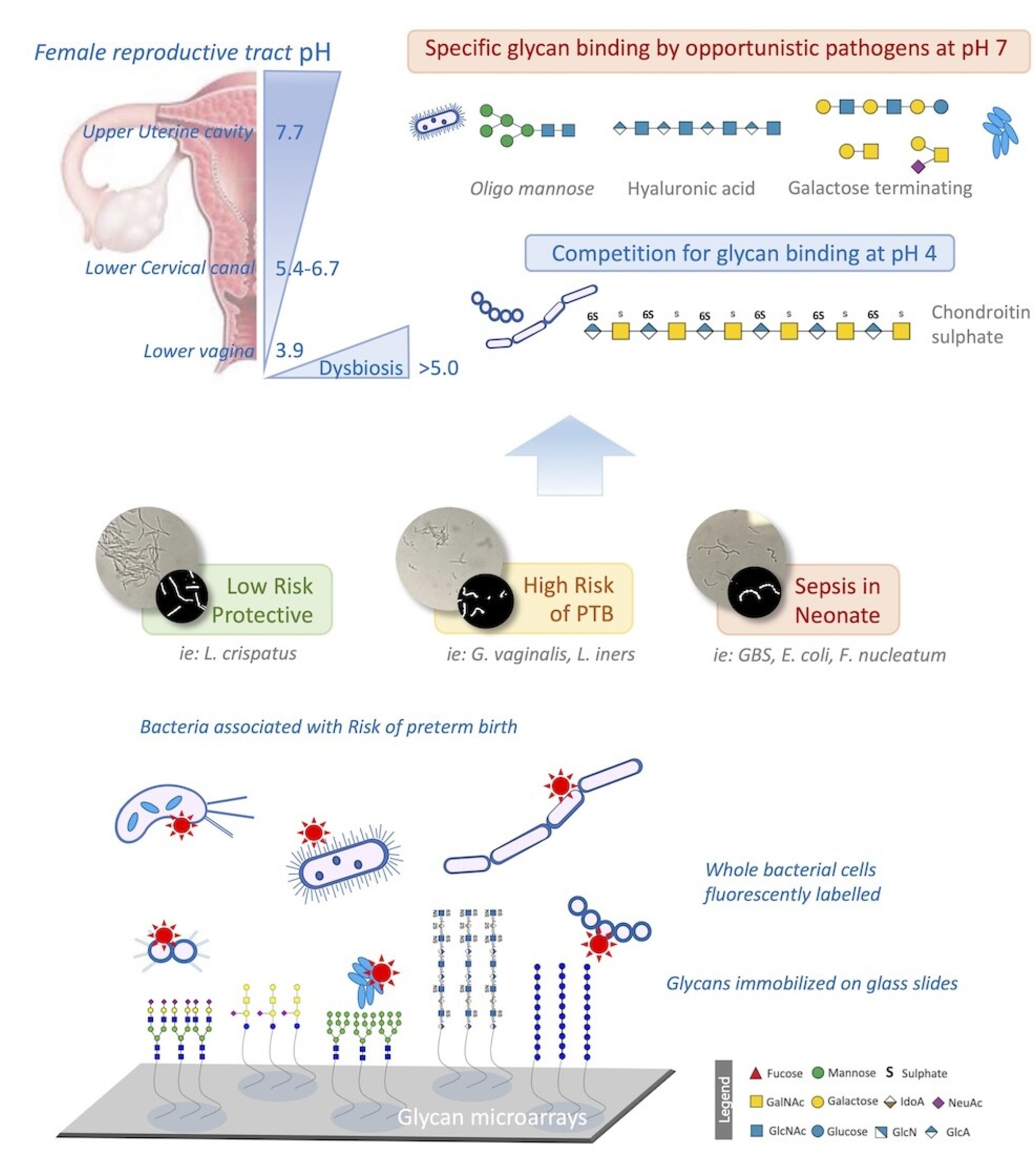
Next steps and broader impact
While the glycan microarray platform provides a powerful tool to study bacterial binding, it doesn’t fully replicate the complexity of living environments. The researchers are now working on more advanced microarrays using mucins, complex molecules found in vaginal fluid, to better reflect real biological conditions.
They are also investigating how bacteria modify the glycans they bind to, and how these changes affect immune responses and microbial competition over time.
This research marks an important step toward understanding how microbes interact with the human body at a molecular level. By revealing how bacteria bind to specific sugar molecules in the vaginal environment, the findings could inform the development of probiotic or glycan-based therapies to support a healthy microbiome, tools to assess infection risk or personalise treatments, and strategies to reduce adverse pregnancy outcomes, such as preterm birth. These insights also pave the way for further glycan-focused studies aimed at advancing microbiome-related health interventions.
Tajadura-Ortega, V., Chai, W., Roberts, L.A. et al. Identification and characterisation of vaginal bacteria-glycan interactions implicated in reproductive tract health and pregnancy outcomes. Nat Commun 16, 5207 (2025). https://doi.org/10.1038/s41467-025-60404-1
Article text (excluding photos or graphics) © Imperial College London.
Photos and graphics subject to third party copyright used with permission or © Imperial College London.
Reporter
Benjie Coleman
Department of Surgery & Cancer