Best Paper Award – another step for ‘Unlimited Sensing’
by Jane Horrell
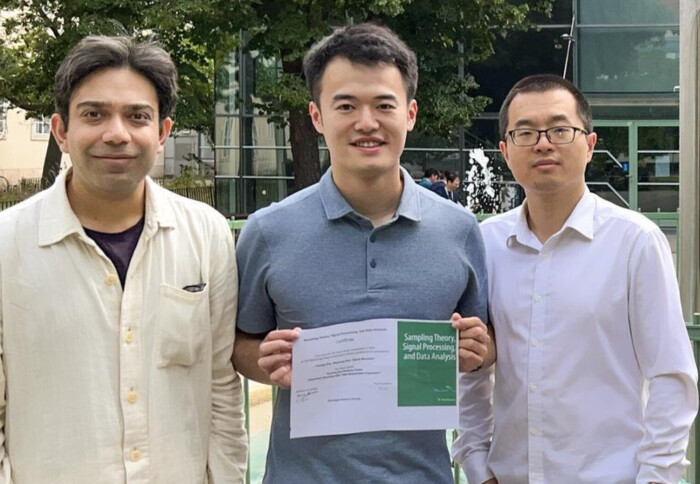
(l-r) Ayush, Yuliang and Ruiming at the conference in Vienna
A team of EEE researchers has won a Best Paper Award at the 2025 Sampling Theory and Applications (SampTA) conference.
The paper, Ironing the Modulo Folds: Unlimited Sensing with 100× Bandwidth Expansion, is authored by PhD student Yuliang Zhu, postdoctoral researcher Dr Ruiming Guo, and principal investigator Dr Ayush Bhandari.
It demonstrates how a combined hardware-and-algorithm approach can extend the effective sensing bandwidth of modulo analogue-to-digital converters by a factor of 100.
Why it matters
Digital data capture is the backbone of modern electronic systems. Every digital device that senses the world – whether it’s a camera, a medical scanner or a microphone — relies on an analogue-to-digital converter (ADC). These tiny chips convert real-world analogue signals like sound, light or voltage into digital information that computers can store and process.
The research in the award-winning paper builds on more than five years of work in Unlimited Sensing — a radically new framework for acquiring and digitising signals that overcomes fundamental limitations of conventional technology. By enabling higher precision and accommodating arbitrarily large signals, Unlimited Sensing has delivered significant advances, including greater sensitivity in radar and medical imaging, as well as demonstrated benefits for communication systems.
These converters face a fundamental constraint: with a fixed number of bits to work with. Dr Bhandari explains: “Traditionally, ADCs implement the Shannon-Nyquist sampling theorem to digitise signals. However, for a fixed bit budget, they face a fundamental limitation: a trade-off between dynamic range and digital resolution. The Unlimited Sensing Framework (USF) offers a paradigm shift. Rather than treating round-off errors as noise, USF leverages them — via what we call analogue modulo folding — as meaningful encodings that can be algorithmically reconstructed during signal recovery.”
Much like twirling a long strand of spaghetti around a fork, the USF ‘folds’ signals that exceed an ADC’s limit into smaller, wrapped signatures known as modulo signals, as demonstrated in this video.

The innovative hardware captures only the sensitive decimal part of each measurement, discarding the integer portion. A dedicated mathematical algorithm then reconstructs the missing integers from these folded decimal signals, producing conventional digital outputs that existing sensors can read — enabling the capture of far wider ranges of data.
‘Folding’ the signal – from theory to reality
In 2017, the team showed — theoretically at least — that radically new method of digitalisation via modulo folding was possible mathematically.
Then in a key development in 2021, Dr Bhandari and colleagues developed custom hardware capable of performing modulo folding, and allowing ADCs to process a much wider range of information than previously possible. “This established that Unlimited Sensing was not only mathematically viable but also technologically feasible.”
The 2025 study takes this concept further, showing that bandwidth limitations can be overcome not by investing in more precise and expensive hardware, but by shifting the focus to sophisticated mathematical models and algorithms — unlocking new capabilities through purely computational advances.
Pushing hardware beyond limits
By combining their novel, custom-built modulo ADCs with new mathematical models and recovery algorithms, they were able to ‘iron out the folds’ in the signal and accurately capture frequencies far beyond the nominal specifications of the ADC hardware — achieving a 100-fold expansion in bandwidth.
“This breakthrough allows accurate acquisition of high-dynamic-range signals without increasing bit depth. By effectively packing more information into each bit, USF naturally enhances the performance of signal processing algorithms. For the same given hardware, we can push the bandwidth by 100x,” said Dr Bhandari. “For instance, we can grab a signal with 100 kHz frequency while the ADC only supports 1 kHz.”
Their contribution includes a theoretical model of non-linear sensing behaviour, a sampling theorem with provable recovery guarantees, and experimental validation using custom-built hardware.
Dr Bhandari says there’s exciting potential for this latest advance: “The paper highlights the power of computational sensing and algorithm–hardware co-design to overcome long-standing bottlenecks in digital acquisition, opening up new possibilities in areas such as radar, communications, and imaging.”
The work was supported by the ERC-funded CoSI-Fold project (Making the Invisible Visible: Computational Sensing and Imaging via Folding Non-Linearities).
Dr Bhandari’s contributions to computational sensing and imaging have been recognised with the 2019 UKRI Future Leaders Fellowship, the 2020 IEEE Best PhD Dissertation Award (Signal Processing Society), and the 2021 President's Medal for Outstanding Early Career Researcher at Imperial and the 2023 Frontiers of Science Award.
Marking its 30th anniversary in 2025, SampTA is a leading biennial conference bringing together mathematicians, engineers and applied scientists to share advances in sampling theory and explore new directions in signal and image processing, compressed sensing, coding theory, control systems, computational neuroscience, and information theory.
Article text (excluding photos or graphics) © Imperial College London.
Photos and graphics subject to third party copyright used with permission or © Imperial College London.
Reporter
Jane Horrell
Department of Electrical and Electronic Engineering