Virtual reality brings back extinct birdsong at Big Bang Fair
by Emily Govan
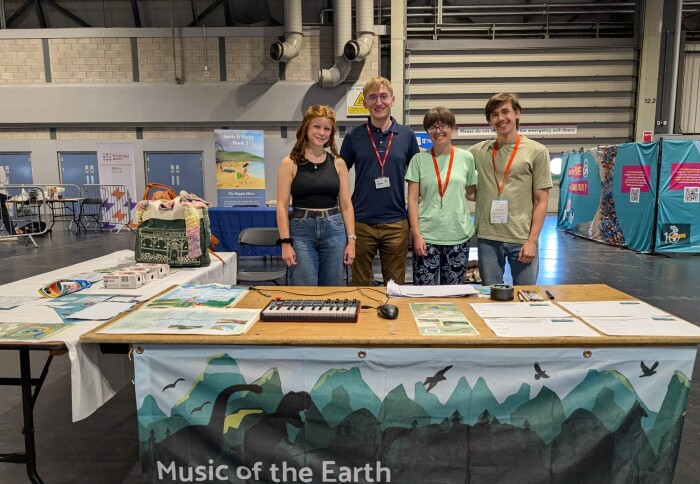
Imperial students brought immersive soundscapes to the UK’s largest STEM fair, showing how biodiversity loss has transformed our planet’s sounds.
Each year, Science and Solutions for a Changing Planet (SSCP) DTP PhD students from the Grantham Institute take part in ‘Challenge Teams’, where cohorts organise outreach and engagement projects focused on the environment and sustainability.
This year, a team including students from the Department of Life Sciences, Sam Orchard, Mili Ostojic, Natasha Granville, and Xiuhan Zhang, created Music of the Earth, a project using VR and recordings of natural soundscapes to educate young people about biodiversity loss, changes in natural soundscapes over time, and their connection with natural spaces.
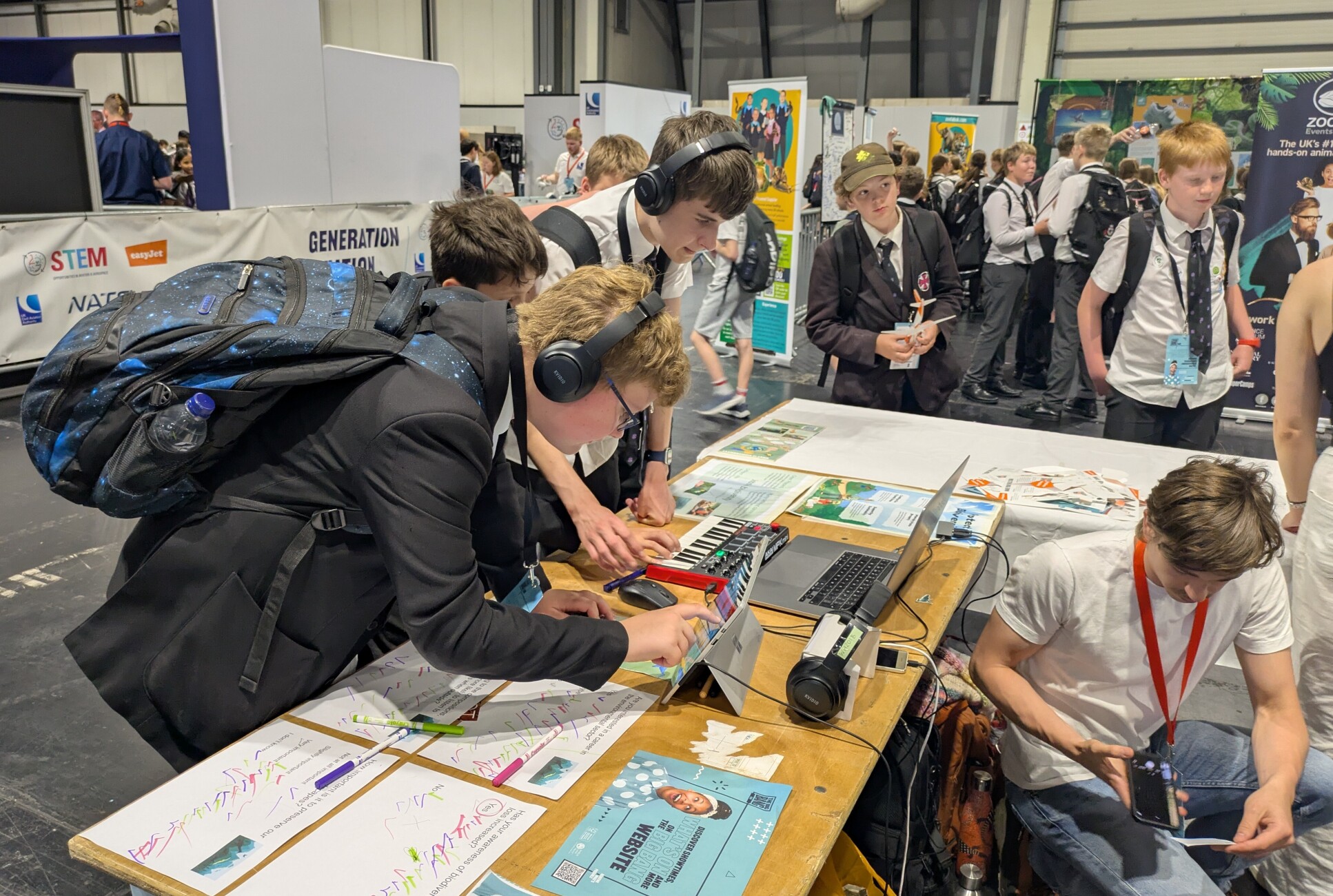
The team brought the project to the Big Bang Fair, the UK’s largest STEM fair for young people, where it drew a huge turnout. Over three days, students visited the stall to explore biodiversity loss, experience immersive VR soundscapes, and discuss future careers in research and the environmental sector.
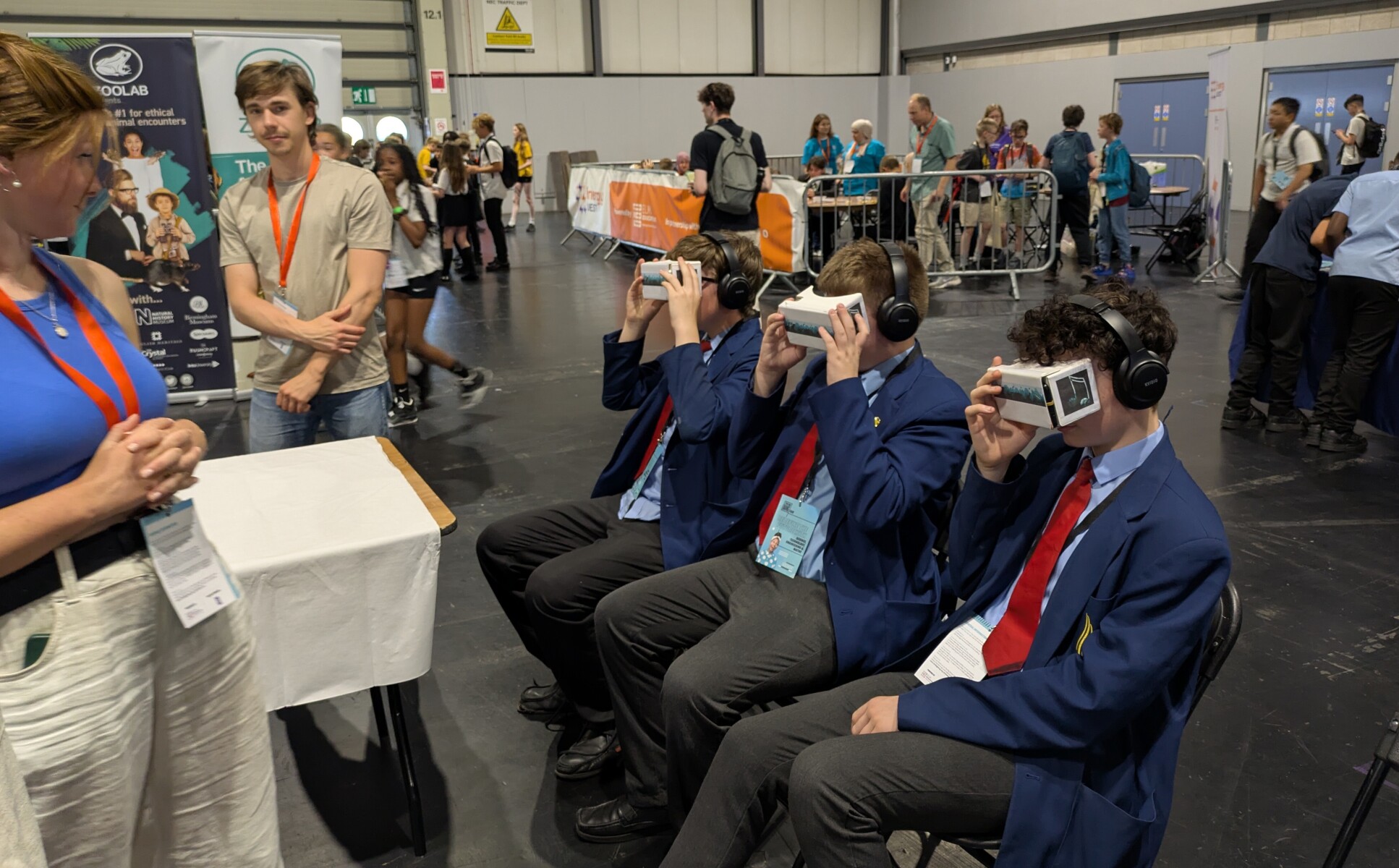
By stepping into the VR experience, visitors could hear how human activity has transformed natural soundscapes - a unique perspective that sets the stage for a deeper conversation about conservation and the environment.
We caught up with Sam Orchard to learn more about the project, its VR experience, and why bringing biodiversity to life for young people is so important.
What is the core message of Music of the Earth?
Music of the Earth aims to show how natural soundscapes have changed over time due to urbanisation and biodiversity loss, and to encourage students to conserve wildlife and protect our environment.
"Giving young people, particularly those with limited access to nature, an understanding and appreciation of the natural world equips them with the knowledge and motivation to tackle sustainability challenges in the future." Sam Orchard PhD Student
Why is it important to bring this project to young people, especially in a STEM context?
Environmental and climate conservation are among the most pressing issues of our time. Giving young people, particularly those with limited access to nature, an understanding and appreciation of the natural world equips them with the knowledge and motivation to tackle sustainability challenges in the future. STEM skills are invaluable in this field, enabling people to develop innovative solutions and interpret data, both crucial for addressing the climate crisis. This project demonstrates how technology and STEM can play a vital role in conservation.
What do you hope students take away from the experience?
We hope the activities give students a greater appreciation of the sounds of nature and the role biodiversity plays in creating rich, inspiring soundscapes. By understanding biodiversity loss and the benefits of spending time in nature, we aim to inspire them to protect the environment and enjoy spending more time outdoors.
How does the project link natural soundscapes to biodiversity loss and climate change?
The project includes soundscapes adapted with calls from extinct birds whose habitats were lost due to climate change and human impacts. We designed the soundscapes as a ‘journey through time’ to illustrate how biodiversity loss has drastically altered what we hear in nature. The VR experience offers a unique perspective on soundscapes that can no longer be experienced in the wild.
What research underpins the soundscapes used in the VR experience?
While the project itself isn’t direct research, it draws heavily on the team’s PhD work. Both Mili Ostojic and I work in the Ecosystem Sensing group led by Dr Sarab Sethi, using sound and acoustics to monitor species distribution and behaviour. This naturally informed the focus on changing soundscapes and biodiversity loss.
Are the sound recordings from specific locations or ecosystems? How were they collected?
The sounds were collected from a variety of landscapes to capture the contrast between natural and urban environments. Recordings were taken from forests, mountains, lakes, central London, and urban green spaces like London parks. Team members also captured 360° photos to accompany the soundscapes. Historical sounds of extinct birds were sourced from the Macauley Library at Cornell University to create a ‘journey through time’.
What was the response from young people at the fair?
The response was overwhelmingly positive. Students were eager to engage with all the activities and found VR a fun and immersive way to explore the contrast between natural and urban soundscapes. Many noted they preferred the calm of natural soundscapes to the noise of the city. Students were excited to learn they had been hearing bird calls that no longer exist in the wild. An additional activity letting students compose music from extinct bird sounds was also very popular and seemed to deepen their understanding of biodiversity loss.
Do you see this project influencing how environmental issues are taught in schools?
We hope it does. Engaging with nature through the senses offers learning experiences that lectures or reading alone cannot provide. This is especially important for students from urban areas with limited access to green spaces. Using technology in this way allows students who are disconnected from nature to experience and learn about their environment in a more interactive and engaging way.
Article text (excluding photos or graphics) © Imperial College London.
Photos and graphics subject to third party copyright used with permission or © Imperial College London.
Reporter
Emily Govan
Department of Life Sciences
