Imperial engineers recognised with major thermophysics award
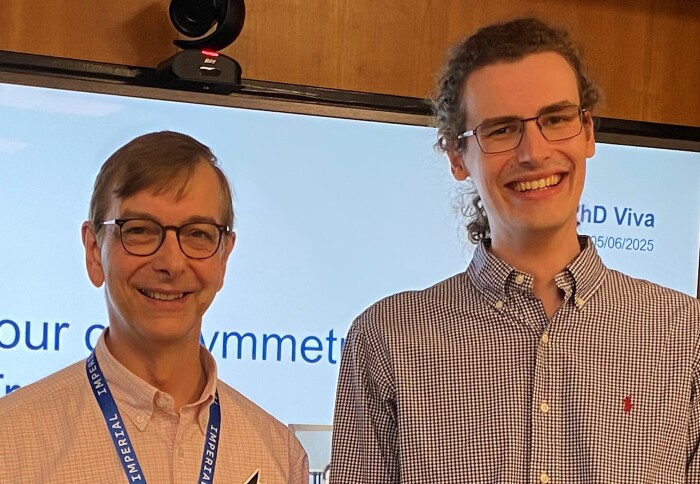
Professor J. P. Martin Trusler and Dr Riley V. Latcham jointly awarded the 2025 Ared Cezairliyan Best Paper Award.
Their paper, “Phase Behavior of Isobutane + CO₂ and Isobutane + H₂ at Temperatures Between 190 and 400 K and at Pressures Up to 20 MPa” (Int J Thermophys, 45:13, 2024), was selected for its outstanding contribution to the understanding of thermophysical properties under extreme conditions.
Fundamentally, this award recognises Riley’s outstanding, careful and insightful PhD research. J. P. Martin Trusler Professor of Thermophysics, Department of Chemical Engineering
Commenting on the paper, Professor Trusler said: "Fundamentally, this award recognises Riley’s outstanding, careful and insightful PhD research; it’s been a huge pleasure to have him working with us."
The awarded paper introduces new experimental data and advanced modelling (via the Peng–Robinson equation of state), providing critical insights into isobutane-based mixtures.
These findings have immediate implications for refrigeration systems, hydrogen transport, and high-pressure fluid technologies.
Ared Cezairliyan Award
Named after the founding editor, the Ared Cezairliyan Award celebrates exceptional thermophysics research. This year’s prize was selected from over 170 submissions published in 2024. Winners receive a €1,500 cash prize and will be formally presented with the award at the 2025 Asian Thermophysical Properties Conference, taking place in October 2025 in Shanghai.
About the authors
Dr Riley V. Latcham
Riley’s research focuses on thermodynamic characterisation and computational modelling of complex fluid mixtures. He holds an MEng in Chemical Engineering from Imperial and has co-authored multiple peer-reviewed publications.
Professor J. P. Martin Trusler FREng
A leading expert in thermophysical measurements, Professor Trusler leads Imperial’s high-pressure fluids group. He is a Fellow of the Royal Society of Chemistry and an Associate Fellow of the IChemE and has published extensively on fluid phase behaviour under extreme conditions.
Article text (excluding photos or graphics) © Imperial College London.
Photos and graphics subject to third party copyright used with permission or © Imperial College London.
Reporter
Navta Hussain
Department of Chemical Engineering
