Mars’s interior more like Rocky Road than Millionaire’s Shortbread
by Simon Levey

New research by Imperial and NASA reveals the Red Planet’s mantle preserves a record of its violent beginnings.
The inside of Mars isn't smooth and uniform like familiar textbook illustrations.
Instead, new research reveals it's chunky - more like a Rocky Road brownie than a neat slice of Millionaire's Shortbread.
We often picture rocky planets like Earth and Mars as having smooth, layered interiors - with crust, mantle, and core stacked like the biscuit base, caramel middle, and chocolate topping of a millionaire's shortbread. But the reality for Mars is rather less tidy.

Seismic vibrations detected by NASA's InSight mission revealed subtle anomalies, which led scientists from Imperial College London and other institutions to uncover a messier reality: Mars's mantle contains ancient fragments up to 4km wide from its formation - preserved like geological fossils from the planet's violent early history.
History of gigantic impacts
Mars and the other rocky planets formed about 4.5 billion years ago, as dust and rock orbiting the young Sun gradually clumped together under gravity.
Once Mars had largely taken shape, it was struck by giant, planet-sized objects in a series of near-cataclysmic collisions - the kind that also likely formed Earth's Moon.
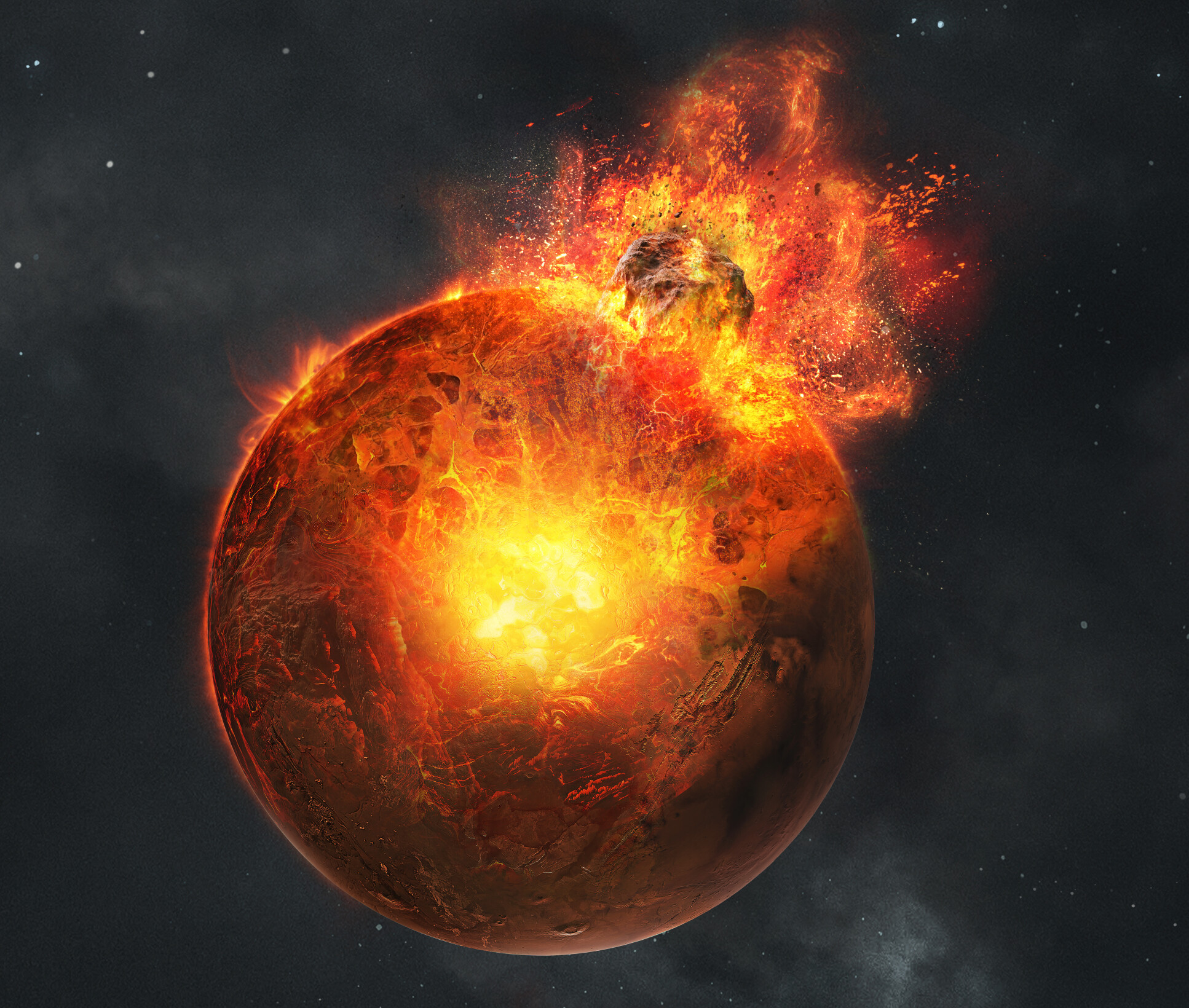
"These colossal impacts unleashed enough energy to melt large parts of the young planet into vast magma oceans," said Dr Constantinos Charalambous from the Department of Electrical and Electronic Engineering at Imperial College London.
"As those magma oceans cooled and crystallised, they left behind compositionally distinct lumps of material - and we believe it's these we're now detecting deep inside Mars."
Most of this chaos likely unfolded in Mars's first 100 million years Dr Constantinos Charalambous
These early impacts and their aftermath scattered and mixed fragments of the planet's early crust and mantle - and possibly debris from the impacting objects themselves - into the molten interior. As Mars slowly cooled, these chemically diverse lumps were trapped in a sluggishly churning mantle, like ingredients folded into a Rocky Road brownie mix, and the mixing was too weak to fully smooth things out.
Unlike Earth, where plate tectonics continuously recycle the crust and mantle, Mars sealed up early beneath a stagnant outer crust, preserving its interior as a geological time capsule.
"Most of this chaos likely unfolded in Mars's first 100 million years," says Dr Charalambous. "The fact that we can still detect its traces after four and a half billion years shows just how sluggishly Mars's interior has been churning ever since."
Listening into Mars
The evidence comes from seismic data recorded by NASA's InSight lander - in particular, eight especially clear marsquakes, including two triggered by two recent meteorite impacts that left 150-metre-wide craters in Mars's surface.
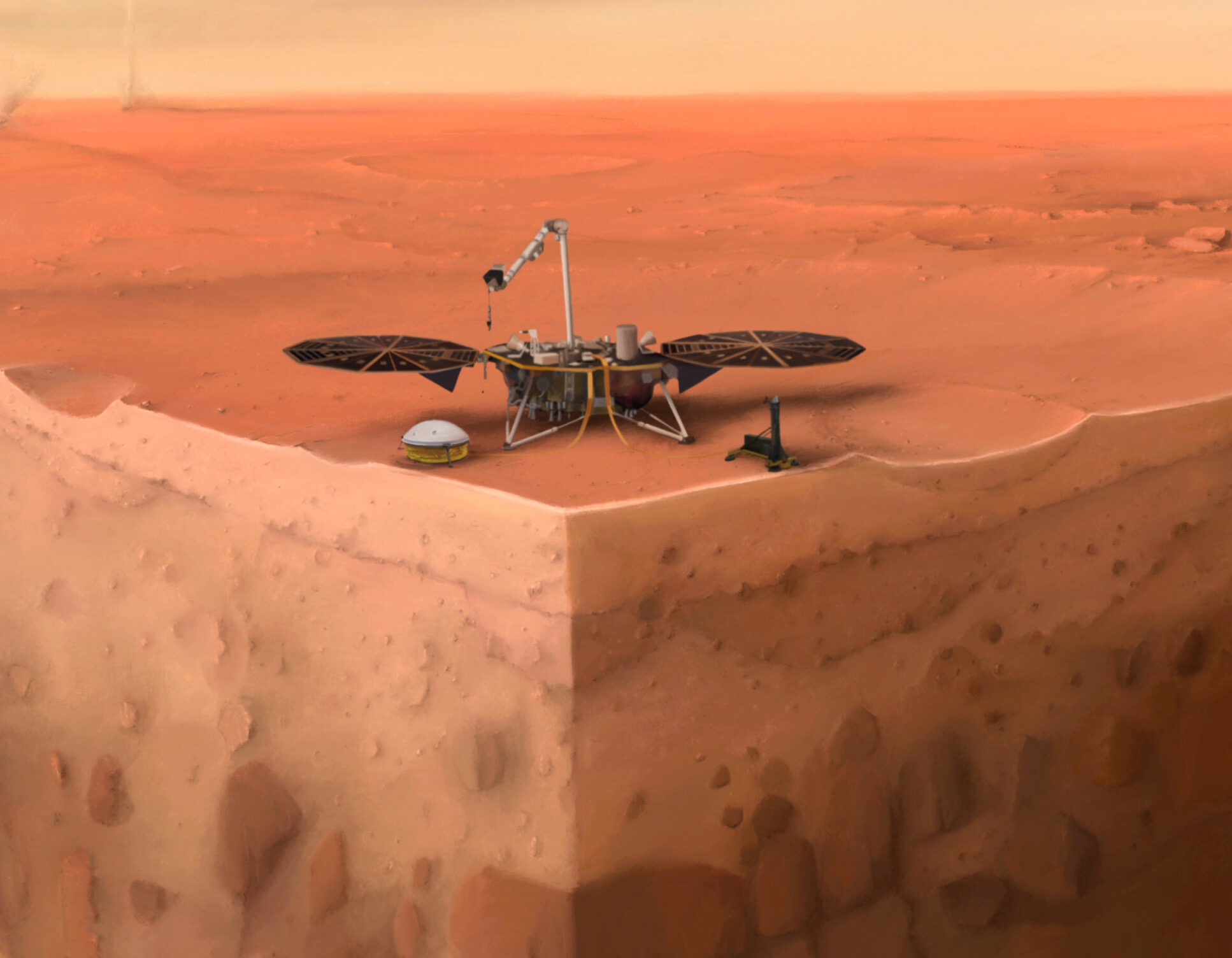
InSight picks up seismic waves travelling through the mantle and the scientists could see that waves of higher frequencies took longer to reach its sensors from the impact site. These signs of interference, they say, shows that the interior is chunky rather than smooth.
"These signals showed clear signs of interference as they travelled through Mars's deep interior," said Dr Charalambous. "That's consistent with a mantle full of structures of different compositional origins - leftovers from Mars's early days."
"What happened on Mars is that, after those early events, the surface solidified into a stagnant lid," he explained. "It sealed off the mantle beneath, locking in those ancient chaotic features — like a planetary time capsule."
Unlike the interior of Earth
Earth's crust, by comparison, is always slowly shifting and recycling material from the surface into our planet's mantle – at tectonic plates such as the Cascadia subduction zone where some of the plates forming the Pacific Ocean floor are pushed under the North American continental plate.
The lumps detected in Mars's mantle follow a striking pattern, with a few large fragments - up to 4 km wide - but many smaller ones.
It's exciting to see scientists making new discoveries with the quakes we detected! Dr Mark Panning NASA's Jet Propulsion Laboratory
Professor Tom Pike, who worked with Dr Charalambous to unravel what caused these lumps, said: "What we are seeing is a 'fractal' distribution, which happens when the energy from a cataclysmic collision overwhelms the strength of an object. You see the same effect when a glass falls onto a tiled floor as when a meteorite collides with a planet: it breaks into a few big shards and a large number of smaller pieces. It's remarkable that we can still detect this distribution today."
The finding could have implications for our understanding of how the other rocky planets - like Venus and Mercury - evolved over billions of years. This new discovery of Mars's preserved interior offers a rare glimpse into what might lie hidden beneath the surface of stagnant worlds.
Co-author Carys Bill, a second year PhD researcher in the Department of Earth Science and Engineering who contributed to the data analysis during her Master’s, said: “Even with the rich seismic data we have about the Earth, the high levels of moisture within our planet means signals are absorbed before they can reach deep inside. That means we can’t tell for sure if Earth’s mantle hides similar preserved lumps - or if Mars’s interior is truly different. Having this insight into Mars is therefore a rare window into the hidden workings of rocky planets.”
"InSight's data continues to reshape how we think about the formation of rocky planets, and Mars in particular," said Dr Mark Panning of NASA's Jet Propulsion Laboratory in Southern California. JPL led the InSight mission before its end in 2022. "It's exciting to see scientists making new discoveries with the quakes we detected!"
--
"Seismic evidence for a highly heterogeneous Martian mantle" by Charalambous, C et al., is published in the journal Science. It can be accessed via the DOI: 10.1126/science.adk4292
Article supporters
Article text (excluding photos or graphics) © Imperial College London.
Photos and graphics subject to third party copyright used with permission or © Imperial College London.
Reporter
Simon Levey
Communications Division