Centre for Bacterial Resistance Biology scientist recognised by Princess Royal
by Emily Govan
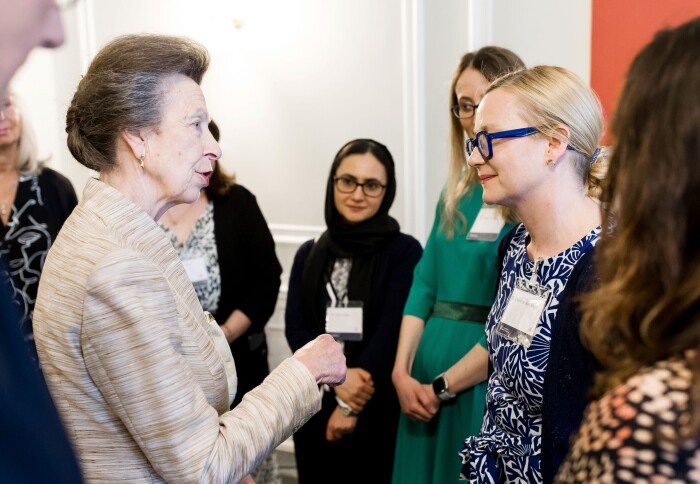
Dr Charlotte-Eve Short was recognised by Her Royal Highness the Princess Royal during the Academy of Medical Sciences’ Helix Reception.
Dr Short is a Clinical Associate Professor in HIV and GU Medicine in the Department of Infectious Disease and Centre for Bacterial Resistance Biology, and a participant in the Academy’s SUSTAIN programme. The event marked 10 years of donor support advancing biomedical research and policy.
Charlotte is leading vital research into bacterial vaginosis, an under-researched condition where her work is paving the way for better diagnostics and treatments to improve women’s health.
We caught up with Charlotte to learn more about her research in this Q&A.
How did you come to be invited to present your research to Princess Anne?
I was invited to the Academy of Medical Science Helix Reception as an alumni of their SUSTAIN women in research programme. I was part of a small group chosen to discuss their research with Her Royal Highness Princess Anne to demonstrate the role SUSTAIN has in supporting female researchers like myself in maintaining their academic career trajectories and securing senior leadership roles.
What was the event like and who else was involved?
The event was a celebratory afternoon tea held at the Academy’s headquarters, attended by HRH and researchers whose careers have been supported by the Academy, alongside patient and public partners, Academy fellows and staff. After my meeting with HRH, I also gave a more detailed presentation to the Academy fellows, including our own Dean Professor Deborah Ashby.
How would you describe your research to someone outside your field?
I study how the microbiome impacts women’s health, with ‘friendly’ bacteria (Lactobacilli) playing an important role in synergy with our immune system, to protect against infections and poor birth outcomes. I am specifically interested in how to get rid of ‘unfriendly’ vaginal bacteria that cause a common condition called Bacterial Vaginosis, which can lead to unpleasant vaginal discharge. I am focusing on how this condition impacts the body’s immune system, understanding why it’s difficult to treat with current antibiotics, and designing clinical trials of new treatment approaches.
"I have seen how difficult Bacterial vaginosis is to treat and how it can lead to poor mental health and reproductive outcomes, particularly preterm birth, infertility and risk of sexual transmitted infections like HIV. I wanted to apply my skills to a relative neglected area that significantly impacts women." Dr Charlotte-Eve Short Clinical Associate Professor in HIV and GU Medicine
What inspired you to work in this area?
I have worked as a sexual health doctor for twenty years and have seen how difficult Bacterial Vaginosis is to treat and how it can lead to poor mental health and reproductive outcomes, particularly preterm birth, infertility and risk of sexual transmitted infections like HIV. I wanted to apply my skills to a relatively neglected area that significantly impacts women.
What are the key findings or insights so far?
My research from my PhD and Clinical Lectureship has focused on the role Bacterial Vaginosis has in pregnancy, particularly in dissecting why women living with HIV, who have increased prevalence of this condition, and associated transitional vaginal bacterial states, experience high rates of preterm birth. Black women living with HIV who start particular types of antiretroviral therapy in pregnancy (to prevent vertical transmission of HIV) seem to be particularly at risk of shifts to unfavourable vaginal bacterial profiles that are linked with inflammation and preterm birth.
It has recently been demonstrated in the field that for some women, BV is a sexually transmitted biofilm and treatment of both a woman and her sex partner can be improve cure rates. This work has provided hope and marks a new era for this condition which will ideally result in greater focus and inclusion in research strategy and funding to develop new drugs and ways of treating the condition, including probiotics and combination treatments.
Why do you think this research matters - who could it benefit?
There have been minimal improvements in the treatment for Bacterial Vaginosis for the past forty years. It is a highly recurrent condition that comes back repeatedly in up to 80% of women. Current treatments are with antibiotics that are difficult to take due to side effects and don’t work, likely due to drug resistance. We urgently need better treatments for BV that will cure the condition, result in fewer unnecessary antibiotics being prescribed and reduce sex infections and other poor outcomes.
Are there any recent developments or breakthroughs in your work?
My team are currently collecting samples from women with and without Bacterial Vaginosis across the local network of Sexual Health clinics to look at antimicrobial resistance in our local populations. We are also working on comparing findings from my UK HIV Preterm birth study with cohorts from Sub Sahara Africa to examine the role HIV and different racial backgrounds on the non-optimal vaginal bacterial profiles.
What has been your career path up to this point?
I knew I wanted to practice Sexual Health and HIV Medicine and combine this with research before I graduated in Medicine from the University of Birmingham, having always enjoyed Gynaecology, Immunology and undertaken a BMedSci in Molecular Virology and Cell signalling. I progressed through the NIHR Integrated Academic Training pathway undertaking my ACF, PhD and CL at Imperial and have been culturing a passion for Microbiology through my training in Genitourinary Medicine and postdoctoral studies. I was appointed as a Clinical Senior Lecturer in September 2024 to continue my work in this field and have moved into the Section of Molecular Microbiology. I lead the Microbiota-STI group, and our laboratory is in the Centre for Bacterial Resistance Biology, in the Flowers Building on the South Kensington campus.
What’s next for you and your research?
The role of the vaginal microbiome in the pathogenesis and treatment of STIs and vaginitis is my current focus. I have established a Regional Clinical Vaginitis Network and have designed and applied for funding for a new clinical trial of combination treatments for Bacterial Vaginosis including a vaginal probiotic. My group are also continuing mechanistic work into recurrent BV (including AMR). We are planning to branch into work with vaginal Candida species which frequently co occur with BV in the near future.
Article text (excluding photos or graphics) © Imperial College London.
Photos and graphics subject to third party copyright used with permission or © Imperial College London.
Reporter
Emily Govan
Department of Life Sciences
