Bacterial “piggyback” platform speeds antibody development
by Emily Govan
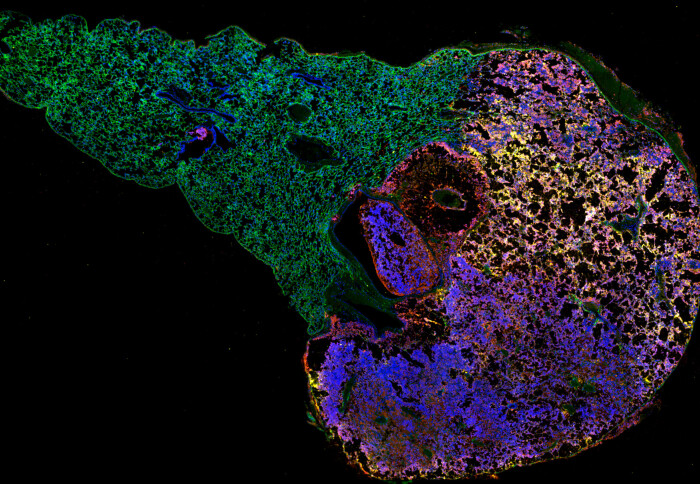
Mouse lung infected with Klebsiella pneumoniae causing severe infection. Credit: Dr Rita Berkachy, Department of Life Sciences
A new genetic platform allows the rapid production of antibodies against dangerous bacteria, without the need to purify or synthesise antigens.
Published on 6 October in Nature Communications, the study from Department of Life Sciences / Centre for Bacterial Resistance Biology researchers demonstrates how the mouse gut pathogen Citrobacter rodentium can be reprogrammed to present antigens from high-priority human pathogens such as Klebsiella pneumoniae and Escherichia coli during infection. This triggers the host immune system to generate protective antibodies in just one infection cycle.
Co-lead author Dr Joshua Wong said: ‘This approach is like an Ikea flatpack. We’ve ironed out the problems so that all the user needs to do is follow the instructions, instead of starting from scratch. It means we can go from genetic code to functional antibodies much faster than before.’
A new route to antibody therapies
Antibodies are already widely used in medicine, including in cancer and autoimmune disease treatment. However only one antibody therapy is currently licensed for use against bacterial infections in humans, despite the urgent threat of antimicrobial resistance (AMR).
‘This approach is like an Ikea flatpack. We’ve ironed out the problems so that all the user needs to do is follow the instructions, instead of starting from scratch. It means we can go from genetic code to functional antibodies much faster than before Dr Joshua Wong
Traditional methods to generate antibodies against bacteria require either purified sugars and proteins or painstaking chemical synthesis. The new 'citrOgen' platform bypasses this step by using C. rodentium as a ‘carrier’ system to produce and present bacterial antigens naturally.
In proof-of-concept experiments, the team engineered C. rodentium to display four different antigens from K. pneumoniae and E. coli. Within 28 days, infected mice produced antibodies that were not only specific but also functional, protecting against infection, blocking biofilm formation, and even enabling bacterial serotyping.
This is the first time C. rodentium has been used in this way. The team’s detailed understanding of this pathogen meant they could reprogram it to attach more strongly to host cells, ensuring robust infection and productive antibody responses.
Tackling urgent threats
The researchers believe the technology can be adapted to generate antibodies against a wide range of Gram-negative bacteria, with Gram-positive targets like Staphylococcus aureus next in line.
Dr Wong said: 'The AMR pandemic is going to render current antibiotics useless over time and antibodies could be the next generation of infection-fighting drugs. Our scalable approach could help industry develop them more quickly.’
 Next steps
The team’s goal is not to infect people directly with engineered bacteria, but to use the system to rapidly identify and produce candidate antibodies in the lab. These can then be developed into therapies using established pharmaceutical pipelines.
Beyond clinical applications, the platform could also be deployed in outbreak situations to accelerate the development of antibody tools for public health and research. Co-lead author Dr Julia Sanchez-Garrido sees additional broader applications of citrOgen in understanding immunity itself.
Dr Sanchez-Garrido said: ‘What's particularly exciting to me is that we can also use this platform to systematically explore how our immune defences recognise and responds to different bacterial structures. This could transform both antibody therapy and vaccine design by allowing us to "ask" the immune system which bacterial components offer the best protection.’
- citrOgen: a synthesis-free polysaccharide and protein antigen-presentation to antibody-induction platform’ by Joshua L. C. Wong, Julia Sanchez-Garrido, Jaie Rattle, Jonathan Bradshaw, Vishwas Mishra and Gad Frankel is published in Nature Communications.
- citrOgen – the first universal presentation platform for bacterial antigens
Article text (excluding photos or graphics) © Imperial College London.
Photos and graphics subject to third party copyright used with permission or © Imperial College London.
Reporter
Emily Govan
Department of Life Sciences
