Collapsible bicycle helmets provide less protection on average than conventional helmets, study finds

New research from Imperial College London has found that, on average, collapsible (sometimes called ‘foldable’) bicycle helmets provide lower levels of protection against serious head injuries than non-collapsible helmets.
However, the researchers found nothing inherent in a collapsible design that means they could not be further developed to become equally safe to conventional designs in the future – evidence suggests lighter weight alternatives with added rotational protection technologies would substantially improve the outcome of head injuries for riders.
Although the study showed varying levels of protection for different helmets, all helmets included in the study met the minimum regulatory standards for safety and evidence shows that wearing any helmet provides better protection than not wearing a helmet at all.
"Collapsible helmets are a great solution to overcome inconvenience... [but] until now, there has been no way for the wearer to judge how well the different designs protect them against severe head injuries..." Dr William Dawber Dyson School of Design Engineering
Collapsible helmets are increasing in popularity because of their portability and convenience, particularly suiting users of bicycle share scheme such as Santander, Lime, and Forest. Their price, however, is often higher compared with conventional helmets: collapsible helmets purchased for this study cost £101 on average, compared with £64 for conventional helmets.
The study, funded by The Road Safety Trust, is the first to compare the protection offered by collapsible foam helmets and conventional helmets. During the study, Imperial researchers from the Dyson School of Design Engineering tested 30 commercially available helmets, including 24 conventional models and all 6 collapsible models available in the UK, to simulate the most common head impacts that cyclists experience during a crash.
This study will feed into the HEAD Lab’s Helmet Impact Protection Effectiveness Rating (HIPER) system, established with funding from The Road Safety Trust. which provides consumers with safety data on different helmet models to make informed purchasing decisions, and manufacturers with insights to improve future helmet designs.
The lead author, Dr William Dawber, from Imperial’s Dyson School of Design Engineering, said: “Collapsible helmets are a great solution to overcome inconvenience; one of the most reported reasons people in urban areas don’t wear helmets when they want to ride a bicycle.
“Until now, there has been no way for the wearer to judge how well the different designs protect them against severe head injuries, which is the entire point of wearing a helmet. I am delighted that we can share the findings of our research so people can choose a helmet that fits with their budget and lifestyle.”
Ruth Purdie OBE, Chief Executive of The Road Safety Trust, said: “We are pleased to see the HIPER rating system for cycle helmets continue to grow and evolve.
“Backed by world-class research, it is addressing important and timely issues such as foldable helmets, whose growing popularity makes clear, independent evidence about their safety performance for consumers and manufacturers increasingly vital.”
Room for improvement
Collapsible helmets showed a higher linear injury risk than conventional helmets: the average predicted risk was 24% for collapsible helmets, compared with 20% for conventional helmets. Linear injury risk refers to the risk of injuries, such as skull fractures and focal brain injuries, which are associated with the linear motion of the head during the crash.
While the difference in linear injury risk may seem relatively small, researchers note that even a 4 percentage-point increase could translate into a substantial number of additional serious head injuries overall. The study found no difference in protection against brain injuries caused by head rotation.
“Backed by world-class research, [this work] is addressing important and timely issues such as foldable helmets, whose growing popularity makes clear, independent evidence about their safety performance for consumers and manufacturers increasingly vital.” Ruth Purdie OBE Chief Executive of The Road Safety Trust
Researchers identified two major factors contributing to the lower average safety performance of collapsible helmets: greater helmet weight and the limited use of in-helmet technology to reduce the rotation of the head.
Collapsible helmets were on average 57% heavier than conventional helmets (461 grams versus 294 grams). Increased helmet mass was associated with greater linear injury risk, with an average increase of 0.2% risk per additional 10 grams on a helmet.
In addition, rotational protection technologies reduced both linear and rotational injury risks but were used in only 1 of 6 collapsible helmets, compared with 12 of the 24 conventional helmets.
Overall, 5 of 6 collapsible helmets tested during the study ranked in the bottom half of the protection rankings.
However, the performance gap, researchers found, was not inherent to collapsible helmet designs.
Evidence that their safety performance can be improved came from testing two versions of the same collapsible helmet model, one of which incorporated rotational protection technology, specifically the Multi-directional Impact Protection System (MIPS). The MIPS-equipped helmet ranked 2nd among the 30 helmets (effectively matching or superseding most conventional designs), while the version without MIPS ranked only 26th out of 30.
The overall results suggest that collapsible helmets can be an excellent solution to make helmet use more accessible for cyclists, and producing lighter weight alternatives with added rotational protection technologies can substantially improve helmets’ safety outcomes.
Professor Mazdak Ghajari, Professor of Brain Biomechanics at the Dyson School of Design Engineering and a founder of the HEAD Lab, added: “Any helmet is safer than no helmet and innovative designs that appeal to more people are to be applauded. Underpinning HIPER is our aim to help manufacturers improve the safety of their products and for retailers to use our new clearer ratings in informing customers to make the right choices. We couldn’t do that without the collective years of engineering knowledge and research and connections with brain scientists we have at Imperial.”
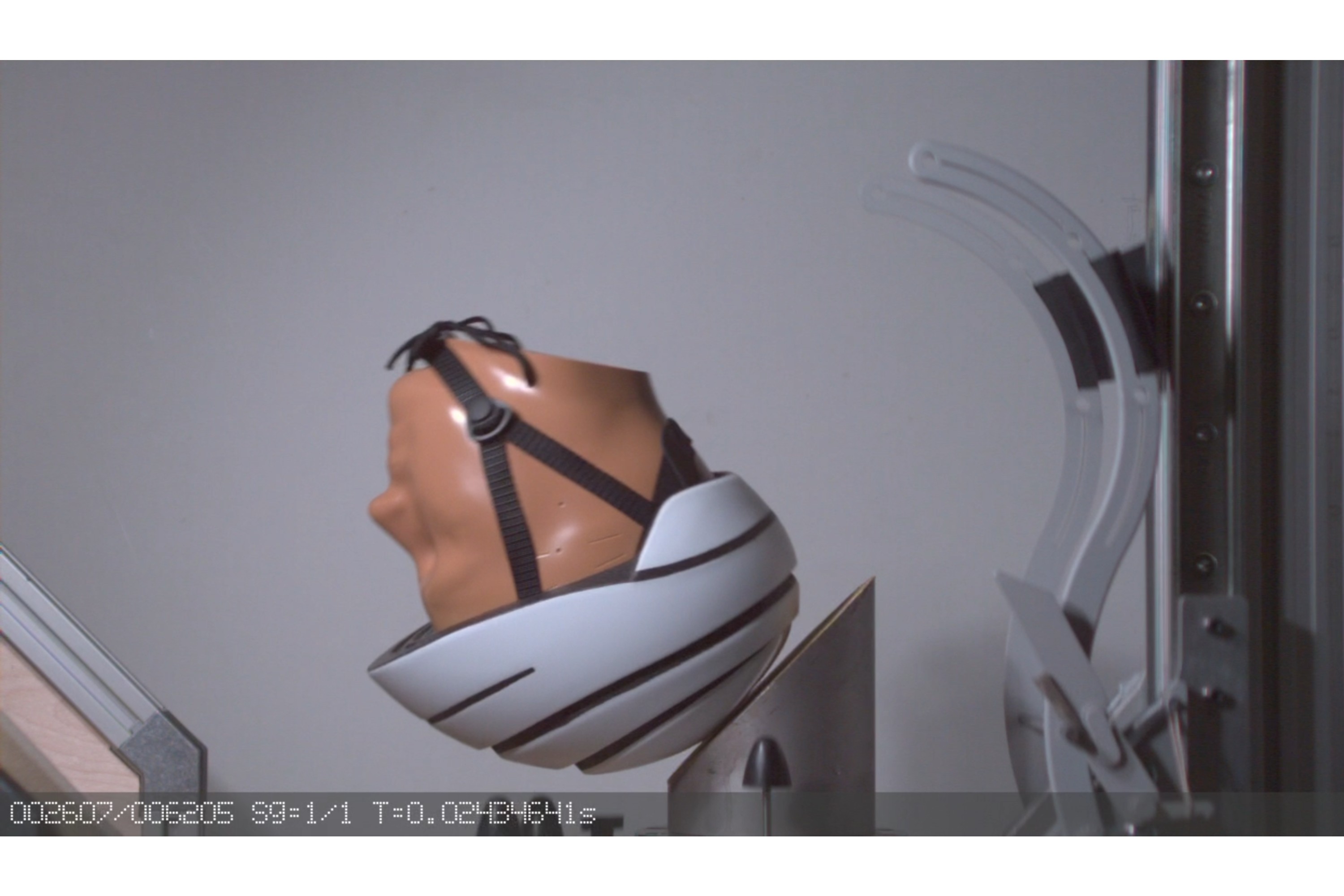
A collapsible bicycle helmet used for the study.
Improved rating system
While all helmets included in the study met the minimum regulatory standards needed to reach the market in the UK and Europe, current certification tests assess helmets only on a pass/fail basis. To help consumers better understand the level of protection provided by different helmets, the HEAD Lab's updated HIPER rating system awards diamond, platinum, gold, silver and bronze medals based on safety performance.
Present regulatory tests for the British Standards Institute (BSI) and European Standardisation Committees (CEN) use a vertical drop test that primarily measures direct impact forces without accounting for oblique impacts or measurement of head rotation.
In practice, however, most cycling impacts occur at an angle, causing the head to rotate sharply, which is a major mechanism of damage to the brain’s wiring and bleeding on the brain. Recent studies have shown head injuries of this kind are linked to an increased risk of dementia later in life.
To better reflect real-world crash conditions the Imperial team tested helmets at four impact locations to measure both linear and rotational head motion. Each impact was repeated three times using a new helmet sample to account for manufacturing and testing variability.
Updated HIPER ratings system
This work builds on previous HEAD Lab research published in Annals of Biomedical Engineering in 2024, which found that helmet price was not a reliable indicator of protection offered by helmets and that some helmets reduced rotational risks much better than others.
In a separate study, the team also found that a novel air-inflated collapsible helmet design reduced overall linear brain injury risk by 44% compared with the best-performing foam lined helmet.
"Underpinning HIPER is our aim to help manufacturers improve the safety of their products and for retailers to use our new clearer ratings in informing customers to make the right choices." Professor Mazdak Ghajari Dyson School of Design Engineering
As part of this latest set of research, the team has expanded HIPER to include collapsible helmets, which are becoming increasingly popular among cyclists seeking greater portability. Ratings for all adult helmets tested to date by the HEAD Lab team are available on the HIPER website, with children’s helmet ratings planned for future releases.
Following consultation with cyclists, retailers, and manufacturers, the team has also recently updated the way results are presented.
The previous star-rating system has been replaced with a medal-based approach to reinforce the message that every helmet included in the rankings has passed the European safety standard and offers protection against head injuries.
The researchers stress that helmet use is a significant factor in reducing the risk of serious head injury. While conventional helmets generally performed better in the testing, wearing a collapsible helmet remains substantially safer than not wearing a helmet at all.
“Are collapsible bicycle helmets as protective against head injuries as conventional designs?” by William Dawber et al is published in Accident Analysis & Prevention.
Article text (excluding photos or graphics) © Imperial College London.
Photos and graphics subject to third party copyright used with permission or © Imperial College London.
Article people, mentions and related links
Conrad Duncan
Administration/Non-faculty departments
- Tel: +44 (0)20 7594 6860
- Email: c.duncan@imperial.ac.uk
- Articles by this author

Wiktoria Tunska
Centres