Imperial strengthens India partnerships at global AI summit
/prod01/channel_4/imperial-news/media/news-images/3000X2000-main-article-images/shutterstock_2394807119.jpg)
Imperial announced plans to develop and deepen its AI for science partnerships with India at the world’s biggest gathering of AI and tech leadership.
The AI Impact Summit in New Delhi, the first major international AI meeting hosted in the Global South, brought together global leaders and technology executives to shape the future of AI.
Imperial showcased several new partnerships with Indian collaborators during the Summit – including a £5.3million project to adapt and scale an AI enabled digital mental health programme for adolescent girls living in rural India.
Imperial’s research lead for the project Professor Ceire Costelloe, Chair in Health Informatics at the School of Public Health, attended the Summit to showcase the project.
Imperial’s Department of Earth Science and Engineering have agreed a partnership with Thapar Institute of Engineering and Technology in India, and the University of Surrey and the Royal College of Art in the UK to co-develop next generation physics-based and AI foundational models that can simulate and predict air pollution dynamics in Northern India, allowing science to link directly to health and policy outcomes.
"The diffusion of AI has the potential to drive growth and deliver benefits for people around the world. India is home to dynamic tech talent and boldest thinking in AI." Amanda Wolthuizen Vice-President, Strategic Engagement and Communications and Chief of Staff to the President
Supported by Imperial’s tech and science hub in India — Imperial Global India — the university highlighted its rapidly expanding research and innovation network across the country, which spans key government bodies, leading academic institutions, and major industry partners.
Imperial’s Vice President (Communications and Strategic Engagement) and Chief of Staff to the President, Amanda Wolthuizen, met with partners across industry and research, including senior leaders from the Government of Karnataka to explore opportunities for new collaborations in AI research and innovation.
The Vice President also met leaders from the Foundation for Interoperability in Digital Economy (FIDE). Working at the science-policy interface, Imperial is partnering with the FIDE to convene researchers, regulators and industry from the UK and India to examine how digital energy grids and emerging technologies such as AI can accelerate the global energy transition.
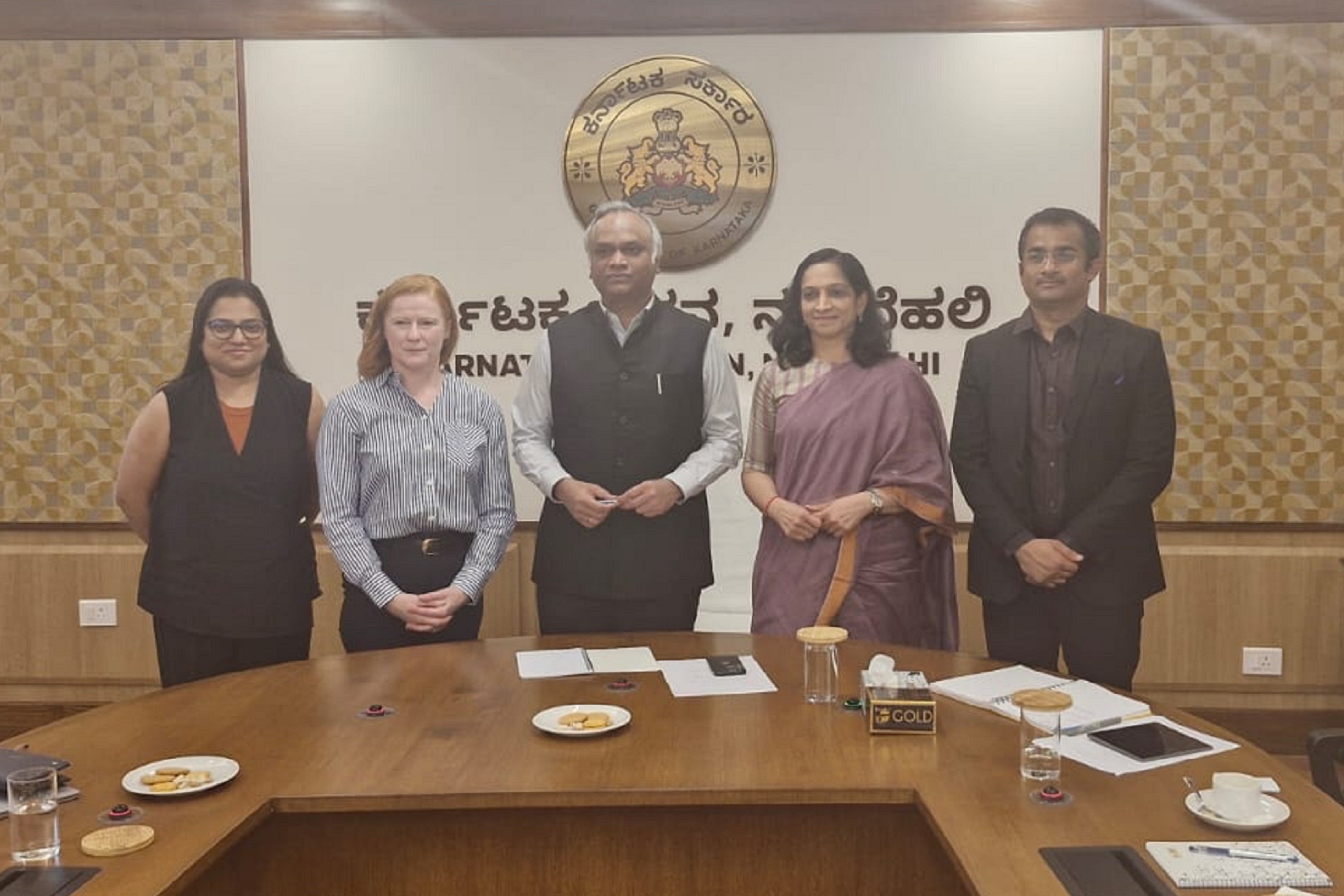
Amanda Wolthuizen, Vice-President, Strategic Engagement and Communications and Chief of Staff to the President, said: “The diffusion of AI has the potential to drive growth and deliver benefits for people around the world. India is home to dynamic tech talent and boldest thinking in AI. Through our Imperial Global India hub we are building partnerships within the Indian AI ecosystem that will not only advance scientific discovery but also deliver real‑world impact for communities. I’m excited by the momentum we are creating through collaborations and the opportunities ahead for developing and deepening our partnerships.”
Showcasing global AI leadership
The five-day Summit comes just weeks after Imperial and the World Economic Forum launched an exciting new UK Centre for AI-Driven Innovation - accelerating the responsible adoption of AI breakthrough to transform industries and boost economic growth. The UK Centre for AI-Driven Innovation will advance AI adoption, while reinforcing leadership in productive and responsible development.
The new initiative will connect with the three WEF Centres for the Fourth Industrial Revolution (C4IR) in India located in Mumbai, Telangana, and Andhra Pradesh. The Centre will also contribute to the WEF AI Global Alliance, strengthening international competitiveness and supporting innovation across sectors including advanced manufacturing, life sciences and creative industries.
India focused AI collaborations
Imperial is working with India's public and private energy sectors to ensure a reliable and green supply of energy required to power the country's AI transition.
Researchers from Imperial Business School are working with Tata Power and technology partners in Mumbai and Delhi to explore how smart devices can shift electricity demand to periods when the grid is at its cleanest. The project tests how digital technologies can cut urban carbon emissions without requiring changes in consumer behaviour. The collaboration is led by Dr Mirabelle Muûls (Imperial Business School) and Professor Suryanarayana Doolla (IIT Bombay & MP Ensystems).
Accelerating talent
Supported by Schmidt Sciences, Imperial’s I-X Centre delivers the Eric and Wendy Schmidt AI in Science Global Faculty Fellowship and is building a transnational research community using artificial intelligence to accelerate discovery. India’s Indian Institute of Science (IISc) and National Centre for Biological Sciences (NCBS) are partner institutions in the programme and the current cohort of researchers is now embedded in Imperial’s Deep Tech White City campus and includes Infosys Life Sciences Prize winner Professor Anjana Badrinarayanan from NCBS who is using AI to accelerate her work in molecular biology, and Dr Anubhab Khan who studies genetic variation in wildlife populations to inform best conservation practices for endangered species in the Indian subcontinent.
Deepening and expanding India–Imperial connections
Imperial’s collaborations in India continue to grow. Between 2020 and 2025, Imperial academics co-authored 2,150 publications with colleagues at 468 Indian institutions. Imperial currently hosts just over 800 Indian students, 165 staff and a community of more than 3,000 alumni across India.
Supported by Imperial Global India, Imperial’s academics are working with partners in India to co-develop and implement cutting edge technologies for societal impact. From using quantum computing for climate resilient agriculture to developing novel nanorobotics for medical sensing, Imperial is collaborating with top Indian institutions at the frontiers of science and deep tech innovation.
Last year Imperial began partnering with Science Gallery Bengaluru (SGB) - a cutting-edge hub for innovation, research and public engagement. The collaboration will drive the exchange of talent and knowledge between the UK and India, with the development of cutting edge open-research facilities, a joint fellowship programme, and public engagement activities.
Dr Jess Wade, Department of Materials, will speak at the upcoming NASSCOM Technology & Leadership Forum, exploring how emerging technologies, such as quantum devices, can amplify human potential and create meaningful impact.
Get involved
Contact Imperial Global India to explore partnership opportunities.
Join our India alumni community to connect with collaborators and events across the region.
--
Main picture credit: Arnav Pratap Singh / Shutterstock.com

Article text (excluding photos or graphics) © Imperial College London.
Photos and graphics subject to third party copyright used with permission or © Imperial College London.
Article people, mentions and related links
Stephen Johns
Administration/Non-faculty departments