Campus and community
/prod01/channel_4/imperial-news/media/images/landscape-3000X2000/250605_WE_Innovate_grand-final-2025-1G8A9395-Enhanced-NR.jpg)
Five women-led startups developing new technology to improve the world will compete for a £30,000 prize fund in Imperial’s flagship programme for women entrepreneurs.
This year’s WE Innovate finalists are building businesses to tackle challenges in areas such as vaccine technology, epilepsy care and the destruction of ‘forever chemicals’.
The WE Innovate programme, run by Imperial Enterprise Lab, is a targeted pre-accelerator open to teams led by students, recent alumni and Early Career Researchers who identify as women.
The programme supports 25 women-led teams through six-months of masterclasses, business coaching, 1-to-1 expert support, and peer mentoring. The top five teams get a chance to compete to win a share of a £30,000 prize fund.
This year’s final also marks the second year of WE Innovate National – a growing UK-wide programme which has expanded the WE Innovate model built at Imperial to other parts of the country.
Alongside Imperial, Queen’s University Belfast, Swansea University, and Loughborough University are each hosting their own Grand Final showcases at their respective campuses. The four showcases are collectively contributing to a shared national ecosystem focused on supporting women-led innovation.
WE Innovate National is set to expand further to include seven universities next year, supporting 175 women‑led startup teams nationwide.
The finalists for Imperial’s WE Innovate Grand Final Showcase 2026 are:
AlphaVectors Biotech is developing a lipid nanoparticle platform to enhance the stability of RNA vaccines at room temperatures.
Current RNA-based therapeutics rely on lipid nanoparticles which need storage at −20°C to −80°C and high dosing. This increases distribution costs and leads to significant wastage - limiting the scalability, deployment and accessibility of this technology in low-resource markets.
The startup says that their technology can dramatically lower the need for temperature-controlled supply chains - reducing costs and improving the scalability of RNA vaccines for global deployment.
AlphaVectors Biotech is led by Dr Apanpreet Kaur, an Imperial alumnus with a PhD in Chemical Engineering.

Epile-X is working on a platform which could provide continuous, real-world brain monitoring for people with epilepsy.
More than 630,000 people in the UK live with epilepsy, according to the charity Epilepsy Action, and current diagnosis relies on EEG recordings in clinical settings and patient-reported diaries which may miss seizures occurring in daily life.
The startup says their technology combines a wearable EEG with AI-driven analysis to capture daily brain activity and support improved diagnosis and more personalised treatment decisions.
Epile-X is led by Ester D'Alterio, an Innovation, Entrepreneurship and Management MSc graduate from Imperial.

FluoroCycle is developing technology for low-energy chemical destruction of PFAS, breaking down ‘forever chemicals’ at 10x lower temperatures than current incineration methods.
PFAS are a group of synthetic chemicals which have been found to contaminate air, water and soil, with some studies linking exposure to these chemicals to thyroid disease, reproductive illness and cancer.
The startup is aiming to make the chemical destruction of PFAS more affordable by providing its technology in the form of an onsite engineered unit - allowing customers to save on energy and transportation costs, and to cut down their carbon footprint.
FluoroCycle is led by Amanda Fogh, a Research Associate in the Department of Chemistry at Imperial.

Waypoint is building a video game controller for visually impaired players to hear and feel popular games, such as Super Mario and Minecraft.
At least 2.2 billion people globally have some form of vision impairment, according to the World Health Organisation, while estimates show around 43 million people have complete blindness. Despite this, Waypoint say that only 0.001% of video games are fully playable for blind gamers.
The startup’s technology uses computer vision and AI to read the game screen and translate key information into sound, vibration, and touch for a fully immersive experience. The founders say their technology is the first-ever game controller designed to make video games fully playable for blind players.
Waypoint is led by Bana Quronfuleh, an Innovation Design Engineering MSc student at Imperial.

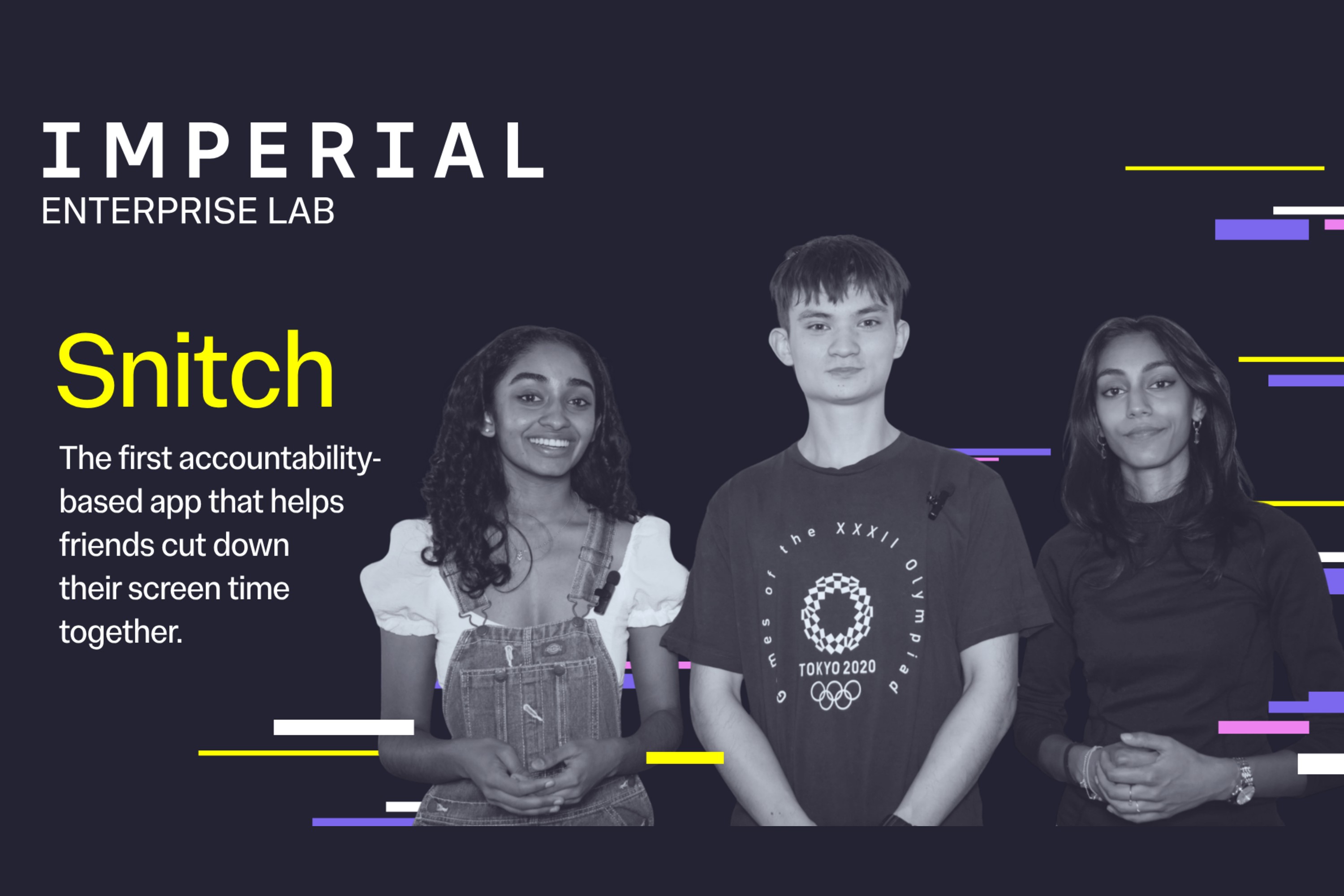
Snitch is developing an ‘accountability-based’ app which allows friends to cut down their screen time together.
UK adults spend an average of 4.5 hours a day online on personal smartphones, tablets and computers, with young adults spending more than 6 hours online on average, according to Ofcom’s Online Nation 2025 report. Some research suggests that excessive screen use may have a negative impact on mental and physical health.
Snitch’s app allows users to join accountability groups and set shared limits across their most used apps. When one person scrolls, the group’s combined timer counts down. The founders say this helps to build awareness, encourage reflection and create small behavioural shifts by making screen use a shared responsibility.
Snitch is led by Asha Bakhai, a Design Engineering MEng graduate from Imperial.
--
To find out more about this year’s teams and their business ideas, visit the Imperial Enterprise Lab pitchbook.
Article text (excluding photos or graphics) © Imperial College London.
Photos and graphics subject to third party copyright used with permission or © Imperial College London.
Administration/Non-faculty departments