
Health
by Ian Mundell
/prod01/channel_4/imperial-news/media/news-images/3000X2000-main-article-images/2026-01-22-Permia-Sensing-palm-monitoring.jpg)
The UAE FoodTech Challenge prize will help Permia Sensing bring its precision agriculture technology to new markets and new crops in the Middle East and India.
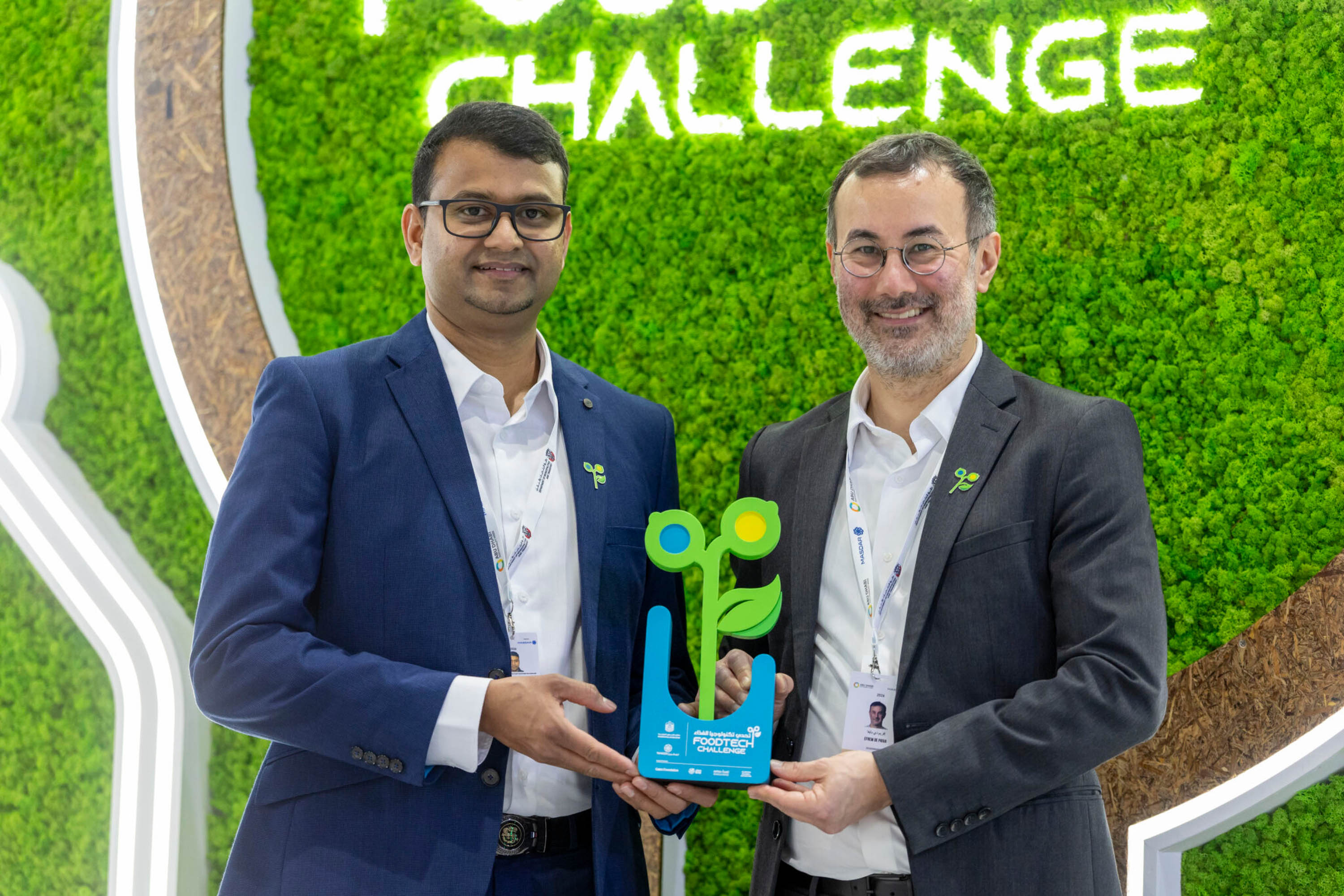
Permia Sensing, a spinout from the Dyson School of Design Engineering, is among the four winners of the 2026 UAE FoodTech Challenge, a competition for innovative agricultural technology companies run by the government of the United Arab Emirates. Alongside a prize of $500,000, Permia will receive support to pilot and scale up its technology in the UAE and the global south.
“The FoodTech Challenge prize allows us to set up our base in Abu Dhabi,” said Efrem de Paiva, the company’s chief executive. “This will serve the other countries of the Middle East and North Africa region, and give us access to stakeholders, research institutes, governments and universities, so that we can bring in the best talent to help us take our technology further.”
In Sri Lanka, the average coconut yield now is 36 nuts per tree per year. With precision agriculture improving the health of the trees, they have the potential to go up to 120 nuts per tree. Professor Thrishantha Nanayakkara Dyson School of Design Engineering
Permia Sensing uses artificial intelligence, bioacoustic sensors and drone imaging to monitor tree health, and recommend interventions at the level of individual plants, an approach known as precision agriculture. Already covering over 15,000 hectares of coconut and palm oil plantations in Sri Lanka, the technology offers early detection of stress factors such as dehydration and pest infestations, enabling farmers to boost yields and reduce waste.
“In Sri Lanka, the average coconut yield now is 36 nuts per tree per year. With precision agriculture improving the health of the trees, they have the potential to go up to 120 nuts per tree,” says Professor Thrishantha Nanayakkara, founder and R&D director of Permia Sensing. “Even if we just double the yield from the same land, that will be very significant.”
This also has implications for nature conservation. “With static yields, the only way to increase profits is to expand into natural rain forests. Our system gives growers a way of increasing yields and so reduces the threat of deforestation.”
The same benefits are likely for other crops, in other regions. “We want to enter into high-value crops such as date palm and oil palm in the UAE region, Egypt and India,” says Professor Nanayakkara.
Permia Sensing’s technology has its roots in a project for the Coconut Research Institute of Sri Lanka, carried out around 2005 when Professor Nanayakkara was a senior lecturer at the University of Moratuwa. He and his colleagues developed a sensor that could pick up the sound of red palm weevil larvae eating and growing inside the trunks of coconut palms.
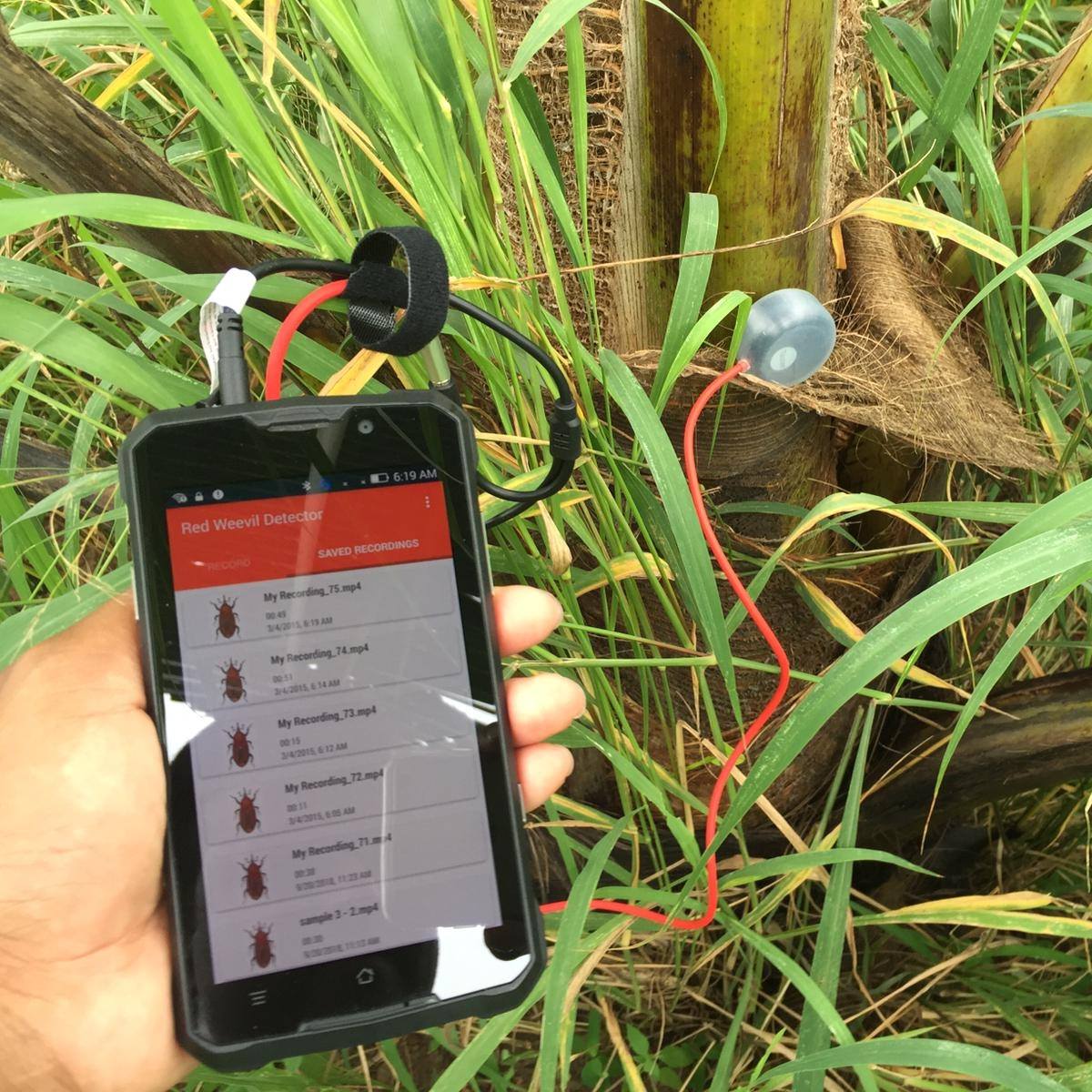 These acoustic sensors proved to be highly effective at detecting this very damaging pest, but the cost of making the device to process the data and produce a result meant it was not a commercially viable proposition.
Professor Nanayakkara returned to the idea after moving to Imperial in 2017, where he set up the Morph Lab at the Dyson School of Design Engineering. What had changed in the intervening years was the smartphone. “Each smartphone contains a very advanced sound processor, so we didn’t need a separate circuit to process the signal from the sensor,” he explains. “That meant we could get rid of the portable electronics, which was the most expensive part to manufacture.”
Hasitha Wegiriya, a Sri Lankan PhD student working in the Morph Lab, was given the task of developing a mobile phone app that could process the sensor data and of picking up the collaboration with the Coconut Research Institute. When Permia Sensing was spun out in 2020 to commercialise the technology, he became the co-founder and company’s chief technology officer.
Imperial’s support for entrepreneurial academics also played an important part in this process. “We were given Impact Acceleration Grants and then proof of concept seed funding, and a lot of support,” recalls Professor Nanayakkara. “So, I wouldn’t be doing this without Imperial Enterprise.”
Initially, the company’s business plan focused on a service detecting weevil infestation, but it soon expanded to look at tree health more broadly. “We added other layers, such as drone-based multispectral imaging, and other sensors,” says Professor Nanayakkara. “We can also collect other acoustic information while listening to the red palm weevil and use that to assess hydration and transpiration.”
Beginning with satellite and drone data, a plantation can be mapped to single out trees that may be struggling. Then a ground crew is sent in to identify whether the problem is hydration, nutrition or an infestation. The grower can then administer targeted remedies, without resorting to costly blanket use of fertilisers or pesticides.
“This reduces the uncertainty in agriculture and increases yield, because each tree gets what it needs,” says Professor Nanayakkara. “In order to do this, you need data-driven approaches, but the incremental investment you make in that is recoverable, in our case, within three years.”
Article text (excluding photos or graphics) © Imperial College London.
Photos and graphics subject to third party copyright used with permission or © Imperial College London.
Administration/Non-faculty departments

Health

Health

Science

Science
Campus and community
Imperial Global
Health
Discover more Imperial News
Search all articlesDiscover more Imperial News
Search all articles