
Science
by Press Office
/prod01/channel_4/imperial-news/media/images/landscape-3000X2000/borehole1_3000X2000.jpg)
In late 2025, industrial machinery was set up on the Queen’s Lawn at the centre of Imperial’s South Kensington campus. This was part of a feasibility study to explore whether the ground beneath the campus could support a low-carbon heating system — part of the university’s explorations for future sustainable future energy provision.
As a scientific institution, Imperial bases decisions on evidence. Before considering the implementation of any new approach, it’s important to understand its suitability for our unique environment.
Ground source heat pump systems use the stable temperature of the earth to provide heating and cooling, but their performance depends heavily on local geological conditions. This trial was designed to gather accurate data to inform the next steps of our carbon reduction journey.
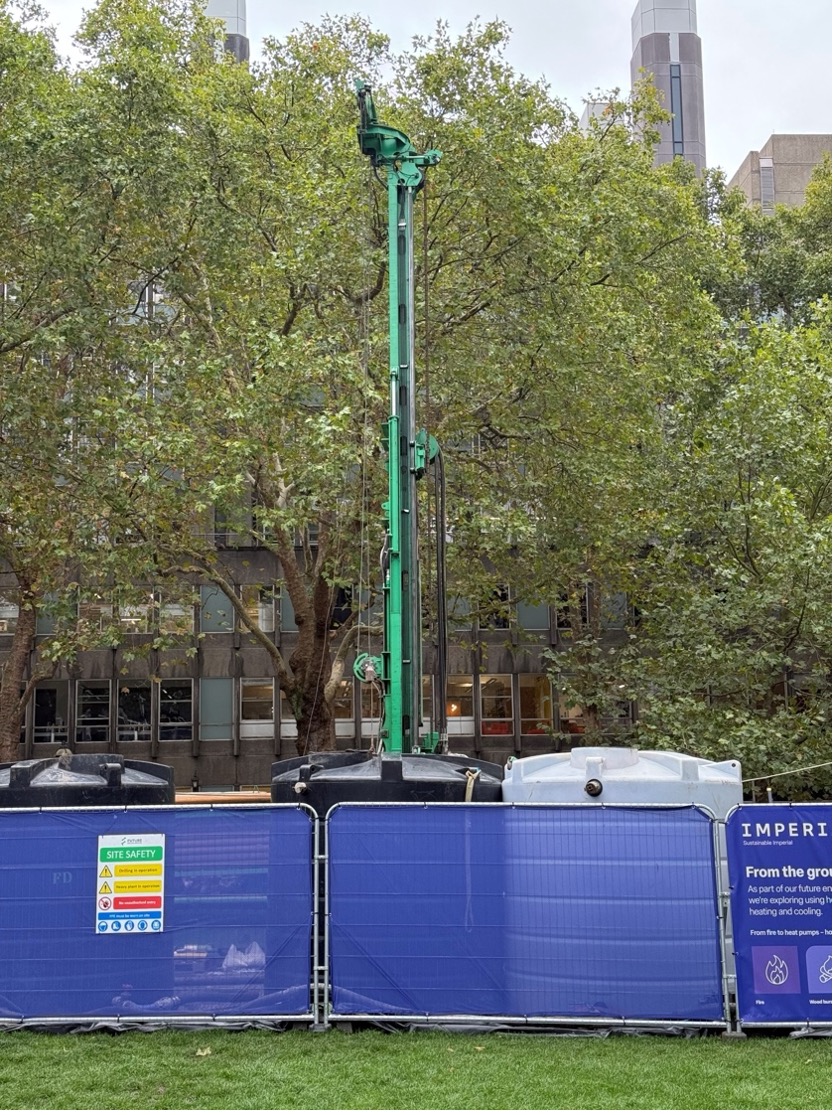
Working with Celsius Energy — a company specialising in shallow geothermal energy production — a borehole was drilled to a depth of almost 250 metres, nearly three times the height of the Queen’s Tower.
A continuous loop of pipe was then installed to the full depth of the borehole to enable a Thermal Response Test (TRT). In this type of test, warm fluid is circulated through the pipe, and the temperature difference between the inlet and outlet is measured over time. This helps to show how readily heat is transferred into and out of the ground, offering key data on thermal conductivity and thermal resistance.
Understanding ground source heat pumps – an animation
To design a large ground source array like this, it is necessary to understand both the thermal properties of the ground and its geological structure. These factors determine the potential capacity of the system and the drilling techniques required for its implementation.
As a science focused institution these explorations are vital in order to inform our sustainability journey as we work towards our goal of a net zero carbon campus by 2040. Mark Wilkinson Head of Net Zero Carbon
For this borehole, the team was already aware of an aquifer – a natural underground layer of porous rock that holds and transmits groundwater – approximately 100 metres below ground level. To account for this, a fibre optic cable was installed alongside the loop, enabling a Distributed Thermal Response Test. This revealed the potential influence of the aquifer on the ground’s thermal properties.
The purpose of the borehole experiment was to test assumptions and gather real-world evidence about the feasibility of such a system in meeting our future campus energy needs.
Mark Wilkinson, Head of Net Zero Carbon said, “In undertaking this trial, we are ensuring we fully evaluate all potential technologies that could feed into our future South Kensington Energy Strategy and make an informed decision on the best route forward. As a science focused institution these explorations are vital in order to inform our sustainability journey as we work towards our goal of a net zero carbon campus by 2040. It’s been amazing to see the interest and enthusiasm this project has generated in the Imperial community.”
With the test complete and the Queen’s Lawn fully restored, engineers and sustainability specialists are now analysing the trial data to determine whether this technology could play a role in our future energy mix.
At the same time, exploration on other sustainable solutions such as air source heat pumps is continuing — all part of ensuring our future approach is as efficient as possible in its alignment with our campus requirements and net zero carbon goals.
Find out more about this and other initiatives focusing on minimising our carbon footprint on the Sustainable Imperial webpages.
Article text (excluding photos or graphics) © Imperial College London.
Photos and graphics subject to third party copyright used with permission or © Imperial College London.
Administration/Non-faculty departments

Science

Health
.jpg)
Health

Cross-faculty
Health
Engineering
Imperial Global
Discover more Imperial News
Search all articlesDiscover more Imperial News
Search all articles