Imperial hosts UK Physical AI & Robotics Roundtable with NVIDIA during London Tech Week
/prod01/channel_4/imperial-news/media/news-images/3000X2000-main-article-images/3000X2000.jpg)
The UK has an opportunity to lead the world in AI-powered robotics, according to experts at a roundtable hosted at Imperial earlier this month by NVIDIA, the world leader in accelerated computing and AI.
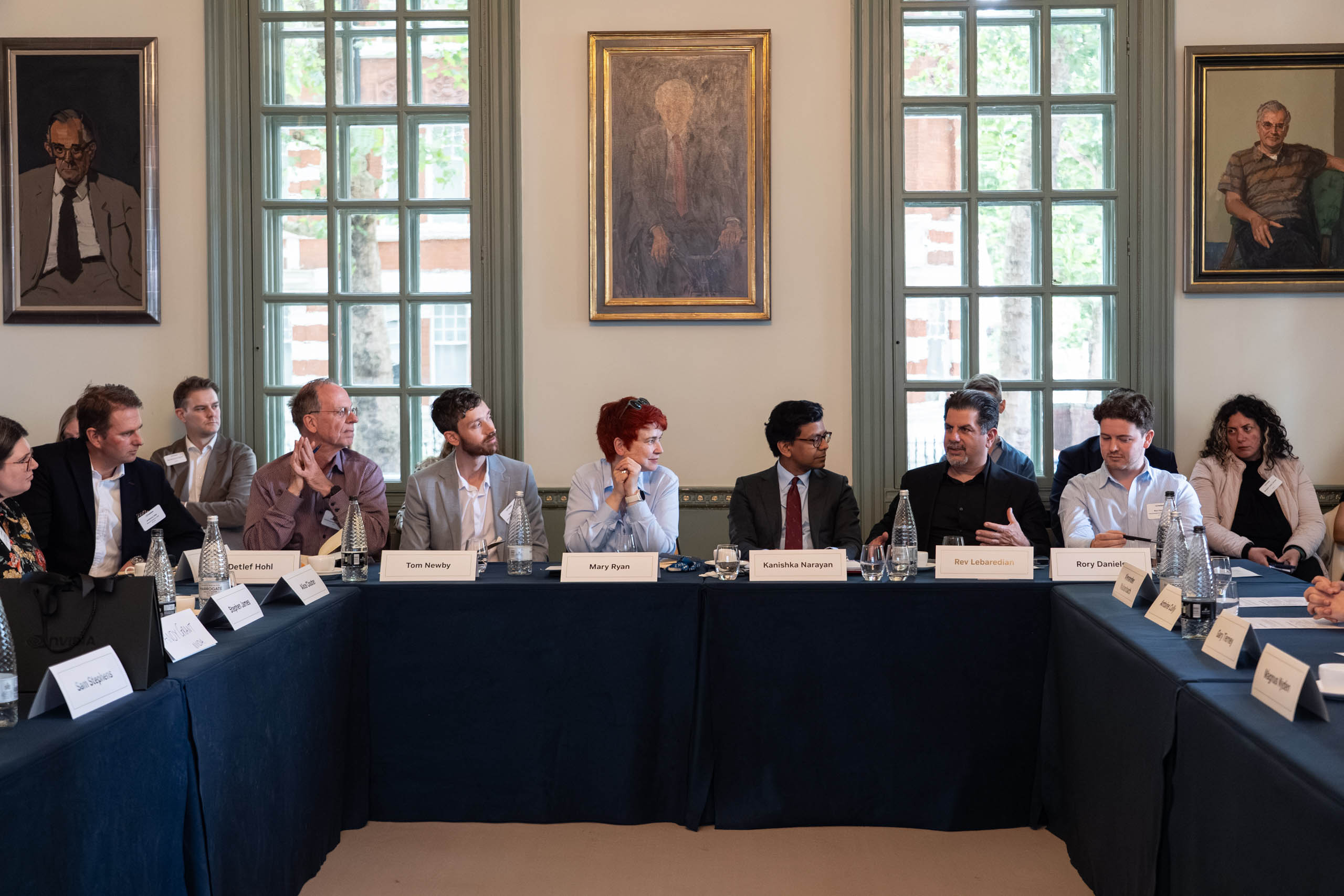
On Tuesday 9 June Imperial College London hosted the NVIDIA UK Physical AI & Robotics Roundtable as part of London Tech Week.
The event convened senior leaders and experts from across the UK’s AI, robotics and policy landscape spanning government, academia and industry to explore how the UK can leverage its core strengths in research and innovation to lead the next wave of physical AI and robotics innovation.
Discussions focused on the opportunities and challenges associated with the development and deployment of these technologies across the UK.
The event was co-chaired by Kanishka Narayan MP, Minister for AI and Online Safety, Rev Lebaredian, Vice President of Physical AI Simulation at NVIDIA, and Professor Mary Ryan, Imperial’s Vice Provost for Research and Enterprise. Roundtable sessions were also led by techUK partners in attendance.
Building the physical AI era
Rev Lebaredian gave a keynote presentation titled Building the Physical AI Era: From Simulation to the Real World.
He outlined physical AI as the next frontier of AI – systems that can understand and act in the physical world. It was emphasised that the scale and complexity of developing this technology necessitates collaboration across institutions, sectors and countries.
He also described NVIDIA’s full-stack approach - spanning simulation, AI models and robotics - as a foundation for enabling this transition and unlocking applications across a wide range of physical industries beyond digital AI.

The UK’s opportunity
The UK has a history of research excellence, alongside many of the capabilities and infrastructure needed to become a global leader in physical AI and robotics. Subsequent discussion explored how the UK can build on these strengths to remain ahead of the curve and lead in both the development of new systems and their deployment in real-world applications.
Physical AI refers to systems that can understand, reason about and act in the physical world, while robotics provides the embodied platforms through which these capabilities are deployed and tested.
Its potential impact could extend across a wide range of physical industries beyond the knowledge sector, but discussions highlighted that realising this opportunity will depend on how effectively the UK can connect world-class research with industry and deployment pathways - and identify priority sectors and capability gaps.
Addressing fragmentation across the UK ecosystem
.jpeg)
Professor Mary Ryan also set out the case for building on the UK's research strengths through deeper collaboration across sectors.
She highlighted national fragmentation as a key barrier, noting that startups, researchers, industry and policymakers often operate in separate communities, slowing the translation of promising discoveries into real-world applications.
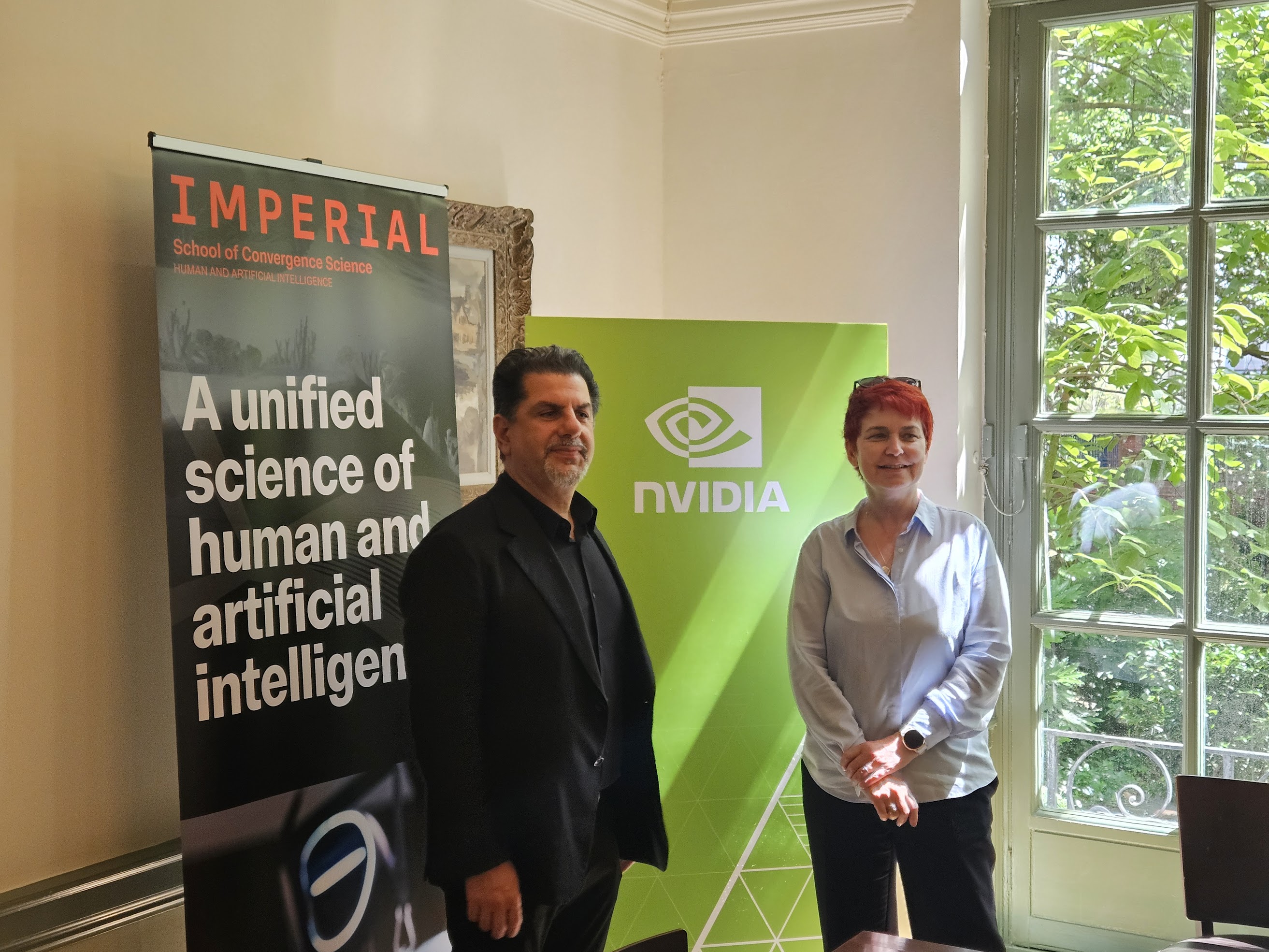
She introduced Imperial’s School of Convergence Science, co-hosts of the event, which organises research around mission-led areas including Human and Artificial Intelligence, and brings together expertise across science, engineering, medicine and business to accelerate real-world impact.
The Human and Artificial Intelligence theme is guided by pillars focused on augmenting human intelligence and enabling AI that can operate safely in the physical world. It is anchored within the School’s broader function of breaking down traditional silos and supporting the translation of science into real-world action.
Participants agreed that physical AI and robotics require expertise from across disciplines and sectors, and that strong national coordination - from discovery and research through to testing, deployment and adoption - will be critical if the UK is to become a leader in this rapidly advancing field.
A moment of significant opportunity
The roundtable spotlighted the UK's world-class research base, talent and innovation ecosystem, as well as the growing momentum behind physical AI globally at this time.
As investment in physical AI and robotics accelerates worldwide, discussions explored how the UK can position itself not only as a centre of research excellence, but also as a leader in the development and deployment of emerging technologies.
The subsequent presentations and visit to Imperial's leading robotics laboratories provided attendees with an opportunity to see some of the existing UK research and innovation capabilities that lend themselves to these ambitions.
Inside Imperial’s robotics labs
Visitors saw ongoing research into autonomous systems, intelligent robotics and AI-enabled engineering applications during the scheduled lab tours and showcase presentations.
The labs presented included:
DIGIBAT
- DIGIBAT is an automated research facility that accelerates the discovery of energy materials, with a focus on batteries and electrocatalysis. It provides a fully integrated workflow, spanning materials synthesis, electrode preparation, electrolyte formulation, battery assembly, and electrochemical testing, enabling reproducible and data-driven experimentation for both academic and industrial researchers. Operating as a digital twin laboratory, automated equipment links to a continuously updated digital model and shared data system, meaning experiments are recorded and mirrored digitally.
- Presented by Dr Jingyu Feng, DIGIBAT Facility Manager and Felix Mildner, Research Associate.
Adaptive & Intelligent Robotics Lab (AIRL)
- AIRL develops methods for enabling robots to operate robustly in unpredictable environments. Its research builds repertoires of diverse, high-performing behaviours that allow robots to rapidly adapt to damage, changing conditions and novel tasks by switching between strategies without reprogramming. At a technical level, this is achieved through quality-diversity reinforcement learning and agentic methods that explicitly encourage the discovery of diverse behavioural solutions rather than a single optimal policy.
- Presented by Professor Antoine Cully, Professor in Machine Learning and Robotics and Director of AIRL.
The Robot Learning Lab
- The Robot Learning Lab sits at the intersection of robotics, computer vision, and machine learning, developing methods that enable robots to manipulate objects in the physical world. Its research focuses on robot manipulation: how robots use arms and hands to grasp, move and assemble objects, using learning-based approaches such as imitation learning, reinforcement learning and vision-language models. These methods can be applied to tasks in domestic, industrial and warehouse environments.
- Presented by Dr Ed Johns, Associate Professor of Robot Learning and Director of the Robot Learning Lab.
The Brain & Behaviour Lab
- The Brain & Behaviour Lab at Imperial College London uses machine learning to study human brain function and behaviour, applying these insights to develop more intelligent and human-centred AI systems. The lab works at the convergence of neuroscience, robotics, bioengineering and healthcare, leveraging human signals and real-world health data while engaging with clinical and healthcare settings to bridge the gap between fundamental science and healthcare practice.
- Presented by Professor Aldo Faisal, Co-Director of the School of Convergence Science and Professor of AI & Neuroscience and Dr Bukeikhan Omarali, Research Associate in Human-Robot Interaction.
The Hamlyn Centre for Robotic Surgery
- The Hamlyn Centre for Robotic Surgery was introduced with an overview of its history and strategy, illustrating its mission to develop safe, effective and accessible technologies with a strong emphasis on clinical translation – and where it sits today at the cutting-edge of surgical robotics research. Some of the specific technologies demonstrated spanned AI assisted surgery, markerless tracking and self-propelled robotic scopes.
- Presented by Professor Ferdinando Rodriguez y Baena, Professor of Medical Robotics and Co-Director of the Hamlyn Centre.
Safe Whole-body Intelligent Robotics Lab (SWIRL)
- SWIRL develops safe and intelligent robotic systems that learn to use their full bodies to operate in complex, real-world environments. The lab’s research focuses on reinforcement learning and imitation learning, with an emphasis on enabling robots to learn efficiently from limited experience and to act safely alongside humans.
- Presented by Dr Stephen James, Assistant Professor in Computing and SWIRL Lab lead.
World models for intelligent robotics
- Professor Amir Bar, Assistant Professor of Computing, showcased research he is leading to develop embodied world models that allow AI systems to understand, predict and simulate the world from visual data. He presented work focused on video-based learning for robotics, enabling systems to plan and generate actions from what they see - supporting control and navigation in new and unseen environments.

Imperial’s enterprising strengths
Imperial’s deep tech innovation ecosystem brings together research, entrepreneurship and industry to accelerate the translation of ideas into impact.
Through dedicated initiatives such as Imperial Enterprise Lab, Imperial Partnerships, WestTech London and the convergence science approach built into the Science for Humanity strategy, the university actively promotes collaboration across disciplines and helps move discoveries from the laboratory towards real-world application.
This is all underpinned by strong cross-sector partnerships and interdisciplinary working, enabling researchers to tackle complex challenges in robotics, autonomous systems and AI-enabled engineering, alongside applications in areas such as healthcare and energy.
Imperial’s ‘living lab’ environments also further support the development and testing of technologies in real-world settings, including systems designed to operate safely and effectively alongside people.
Looking ahead
The roundtable event highlighted the rapid pace of progress in physical AI and robotics, and the opportunities available for the UK to play a leading role in continued development and deployment.
Participants noted that there are still practical challenges ahead, and as technology evolves rapidly, considerations around infrastructure, skills, regulation and adoption will also be important across different applications.
Continued progress across these areas - alongside sustained collaboration across research, industry and government, will be of sustained importance as the technology develops.
"The UK has world-class research in this emergent area. Coupled with a thriving startup ecosystem and policy momentum, this makes the UK ready to lead in physical AI. What this roundtable made clear is that connecting those communities more deliberately, across research, industry and government, is where the real opportunity lies. That is what Imperial is committed to helping build." – Professor Mary Ryan
Supporters

Article text (excluding photos or graphics) © Imperial College London.
Photos and graphics subject to third party copyright used with permission or © Imperial College London.
Article people, mentions and related links
Tashiana Langley
Administration/Non-faculty departments